Most organisations still treat data quality as an IT concern or a housekeeping task. Something to address in a quarterly clean-up, between pipeline reviews and board preparations.
That framing is costing them millions.
This article moves beyond the dictionary definition to reframe B2B data quality as a strategic revenue metric.
We’ll show where the damage occurs when organisations treat it as anything less, then examine the five dimensions that determine whether data is truly fit for GTM use.
What is data quality?
Data quality is the degree to which your go-to-market engine can act on what it knows. When it comes to contact data, it refers to how accurate, complete, and consistent the contact details in your CRM or data provider are.
The technical definition often centres on accuracy, completeness, consistency and timeliness.
In a revenue context, those dimensions matter only if they help B2B sales and marketing teams reach the right people, at the right companies, with the right message, and at scale.
A technically “complete” CRM record is still a liability if the contact has changed role, the company no longer fits your ICP, or the account data can’t support a qualified commercial conversation.
If you don’t have high-quality B2B data, it accumulates quietly across CRM, marketing automation, and enrichment layers, degrading every workflow it touches.
Gartner research estimates the annual financial impact of poor data quality at $12.9 million to $15 million per organisation.
It wastes sales capacity, misdirects marketing spend, weakens forecasting and slows revenue execution. As GTM teams embed AI into more workflows, the stakes rise further.
Data quality management is increasingly AI-enabled. Gartner’s Magic Quadrant for Augmented Data Quality Solutions evaluates vendors in a category focused on identifying data quality issues, suggesting corrective actions, and automating key data quality processes.
Gartner describes augmented data quality solutions as capabilities that use AI, metadata, profiling, monitoring, rule discovery and automation to improve data reliability.
For GTM teams, this confirms an important shift.
Data quality can no longer depend on manual clean-ups, occasional audits or fragmented ownership. As CRM, enrichment, marketing automation, and AI workflows become more connected, revenue teams need a data foundation that can be continuously monitored, enriched, and maintained.
That’s why the next step is measurement. To improve data quality, RevOps teams need to know which signals indicate whether their contact, account, and CRM data are accurate, complete, current, and fit for execution.
Data integrity vs data quality: what’s the difference?
Data quality and data integrity are often used interchangeably, but they solve different GTM problems.
-
Data quality is about whether a record is fit for use. Is the contact accurate, complete, current and relevant enough for sales, marketing and operations to act on?
-
Data integrity is about whether that data remains reliable as it moves across systems, workflows and teams.
In practice, a correctly formatted email address may pass a data quality check.
But if that email is attached to the wrong account in your CRM because of a broken sync or poor field mapping, you have a data integrity problem.
The record looks clean, but the structure beneath it is unreliable.
That kind of issue can quietly damage lead routing, attribution, reporting and forecasting.
This distinction matters because GTM systems rarely operate in isolation. CRM, marketing automation, enrichment platforms, sales tools, analytics systems and data warehouses all exchange information.
Each connection creates a possible point of failure.
-
A sync can break
-
A field can map incorrectly
-
A duplicate can spread across systems
-
A record can be updated in one platform but remain stale in another
Revenue teams need both quality data and data integrity to build a trustworthy operating model.
Quality ensures the data is accurate and usable.
Integrity ensures it stays consistent, secure and reliable across the full data lifecycle.
One without the other is fragile:
-
Clean data will decay quickly if the systems beneath it can’t preserve consistency
-
Structurally sound data won’t drive revenue if the records themselves are outdated, incomplete or irrelevant
For GTM teams, the outcome is a single, trusted view of the market.
Sales, marketing and RevOps can work from the same account and contact data, report with greater confidence and scale AI-driven workflows on stronger foundations.
That matters because even accurate data doesn’t stay accurate for long. The next challenge is data decay.
If you’re looking for a tool that ensures the highest data quality standards, then you might want to take a look at Cognism. It’s B2B data integration with popular CRMs, verified data, and enrichment ensures you’re always getting the freshest B2B contact data available.

Head of Marketing Strategy and Operations @Darwinbox


Why is data quality important?
Data quality matters because it determines whether revenue teams can trust the information behind their decisions.
Poor data doesn’t stay contained within a single system. It spreads across sales, marketing, reporting, forecasting and AI workflows, creating friction at every stage of the GTM process.
When contact, account, and CRM data are inaccurate, incomplete, or out of date, teams act on the wrong signals.
-
Sales teams waste capacity pursuing low-fit accounts
-
Marketing teams build segments that don’t reflect the market
-
RevOps teams produce forecasts based on unreliable inputs
-
Leadership makes decisions with less confidence
High-quality B2B data supports:
- Accurate forecasting and revenue planning
- Segmentation and campaign performance
- Sales productivity and account prioritisation
- Relevant customer and prospect engagement
- Reduced compliance risk
- CRM, analytics and AI performance
Without a disciplined data hygiene strategy, teams end up contacting people who shouldn’t be contacted, miss high-priority accounts, and scale workflows that introduce more risk than revenue.
The importance of quality data has increased further as AI becomes embedded in GTM execution.
If the underlying records are inaccurate, stale or incomplete, AI-driven workflows will produce unreliable outputs faster and at greater scale.
This creates several risks:
1. Hallucinated personalisation
AI-generated outreach based on bad data can reference the wrong job title, company, industry or business context. That damages the prospect’s trust and weakens your sender reputation.
2. Misaligned lead scoring
When CRM records contain gaps, duplicates or outdated firmographics, AI scoring models can prioritise the wrong accounts. Sales teams are then directed towards low-fit prospects while high-value opportunities receive too little attention.
3. Flawed forecasting
AI-driven pipeline predictions rely on the quality of the contact, account and opportunity data beneath them. If that data is incomplete or inaccurate, revenue forecasts become less reliable, and resource allocation decisions become harder to defend.
Understanding data quality metrics matters because they show whether your data is fit for GTM use.
The 5 dimensions of data quality
Understanding how healthy your B2B data is starts with a clear way to evaluate it.
It can’t remain a vague aspiration or a periodic CRM clean-up exercise. It needs to be measured against specific data quality dimensions that show whether it’s fit for planning, prioritisation and execution.
In a GTM context, five dimensions matter most: accuracy, completeness, consistency, timeliness and validity.
Together, they show whether your contact, account and CRM data can support reliable segmentation, forecasting, outreach, reporting and AI-driven workflows.
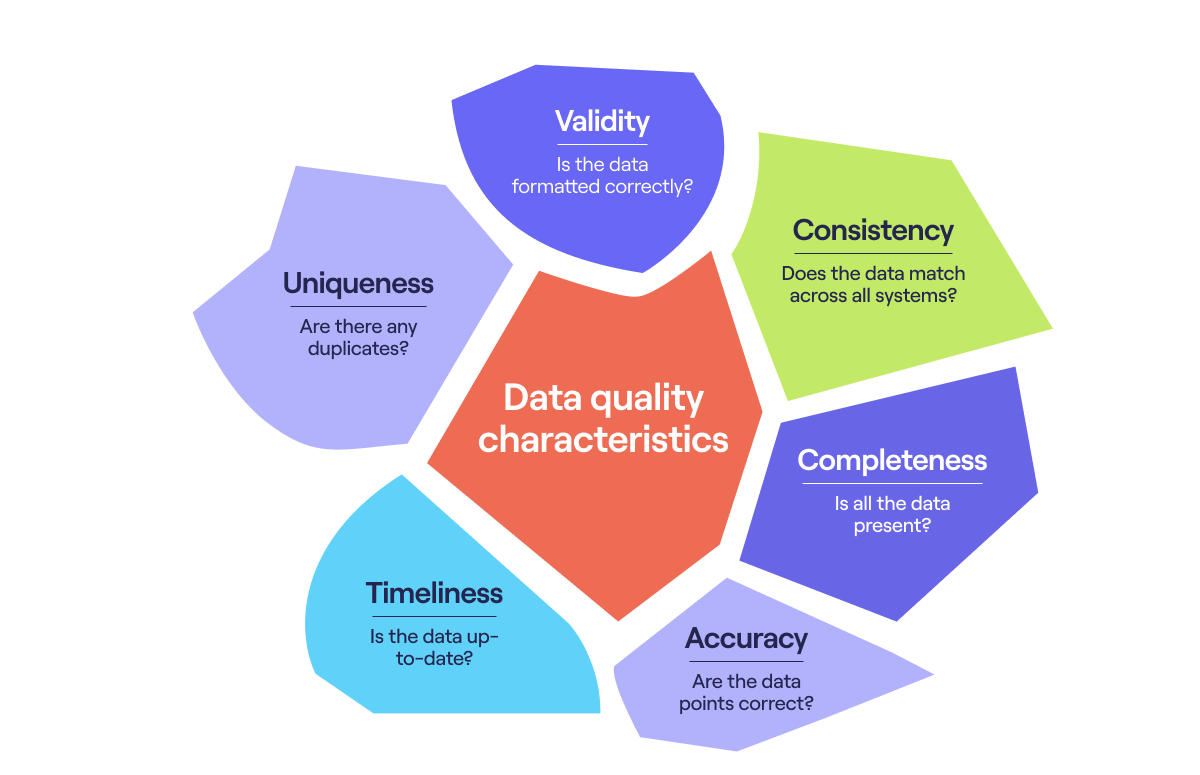
1. Accuracy
The first dimension in the data quality framework is accuracy. This asks the most basic question: Is the data correct?
A contact record with a bounced email address, an incorrect phone number or an outdated job title is an accuracy failure.
In a revenue context, that failure has immediate consequences:
-
Sales teams reach out to the wrong people
-
B2B Marketing teams personalise campaigns using false assumptions
-
RevOps teams report on activity that doesn’t reflect the real market
Accuracy creates decision-grade confidence; without it, every downstream action becomes less reliable.
2. Completeness
Completeness measures whether the fields required for GTM execution are populated.
A record may be technically accurate but still commercially weak if it’s missing key information such as job function, company size, industry, location, seniority, buying committee role or direct contact details.
These gaps undermine segmentation, routing, lead scoring and account prioritisation.
For example:
-
A contact without an industry field can’t be placed into the right campaign segment
-
An account without employee count or region data may be misclassified against your ICP
-
A missing direct dial can limit sales execution
In other words, incomplete data creates gaps in pipeline coverage.
3. Consistency
Consistency asks whether the same data tells the same story across systems.
If your CRM lists a company as “International Business Machines”, your marketing automation platform records it as “IBM”, and your enrichment layer uses another variation, reporting becomes harder to trust.
The same applies to job titles, industries, regions and company sizes.
Small inconsistencies compound when they appear across thousands of records.
Sales data quality and consistency protect the single source of truth.
Without it, GTM teams are likely to argue over whose numbers are right instead of acting on the market.
4. Timeliness
Timeliness measures whether the data is current enough to support action.
B2B data changes constantly: People move roles. Companies restructure. Teams expand into new markets. Contact details decay. A record that was accurate six months ago may now be misleading.
Stale data wastes effort and damages credibility.
-
Sales teams contact people who have left the business
-
Marketing teams target accounts based on old firmographics
-
Forecasting models rely on account information that no longer reflects the market
Timeliness is especially important for AI-driven GTM workflows. AI systems amplify the data they’re given. If that data is out of date, they scale outdated assumptions.
What’s more, data decay creates a practical execution problem: can your teams actually reach the people in your CRM?
Many legacy datasets are still weighted towards landlines and switchboard numbers. That may have worked when office-based contact was the default. Today, it creates drag. Buyers work remotely, hot-desk, screen unknown calls, or change roles faster than CRM records can keep pace.
High-performing GTM teams are moving away from landline-heavy datasets towards verified data that reflects how modern buying committees operate. Verified mobile numbers, current job information and reliable company intelligence are becoming baseline requirements for scalable outbound execution.
Better data improves the probability of reaching the right person. Better reach improves the quality of conversations. Better conversations create stronger pipeline signals.

Director of Business Development @SUB1

5. Validity
Validity ensures data follows the required formats, rules and standards.
An email address without an “@” symbol, a postcode in the wrong field, a phone number with missing digits or an invalid country code are all validity failures.
These data quality problems may look minor, but they can break automations, prevent imports, disrupt routing and reduce CRM reliability.
Validity gives revenue teams confidence that data can move cleanly through the systems that depend on it.
It is the foundation for automation, enrichment, reporting and AI sales workflows.
If you’re looking for data quality assurance, Cognism’s data enrichment features can help.
It fills in gaps in your dataset by integrating with your CRM. Then, it identifies incomplete data fields and enriches them with accurate, verified sales data.
The tool cleanses your existing list, enriches it with company and contact data, and helps you update it in real time as new prospects enter your CRM.
From there, you can put practices in place to prevent incomplete data from existing going forward, such as making form fields compulsory or keeping a data enrichment tool active.
See how it works, take an interactive tour of Cognism Enrich:
How to measure data quality
You can’t improve data quality without measuring it.
The five dimensions of sales data quality map directly to the metrics RevOps teams should monitor: accuracy, completeness, consistency, timeliness and uniqueness.
Together, these metrics show where data is creating confidence and where it’s introducing commercial drag.
1. Data accuracy score
A data accuracy score measures the percentage of records verified as factually correct. This includes whether the contact has the right name, role, company, email address, phone number and location.
Accuracy sits at the centre of any GTM strategy. If a record is wrong, every action built on it becomes weaker.
A low accuracy score means your teams are operating with assumptions rather than intelligence.
2. Fill rate
Fill rate measures the percentage of required fields that are populated across your CRM or revenue systems.
These fields might include job title, seniority, department, industry, company size, location, direct dial, email address, lifecycle stage and ICP fit.
The right fields will depend on your GTM model, but the principle is the same: incomplete records limit action.
3. Bounce rates and connect rates
Email bounce rates and call connect rates are practical indicators of contact data quality.
A high bounce rate usually points to invalid or outdated email addresses. A low call connect rate may suggest incorrect phone numbers, poor direct-dial coverage, or stale contact records. These are all symptoms of data decay.
Tracking bounce and connect rates gives RevOps a real-world view of whether the data is usable in execution, not just acceptable in the CRM.
Say goodbye to high bounce rates! Cognism’s email data has helped users retain a consistent email deliverability rate of 95 to 99%

Global Director of Data @CEC Marketing

4. Duplicate rate
Duplicate rate measures how many repeated contact, lead or account records exist across your systems.
Duplicates create noise. They inflate database size, distort attribution, confuse ownership and cause multiple teams to contact the same person or company. They also weaken reporting because activity and engagement can be split across several records.
A rising duplicate rate is often a sign that system governance, enrichment processes or integration rules need attention.
5. Time-to-update
Time-to-update measures how quickly a record is refreshed after a meaningful change, such as a job move, company restructure, funding event, merger, acquisition or market expansion.
This is a measure of timeliness. B2B data changes quickly, and the longer a record stays stale, the more likely it is to damage execution. Slow updates lead to irrelevant outreach, inaccurate account prioritisation and unreliable forecasts.
Time-to-update is also a measure of data infrastructure maturity. The faster your systems reflect market change, the more confidently teams can act.
6. Uniqueness score
Uniqueness measures whether each real-world person, company, or opportunity is represented by a single clean record.
This is closely related to the duplicate rate, but it examines the broader question of whether your CRM provides a reliable single view of each account and contact.
Poor uniqueness creates fragmented account histories, broken attribution and inconsistent customer understanding.
For teams operating across multiple markets, regions and systems, uniqueness is essential. Without it, global and regional teams may act on different versions of the same customer or prospect.
The most important point is that data quality metrics should be tied to business outcomes.
-
A fill rate matters because it affects segmentation.
-
Accuracy matters because it affects outreach and forecasting.
-
Timeliness matters because GTM teams operate in markets that are constantly changing.
Where possible, automate these measurements through CRM, enrichment and revenue intelligence dashboards.
Monthly data health reporting is more useful than occasional manual data quality audits because it helps RevOps identify decay before it becomes a revenue problem.
How to improve data quality
If you want to ensure you always have high-quality B2B contact data, follow these steps.
1. Evaluate your current data environment
You can’t improve data quality without understanding where problems originate. Start by mapping how data enters, moves through and changes across your GTM systems.
Ask:
- Where is contact, account and opportunity data stored?
- How is data collected?
- Which teams and systems can access it?
- What formats and field standards are currently used?
- Who owns data management?
- How often is data updated?
- How is data quality measured today?
This gives RevOps and revenue leadership a clearer view of the operating model behind the data.
In larger organisations, quality issues often stem from fragmented ownership, inconsistent processes, and teams working from different market versions.
2. Run a GTM data quality audit
A data audit helps determine whether your CRM and contact data are fit for revenue execution.
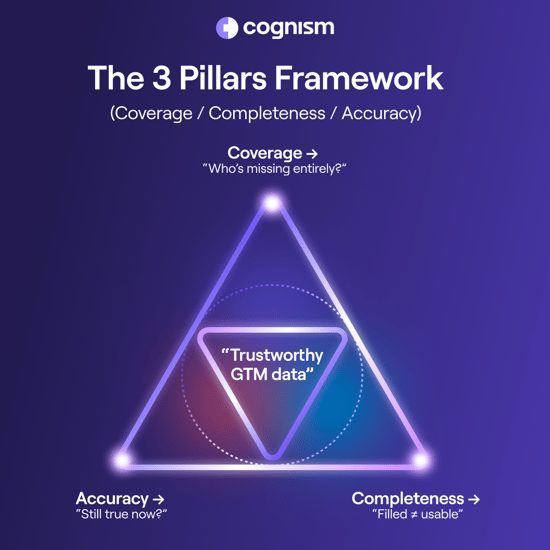
At Cognism, we assess GTM data through three commercial lenses: accuracy, completeness and coverage.
-
Accuracy asks whether the data is correct now, not whether it was correct when it first entered the system. A job title, company name or direct dial may have been accurate six months ago and still be commercially useless today.
-
Completeness asks whether the data is usable. A record with a name and company may look complete at a basic level, but it may still lack the fields needed for segmentation, routing, scoring or outreach.
-
Coverage asks whether your data reflects the market you need to reach. The issue is not whether your database contains many records. It’s whether it covers the right people, in the right companies, across the right regions and buying committees.
For teams expanding into new markets, this matters.
Market coverage, compliance requirements and contact availability vary significantly across borders. A US-centric data model won’t always translate cleanly into European GTM execution.
3. Address existing data quality issues
Once you understand the scale of the problem, prioritise the issues that create the most commercial drag.
Common data quality issues include:
- Inaccurate records caused by human error, outdated sources or poor enrichment
- Duplicate contacts, leads or accounts across CRM and sales systems
- Inconsistent formatting for dates, countries, industries, seniority or job titles
- Irrelevant data that adds noise and increases compliance exposure
- Missing fields that weaken segmentation, routing and reporting
- Non-compliant data that creates regulatory and reputational risk
These issues usually have systemic causes. A validated prospect list imported years ago may now contain contacts who have changed roles, moved companies or left the relevant buying committee.
Without clear sales data quality rules, old records remain in circulation, further weakening GTM execution.
Set rules for data entry, enrichment, deduplication and review. Then connect those rules to measurable outcomes such as bounce rate, connect rate, fill rate, duplicate rate and time-to-update.
4. Validate and enrich your data
Data validation checks whether records meet the required format, standards and business rules. It helps prevent inaccurate, inconsistent, duplicate, outdated and non-compliant data from entering your systems.
Validation should cover fields such as email address, phone number, job title, company name, location, industry, company size and compliance status. For revenue teams, the question is not only “does this field look valid?” but “can this record support a real GTM action?”
Data enrichment is equally important. B2B data decays as people change roles, companies restructure, and markets shift. Enrichment helps keep records current, fills critical gaps and reduces duplication across systems.
This is where trusted data infrastructure matters. Cognism gives revenue teams the accurate, compliant European contact and company data needed to maintain CRM quality, improve market coverage and support reliable GTM execution across the UK and Europe.
5. Use Cognism to improve GTM data workflows
AI is changing how revenue teams manage and act on data. But AI doesn’t replace the need for high-quality B2B data. It increases the need for it.
Sales and marketing teams are already using AI for customer journey management, outreach, research and account prioritisation. The strongest use cases don’t replace human judgment. They help teams work faster, reduce manual effort and act on better intelligence.
Cognis supports this by bringing trusted data, sales intelligence and AI-assisted search into the GTM workflow. Rather than relying on slow manual filtering or exact-match search, teams can identify relevant accounts and contacts using more natural, commercially useful inputs.
/(SEO)%20Product%20-%20Compressed/Cognism-alternative-competitor-listicle-webp-2.webp?width=1400&height=771&name=Cognism-alternative-competitor-listicle-webp-2.webp)
Cognism’s Sales Intelligence helps teams access:
-
Strategic segmentation for target account lists
-
Phone-verified mobile numbers
-
Reliable company data
-
Market intelligence, including job changes, intent signals and technographics
-
AI-generated summaries in the Cognism Browser Extension
-
AI Search functionality to reduce manual research time
The real advantage is stronger execution on a more reliable data foundation. When teams can identify the right accounts, understand the right signals and act on verified contact data, they reduce wasted effort and improve the reliability of GTM activity.
6. Implement data governance
Getting serious about data quality requires a clear governance framework and defined data stewardship roles.
A data governance framework is the formal answer to the question: how will we manage GTM data?
It should include:
- Policies for data access, usage and compliance
- Processes for collecting, entering, validating and updating data
- Metrics for measuring quality, including accuracy, completeness and timeliness
- Tools used to store, enrich, integrate and monitor data
- People responsible for maintaining data quality
Data stewardship answers the related question: who owns data quality?
Data stewards are responsible for monitoring quality within specific departments, systems or domains. They identify issues, resolve inconsistencies, support audits and help break down data siloes between teams.
Clear ownership improves accountability. It also avoids the familiar problem where everyone assumes someone else is responsible for maintaining the CRM.
7. Conduct regular data audits
Your governance policy should define how often data quality audits happen and what they include.
Routine audits help teams identify outdated records, incomplete fields, duplicate contacts, invalid formats and non-compliant data before they create larger commercial problems.
A useful audit should not only identify what is wrong. It should investigate why the issue occurred.
For example, duplicate contacts may point to a poor integration rule. Missing fields may indicate that sales and marketing teams use inconsistent data entry processes. Outdated job titles may reveal that enrichment is too infrequent.
The goal is continuous improvement. Fix the record, then fix the system that allowed the issue to enter in the first place.
8. Standardise data entry processes
Consistency is one of the less visible data quality challenges, but it has a direct effect on GTM efficiency.
When fields are inconsistent, teams waste time interpreting data rather than acting on it.
One system might record “VP Sales”, another “Vice President of Sales” and another “Sales Leader”. Across thousands of records, that inconsistency weakens segmentation, reporting and automation.
Create standardised protocols for data entry. Define which fields must be completed, how values should be formatted and which naming conventions teams should use.
Be specific. For example, clarify:
- How job titles should be written
- How company names should be standardised
- How phone numbers should be entered
- How countries and regions should be recorded
- How dates should be formatted
- Which fields are mandatory before a record can progress
The more consistent the input, the more reliable the output.
9. Integrate data sources
GTM data often comes from multiple sources:
-
Website forms
-
CRM entries
-
Intent signals
-
Product usage data
-
Event lists and offline activity
If those sources are not integrated properly, they create siloes, duplicates and conflicting records.
Review how data moves between systems.
Pay particular attention to similar fields that come from different sources.
Where appropriate, use “overwrite existing” or “update existing” rules instead of creating new records automatically. This helps reduce duplication and keeps account and contact histories intact.
A connected data environment gives teams a more reliable view of the market. It also improves the quality of reporting, routing, attribution and AI-driven workflows.
10. Centralise GTM data where possible
Many data problems begin when sales, marketing, operations and IT work from disconnected systems. Siloed data leads to inconsistent records, duplicated effort and poor alignment between teams.
A centralised data layer provides revenue teams with a shared view of accounts, contacts, and markets. It helps sales and marketing coordinate activity, improves reporting accuracy and reduces the risk of teams acting on conflicting information.
This becomes more important as organisations scale across multiple markets. Without a trusted data foundation, regional teams can end up interpreting the same account or customer differently.
11. Train employees on data standards
Human error is a common cause of poor data quality, but it is often a process problem rather than an individual failure. If employees are not trained on how to enter, update, and use data, inconsistency is inevitable.
Training should include:
- Standard operating procedures for data entry and management
- Examples of how poor data quality affects revenue, forecasting and customer experience
- Guidance on compliance requirements
- Policies for sourcing, purchasing and enriching B2B data
- Practical instruction on how to interpret and act on data insights
You can also make training easier to sustain by creating role-specific sessions, short reference videos and internal channels where teams can share examples of good data practice.
12. Implement data orchestration as a long-term project
Data orchestration supports the shift from standalone systems to a more connected, modular GTM architecture. It helps create a single source of truth for data-driven decisions and reduces reliance on manual intervention.
In practice, Data as a Service can support this by moving data through a structured workflow:
Data ingestion
Gather data from website forms, intent signals, trusted providers such as Cognism and offline sources.
Data cleansing and validation
Remove duplicates, standardise fields and update outdated information.
Enrichment
Add contextual data such as firmographics, technographics, buying signals and compliance checks.
Transformation
Restructure data to match your CRM, MAP, analytics platform or warehouse schema, while applying business logic for routing, scoring and segmentation.
Delivery
Transfer enriched, validated data into the systems where teams need to act on it.
This is how data quality for marketing and sales becomes scalable. Instead of relying on periodic manual clean-ups, teams build the infrastructure to keep data accurate, compliant and commercially useful over time.
13. Review and update data quality procedures
Data quality management is never finished. Markets change, regulations evolve, systems change, and customer expectations rise. Your processes need to keep pace.
Review your procedures regularly by:
- Monitoring accuracy, completeness, uniqueness, timeliness and compliance metrics
- Collecting feedback from sales, marketing and RevOps teams
- Running recurring data audits
- Reviewing regulatory requirements
- Documenting data sources, processes and system changes
Documentation matters. If a data process is not documented, it is difficult to enforce, improve, or scale.
Improving data quality is ultimately about building commercial confidence. Clean, compliant and current data helps teams prioritise the right accounts, reach the right people, forecast more accurately and run AI workflows on trusted inputs.
FAQs
Improve data quality with Cognism
High-quality B2B contact data is what turns GTM strategy into revenue execution. It gives teams the confidence to forecast accurately, prioritise the right accounts, reach the right people and build campaigns on signals they can trust.
Poor data slows every part of the revenue engine. It wastes sales capacity, weakens reporting, creates compliance exposure and leaves teams fixing records instead of growing pipeline.
Cognism gives revenue teams the accurate, compliant and current European data foundation they need to move faster with confidence.
With CRM cleansing, CSV and API enrichment, phone-verified mobile numbers through Diamond Data® and Cognism’s Sales Intelligence for AI Search, firmographics, technographics, intent signals and job-change insights, teams can improve data quality at scale and act on the accounts that matter most.
Put Cognism’s data to the test and see how your current provider compares.
/CTAs%20(SEO)/Data-sample-CTA-extra-instructions.webp?width=2625&height=928&name=Data-sample-CTA-extra-instructions.webp)