A contact data API gives your GTM teams programmatic access to verified B2B contacts, so sales, marketing, and RevOps can enrich, route, and reach decision-makers without manual research. It differs from a company data API by returning people-level records rather than organisation-level ones, and the right provider combines accuracy, compliance, and entitlement-aware payloads that fit cleanly into your CRM or data warehouse.
A contact data API gives your GTM teams access to verified B2B contacts, so sales, marketing, and RevOps can quickly enrich, route, and reach decision-makers.
If your teams are still guessing email formats or dialling dead numbers, or you've outgrown spreadsheets, this page covers what a contact data API is, why it matters, key features and use cases, how it differs from a company data API, how to choose a provider, and how Cognism's contacts API works.
What is a contact data API?
A verified contact data API is a REST API that returns verified business contact info (emails, mobile/direct dials, titles, LinkedIn) so your systems can search, preview, enrich, and redeem contacts at scale.
What is a REST API?
A REST API is a standard way for apps to exchange data using simple HTTP requests (like GET or POST).
In simple terms, think of it as a menu: you order what you need, and the server delivers the result. In this case, verified contact details like email address, phone numbers, and LinkedIn profiles.
Why use a contact data API?
Teams adopt contact search APIs to increase connect rates, improve routing/scoring, and eliminate manual data fixes across the funnel.
Sales teams
- Verified emails and mobile/direct dials = more live conversations.
- Less time wasted on bounces and wrong numbers.
- Net-new decision-makers added to buying groups.
Marketing teams
- Instant enrichment on form submit = better scoring and routing.
- Higher match rates and tighter audiences for ABM/paid.
- Personalised messaging using job changes and hiring signals.
RevOps / CRM teams
- Automatic data enrichment keeps CRM clean and compliant.
- Consistent schemas and entitlements across tools.
- Better forecasting and attribution with trustworthy data.
Key features of APIs
Look for real-time enrichment, verified contact records, account context, and field-level control via entitlements.
- Real-time lookups and enrichment via REST and standard HTTP verbs.
- Verified contacts – emails with quality indicators, and mobile/direct dials with scoring and DNC flags.
- Professional profile and LinkedIn – title, function, level, education, skills, career events (join/leave/move).
- Account context – industry, size, revenue, locations, technologies, funding/IPO/acquisition/hiring events.
- Entitlements – return only the fields your contract allows (Standard/Advanced) for predictable payloads.
Common contact data API use cases
Use a contact data API to find and reach the right people, automate enrichment, and keep CRMs accurate.
- Sales prospecting and lead generation – add net-new decision-makers with verified emails/phones.
- Marketing automation – enrich forms, boost match rates, improve segmentation.
- CRM enrichment – scheduled updates reduce manual clean-up and routing errors.
- Recruitment – verified candidate contact data with role/seniority filters.
Contact data API vs company data API
The main difference is the record each API returns: a contact data API focuses on individual people, while a company data API focuses on organisations.
Contact records typically include names, job titles, employers, business email addresses and phone numbers, helping teams identify decision-makers, personalise outreach and enrich lead or contact records.
Company records typically include business names, domains, industries, locations and employee counts; some providers also return revenue, funding or technology data. These fields help teams assess account fit, segment target markets and enrich company records.
Use a company data API to identify businesses that match your ideal customer profile, and a contact data API to find the relevant people within those businesses. Used together, company data defines which accounts to target; contact data identifies whom to approach and how to reach them. Some APIs include both types of data, so check the available fields.
How to choose the right contact data API
Focus on accuracy, compliance, performance, entitlement control, and integration fit.
- Accuracy and coverage – verified emails, mobile/direct dials with scoring, and rates by region/seniority.
- Compliance – GDPR/CCPA/PECR alignment, opt-out endpoints, consent metadata, DNC flags.
- Performance and scale – low latency, predictable pagination, fair rate limits.
- Entitlements – Standard/Advanced field sets keep responses focused and audit-friendly.
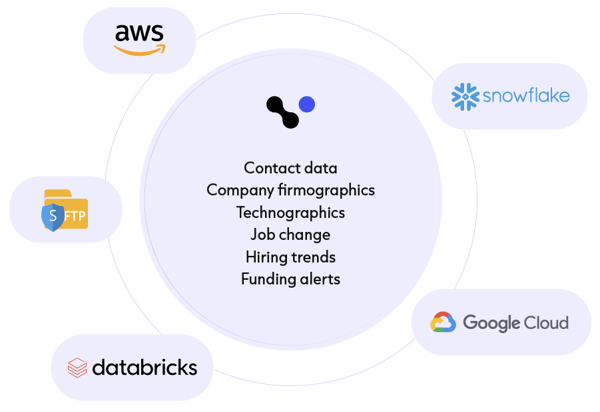
- Ease of integration – a clean JSON schema that works with Salesforce, HubSpot, Marketo, Snowflake, S3, BigQuery, dbt.
How Cognism's contact data API works
Cognism's API is fast, simpler to query, and compliance-first, with entitlement-aware payloads, rich phone coverage, and robust rate limiting.
- Simple, faster responses, with configurable fields to match entitlements.
- Unlimited displayed results and first-to-last pagination (no page hopping).
- Richer context – multiple emails/company phones, and all open positions per contact.
- Authentication – API keys have a time-to-live (TTL) of 6 months, and you can authenticate HTTP requests using a header field or a query string.
- Rate limits – up to 1,000 requests/min with headers to track remaining and reset.
- Preview vs Redeem – previews draw from the preview pool, while redeem consumes standard credits.
Note that API and in-app results may differ due to ongoing updates and system improvements.
Cognism's API and MCP access
A contact data API is the programmatic route into Cognism data. It lets technical teams search, preview and enrich contact and account records through REST endpoints, so Cognism data can be embedded directly into GTM systems and workflows.
For teams building AI-led workflows, MCP offers another way to access Cognism data inside an AI assistant. It uses the same Cognism data, with the value still rooted in data quality, compliance and governance.
Where the API fits
The Cognism API lets teams programmatically search, preview and enrich contacts and accounts. It is designed for programmatic access, with a simpler and more declarative structure than the legacy API, and can show counts before contact data is pulled.
Use the API when the workflow needs structured, repeatable access to Cognism data – for example, enriching records, powering internal tools, supporting lead scoring, or feeding data into existing GTM processes.
Where MCP fits
Cognism MCP is better suited to interactive AI workflows: research, list-building, signal discovery and multi-tool workflows inside an AI assistant. It is currently read-only, meaning it's a way to access and use Cognism data in AI-assisted workflows, not a replacement for API-based enrichment or write-back processes.
Why it matters
The API and MCP serve different entry points into the same Cognism data:
- API: for programmatic, system-to-system access.
- MCP: for AI-assisted, user-led workflows.
Both help teams bring Cognism data closer to where your work happens. The API supports structured GTM workflows, while MCP helps teams use Cognism data through AI assistants for research, targeting and workflow support
Build prospecting on contact data you can trust
A contact data API turns the guesswork out of prospecting: verified emails and mobiles, current job titles, and account context delivered in real time instead of being exported in a batch file. Whether your team needs a single lookup inside a workflow or an always-on data layer across the whole tech stack, the right approach depends on scale, not ambition.
Cognism combines a REST API with compliance-first delivery, so contact data stays accurate and audit-ready wherever your reps, marketers and RevOps teams are working.
Frequently asked questions