Is your sales team drowning in admin and still not quite landing deals as quickly as expected? Or maybe they’re struggling with dropped-off leads and low win rates, but aren’t sure why?
Bad data costs businesses a fortune, and poor data quality costs organisations an average of £12.9 million annually (Gartner). But there’s a solution that’s transforming how B2B companies manage customer relationships.
CRM data enrichment (an area of data enrichment) is now essential in every sales and marketing team’s tech stack. It can eliminate data hygiene issues, reduce admin work, and help your team get the actionable information they need to reach the right prospects at the right time.
What is CRM data enrichment?
CRM enrichment enhances your customer database with additional, corrected, or relevant information not captured during the initial data entry. It makes sure your CRM contact data isn’t outdated.
Standard CRMs store the basics:
Names, contact details, company associations, and interaction logs.
However, you can use additional platforms to further enhance this CRM data. That’s a different beast, giving your sales reps extensive data on potential customers.
You can use your CRM in tandem with data around:
- Firmographics: Company size, revenue, recent funding, and industry.
- Technographics: Existing tech stack (including marketing and sales tools), software usage, and integration potential.
- Intent signals: Buying signals, content consumption, and research patterns.
- Social insights: Professional connections, engagement patterns, and influence metrics.
This information can be invaluable to your sales and marketing teams.
You don’t just know that a prospective customer is a good ICP match; you can also see whether they’re engaged with outreach or showing intent signals, such as active research.
The 3 best B2B data enrichment tools for CRM accuracy
Let’s look at the top CRM enrichment tools. Each is also a well-known data provider.
Cognism
Best for Enterprise and high-growth teams needing real-time, compliant enrichment with global coverage.
Around 30% of B2B contact data changes every year. That means stale records, missed buyers, broken routing, and forecasts that don’t reflect reality.
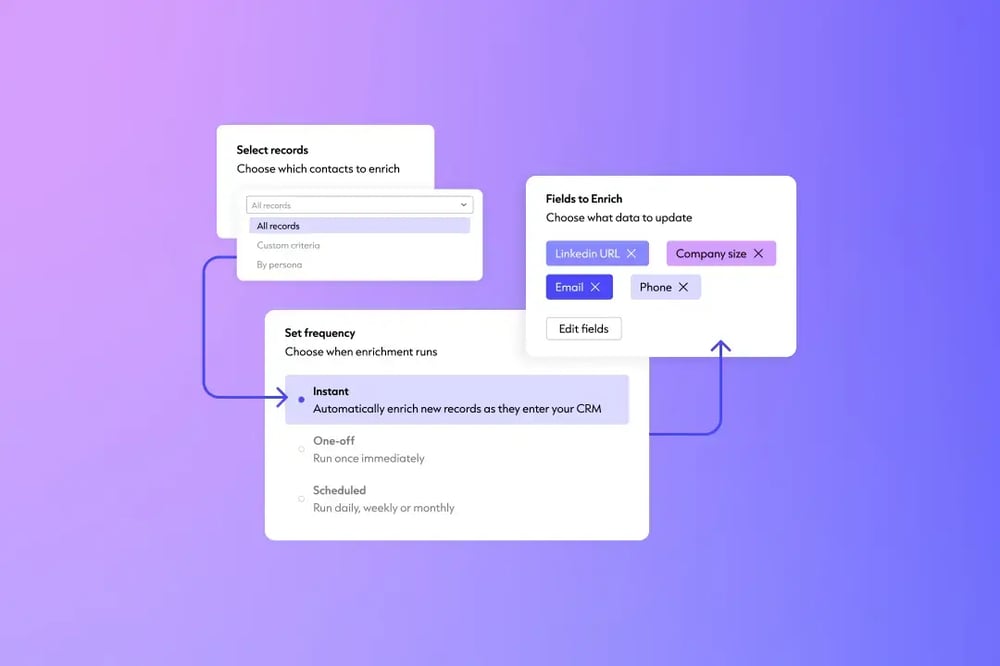
Cognism data enrichment removes that friction. It connects directly to your CRM, shows you where data needs attention, and enriches records through governed workflows - instantly, on a schedule, or on demand. So when someone opens a record, the information is up to date. And your team can move straight into the work that drives revenue.
Pros
-
Built for Europe, not bolted on: Most data providers are built for the US market. Cognism’s strength is European contact data. For teams where EMEA is a serious growth priority, your CRM needs to reflect the reality of the markets you’re selling into, including regional coverage, local job titles, mobile availability and GDPR-aligned data practices.
- Governed enrichment that fits your workflow: Cognism gives RevOps control over how enrichment happens. You decide which fields can be updated, which records should be prioritised and when enrichment jobs should run. This reduces the risk of unintended changes and provides enterprise teams with the governance needed to keep CRM data reliable.
- CRM records your team can trust: When someone opens a CRM record, they should be able to act with confidence. Cognism data enrichment keeps contact and company data complete, current, and reachable, so sales, marketing, and RevOps teams can focus on outreach, campaigns, pipeline reviews, forecasting, and revenue execution.
Pricing
Pricing for our data enrichment solution starts from $12,000 anually, inclusive of 25,000 credits. You can add as many additional credits as required.
Test Cognism data quality for your company using a data sample. Our team will provide you with free leads that match your ICP.

Head of Sales @BearingPoint


ZoomInfo
Best for US-based mid-market to enterprise sales and marketing teams.
ZoomInfo offers one of the most comprehensive B2B databases available, especially strong in North American markets. It combines firmographic and technographic data alongside intent signals, making it a staple for enterprise targeting.
/Competitors%20and%20other%20tools/ZoomInfo-Competitor-Alternative.webp?width=630&height=394&name=ZoomInfo-Competitor-Alternative.webp)
Pros
-
Deep contact and company coverage in the U.S. and global markets.
-
Rich insights through intent signals and web visitor tracking tools.
-
Advanced features supporting segmentation, reporting, and ABM workflows.
-
Has a DaaS solution, like Cognism.
- ZoomInfo data enrichment.
Pricing
ZoomInfo’s pricing is quote-based and tends to be high. Add-ons like advanced intent data or additional integrations increase costs substantially.
HubSpot Breeze Intelligence
Best for teams using HubSpot’s CRM and looking for native enrichment with AI-powered insights.
Formerly Clearbit within HubSpot, Breeze Intelligence (launched in late 2024) seamlessly enriches HubSpot contact and company records with over 40 data attributes. It also integrates buyer-intent insights and form-optimisation features into the platform.
/Competitors%20and%20other%20tools/Breeze-Intelligence-Competitor-Alternative-Clearbit.webp?width=422&height=531&name=Breeze-Intelligence-Competitor-Alternative-Clearbit.webp)
Pros
-
Native integration with HubSpot—no third-party tools required.
-
Provides both data enrichment and first-party buyer intent within CRM workflows.
-
Form shortening improves conversion by reducing unnecessary fields.
-
Easy to configure enrichment settings (e.g. automatic, continuous, bulk).
Pricing
Breeze Intelligence does not yet have public-facing pricing. You will need to contact the HubSpot team.

5 Ways CRM enrichment tools make your life easier
Wondering where to get started with CRM enrichment?
Let’s look at five game-changing ways to use CRM contact enrichment to increase efficiency and drive more sales.
1. Automate data entry to save time
Manual data entry is the vampire of productivity: It can suck the life out of your team’s day.
-cropped.webp?width=500&height=421&name=Cognism_Infographic%205%20(Light)-cropped.webp) With CRM enrichment, data flows automatically from trusted external sources into your system. This means:
With CRM enrichment, data flows automatically from trusted external sources into your system. This means:
- Your reps spend less time on admin, and all that energy can go right into selling.
- New contacts are instantly enriched with company data, giving your team up-to-date, actionable information.
- Record creation happens automatically when you identify new prospects.
These time savings can be significant. One BDE using Cognism saves approximately 10 hours of admin work every week.
2. Unlock relationship intelligence
Enriched CRMs reveal the hidden relationship map across your organisation by:
- Identifying when colleagues have existing relationships with target accounts.
- Tracking connection strength based on interaction frequency and recency.
- Highlighting the warmest paths to introduction for new opportunities.
This relationship intelligence transforms cold outreach into warm introductions, dramatically improving response rates and shortening sales cycles. You can send the right messages at the right time; don’t underestimate that value.
3. Centralise insights from your tech stack
B2B brands typically have complex tech stacks. One study found that almost half of the participants had between 5 and 10 tools in their tech stack, but some brands had more than 20.
That many tools can hold a lot of information… and they can also create massive data silo issues.
B2B CRM data enrichment brings together intelligence from:
- Email engagement metrics.
- Calendar and meeting intelligence.
- LinkedIn activity and connection data.
- Webinar and event participation.
- Content consumption and website behaviour.
By unifying these insights in your CRM, you create a single source of truth that eliminates contradictory data and duplicate work.
4. Enhance decision-making with real-time updates
Real-time CRM enrichment ensures you’re always working with the freshest intelligence.
Enhance the data already in your CRM when you’re prospecting with information about:
- Job changes and role updates.
- Company growth signals and funding events.
- New technology implementations.
- Buying intent signals.
.webp?width=1000&height=563&name=Cognism_Infographic%2012%20(Dark).webp)
You may have been watching a potential prospect for a while and saw that, with a new round of funding, they also hired a new CMO with a high intent to scale. That’s a good time to strike; platforms like our sales prospecting tool are great for identifying all these signals.
You can time your outreach perfectly and adjust strategies based on current circumstances, not outdated assumptions.
5. Use AI to predict and prioritise outcomes
AI is only as effective as the CRM data behind it. If records are incomplete or outdated, AI models have less reliable information to work from.
Cognism data enrichment helps improve the quality of those inputs by keeping contact and company data accurate over time. Teams can prioritise the records that matter most, enrich key fields through governed workflows and keep CRM data current with instant, scheduled or on-demand enrichment.
With a stronger CRM data foundation, AI can:
- Predict which leads are most likely to convert.
- Identify accounts showing buying signals.
- Surface technographic insights to support targeting.
- Recommend the next best action for each prospect.
- Flag customer accounts that may be at risk.
When AI is powered by trusted CRM data, revenue teams can make faster, more informed decisions across sales and marketing.

Digital Marketing Manager @Sparta Global

Why CRM enrichment matters
While having a CRM was enough to be competitive ten years ago, that’s no longer the case.
Sales and marketing are hyper-competitive today, and they’re hyper-personalised.
Basic contact information doesn’t cut it anymore; B2B buyers expect relevant experiences at every touchpoint.
Your teams need comprehensive (and extensive!) data to deliver that.
The growing importance of real-time, complete CRM data links directly to several key trends:
- Personalisation has become the standard, not the luxury. Busy decision-makers immediately filter out generic outreach.
- Buyer journey intelligence requires multiple data dimensions to map and predict next steps accurately.
- Account-based strategies demand rich firmographic and technographic data to execute effectively.
Poor CRM data creates friction across the entire GTM motion.
Incomplete records make targeting less precise. Outdated information leads to irrelevant outreach. Weak segmentation wastes campaign spend and sends sales to the wrong accounts.
For example, a prospect may appear to be a strong ICP fit until the sales process reveals their tech stack isn’t compatible. Or a nurture sequence may keep targeting someone who has changed roles and is no longer part of the buying committee.
Cognism data enrichment helps reduce these gaps by showing where CRM records need attention and enriching the fields that matter most for sales and marketing execution.
Enriched CRM data gives teams the foundation to prioritise better-fit accounts, reach the right buyers and scale campaigns with greater confidence.

SDR Manager EMEA @Druva

CRM enrichment & enhancement in action
Wondering how you can leverage CRM lead enrichment?
Here’s what it can look like in action.
Marketing campaign segmentation
A marketing team could use technographic data to identify accounts with specific tech stack combinations. By focusing campaigns on accounts that could integrate with your software, you’re likely to see higher engagement rates by noting this upfront and avoiding wasting time on leads that would be unlikely to convert.
Lead scoring and routing
Sales ops teams could implement intent-based enrichment to spot research activity among target accounts.
This approach would allow for a scoring model that prioritises accounts showing active buying signals, potentially increasing meeting booking rates. If your team knows which products a customer is considering, they could improve their pitches and follow up more frequently.
Real-time account intelligence
An enterprise marketing team leveraging account-based marketing might set up real-time alerts for funding events within their target accounts. This would enable timely outreach that aligns with major company milestones, which is when budgets are often reassessed and new initiatives launched.
How to choose the right CRM enrichment tool
When evaluating Enterprise CRM enrichment solutions, prioritise:
- Data accuracy: Look for providers with transparent data sourcing methods and regular accuracy audits. Cognism uses multiple verification methods to ensure high data accuracy.
- Integration capabilities: The tool should seamlessly connect with your existing CRM and tech stack, either through native integrations or easy API options.
- Real-time sync: Ensure data is updated automatically and frequently, as real-time enrichment allows for immediate action on changing signals.
- Enrichment depth: Assess the breadth of data types provided. Comprehensive platforms like Cognism offer firmographics, technographics, intent data, and contact details in a single solution.
- Compliance standards: With data regulations constantly evolving, choose providers with robust compliance frameworks and clear data provenance. For example, all of Cognism’s data is GDPR- and CCPA-compliant.
- Scalability: Some tools may be well-suited for small or mid-market brands, while others have more complex features and can handle the volume of enrichment needed by larger organisations. Cognism, for example, is a good option for large teams and enterprise companies.
The future of CRM enrichment
CRM enrichment—and the sales and marketing world as a whole—is evolving alongside rapidly changing technology. Here’s what’s coming soon:
- AI-powered CRM data enrichment will move beyond adding data to actually generating insights. Imagine your CRM not just telling you a prospect’s job title changed, but explaining why that creates an opportunity.
- Predictive CRM enrichment will anticipate data needs before they arise, automatically gathering intelligence specific to emerging opportunities.
- Privacy-first approaches balance enrichment with strengthening compliance, ensuring your data advantages don’t come with legal risks.
For competitive go-to-market teams, staying ahead of these trends isn’t optional – it’s essential for survival in increasingly data-driven markets.
Frequently asked questions
Why do companies need CRM enrichment?
Companies need CRM enrichment to personalise customer interactions, improve targeting accuracy, prioritise opportunities effectively, and make data-driven decisions. Enriched data reduces manual research and admin work, and provides crucial context for sales and marketing activities.
What tools are best for CRM data enrichment?
The best CRM enrichment tools offer accurate data, seamless CRM integration, real-time updates, comprehensive data types, and strong compliance standards. Solutions should align with your specific use cases and integrate well with your existing tech stack.
Cognism is one of the most popular tools for large teams and enterprise companies, thanks to its comprehensive enrichment features and high data accuracy.
Is CRM data enrichment the same as lead enrichment?
Lead enrichment typically focuses on adding data to new prospects at the top of the funnel. CRM enrichment is broader, continuously enhancing data across the entire customer lifecycle from prospect to long-term customer.