For marketing ops teams, audience data enrichment is becoming essential to how campaigns, segmentation, scoring and routing perform. Around 30% of B2B contact data changes every year, according to Forrester. Job titles change, people leave companies, phone numbers go stale, and buying committees shift.
That decay affects the quality of every marketing workflow that depends on CRM data. Campaigns reach contacts who are no longer relevant. ABM lists lose accuracy as target accounts and personas change. Lead scoring becomes harder to trust when the underlying fields are incomplete, outdated or inconsistent.
Most teams have tried enrichment before, but one-off refreshes rarely create lasting data quality. The CRM improves for a while, then the same gaps return.
This guide explains how governed enrichment helps marketing teams identify where audience data is weakening performance, prioritise the records that matter and keep CRM data accurate over time.
What is audience data enrichment?
Audience data enrichment means adding missing or updated information to the contacts and accounts you’re marketing to. It fills in the blanks and corrects what’s gone wrong since you last touched a record.
That could mean updating a job title after someone gets promoted. Adding a mobile number that wasn’t there when the lead first came in. Or appending firmographic details like company size and industry, so your segmentation actually works.
If you search this term, you’ll find a lot of results about ad-tech and third-party data overlays for publishers. That’s a different world. This article is about B2B audience data, the records sitting in your CRM that power your campaigns, routing, and reporting.
Audience enrichment vs. contact enrichment vs. account enrichment
These terms get used interchangeably. They shouldn’t.
-
Contact enrichment updates individual records: a person’s email, title, phone number, and current employer.
-
Account enrichment fills in company-level gaps: headcount, revenue, industry, tech stack.
-
Audience data enrichment is broader. It’s the practice of keeping the data behind your target segments complete, current, and usable. That includes both contact and account layers, across your entire marketable database.
Why audience data enrichment matters more now
Data decay has always been part of B2B marketing, but its commercial impact has increased as CRM data now feeds more of the GTM engine.
Stale records no longer create only visible problems, such as bounced emails. They now affect AI scoring models, lead routing, campaign segmentation, forecasting and attribution. If job titles, regions, seniority levels, or company details are incorrect, teams can end up prioritising the wrong accounts, routing high-intent buyers incorrectly, or reporting on pipeline that doesn’t reflect the market.
This becomes more complex in Europe, where data quality and compliance are closely linked. Marketing teams need confidence that enriched records are accurate, up to date, and supported by the right legal basis, particularly in markets such as Germany and France.
The business case is clear. Gartner has estimated that poor data quality costs organisations an average of $12.9 million per year. For revenue teams, that cost shows up as wasted effort, missed pipeline and decisions made from data that can’t be trusted.
What bad audience data actually costs marketing teams
For marketing ops specifically, the pain shows up in a few familiar places:
- Segmentation breaks down. Your audience segments look right on paper, but half the contacts have outdated titles or missing department fields.
- Campaigns underperform. Email bounce rates creep up. Ad match rates on LinkedIn drop. Nurture sequences frame points for a VP of Marketing to someone who’s been a CMO for a year.
- Inbound leads get misrouted. A lead comes in with incomplete data. Your routing rules can’t assign it properly. It sits in a queue, or worse, goes to the wrong team.
- Reporting loses credibility. If your attribution data is built on stale records, your numbers tell the wrong story. Leadership stops trusting the dashboards.
None of this is hypothetical. If you’ve ever run a campaign where “everything looked good” and the results still fell flat, bad customer data was probably the reason.

Types of audience data you can enrich
Different types of audience data decay at different speeds. Some fields also carry greater commercial weight because they directly influence segmentation, scoring, routing, and campaign performance.
A job title change, for example, can affect persona targeting and lead scoring. A missing region can break campaign segmentation. An outdated company size field can make an account appear to be a poor fit when it has actually grown into your ICP.
Here’s how to prioritise enrichment:
|
Data type |
What it covers |
Marketing use case |
How fast it decays |
|---|---|---|---|
|
Firmographic |
Company size, industry, revenue, HQ |
Account segmentation, ABM targeting |
Moderate. Shifts with M&A, funding rounds, and headcount changes. |
|
Contact/demographic |
Job title, seniority, department, email, mobile |
Persona targeting, lead scoring, routing |
Fast. Job changes drive the majority of annual data decay. |
|
Technographic |
Tech stack, tools in use |
Competitive displacement, integration-based targeting |
Moderate. Changes with vendor switches and stack consolidation. |
|
Intent/behavioural |
Buying signals, content engagement, topic research |
Timing, prioritisation, campaign triggers |
Very fast. Signals are time-sensitive by nature. |
Worth noting: contact-level data decays fastest and hits day-to-day campaign execution hardest. If you’re only enriching at the account level, you’re missing the fields that matter most for personalisation and routing.
How audience enrichment services work and what most teams get wrong
Most teams run lead enrichment in one of three ways.
-
One-off enrichment is the CSV approach. A team exports a list, uploads it to a provider, enriches the records and downloads the updated file. This can be useful for cleaning up event leads or improving an old database, but it only provides a temporary lift for the business. The data decays as soon as the exercise is complete.
-
Scheduled enrichment gives teams more control. Recurring jobs can refresh CRM records daily, weekly, or monthly, reducing the need for manual cleanup and helping keep key fields up to date. The gap between cycles still matters, especially for high-priority records, but it’s a better model than relying on ad hoc projects.
-
Always-on enrichment is the stronger option for revenue teams that need CRM data to support routing, segmentation, forecasting and AI workflows. It keeps the CRM connected to changing contact and company data, so records can be updated as underlying information changes.
So why does enrichment still fail?
The problem is usually process, governance or fit. Some teams treat API enrichment as a one-off project, which means the CRM improves briefly before the same gaps return.
Others enrich every record equally, wasting budget on low-priority contacts while the accounts that matter most remain incomplete. Some teams also lack field-level controls, so enrichment introduces new risks by overwriting fields such as lifecycle stage, ownership, or scoring logic.
For European campaigns, vendor fit also matters. A US-centric provider may offer broad global volume, but execution in EMEA depends on local depth, accurate mobile coverage, and compliance practices tailored to markets such as the UK, Germany, and France.
Effective audience account enrichment should help teams see where CRM data is weak, fix the records that matter and keep those records accurate over time.
/CTAs%20(SEO)/us-to-uk-provider-cta-webp.webp?width=2625&height=928&name=us-to-uk-provider-cta-webp.webp)
What to look for in an audience enrichment solution
If you’re evaluating lead enrichment tools (or re-evaluating what you’ve already got), here’s what matters for marketing ops:
-
Data quality and recency. Match rates and fill rates are table stakes. The real question is freshness. Ask how often records are verified and whether you can see a “last updated” timestamp on each contact.
-
Compliance and GDPR readiness. Your data enrichment provider should have a clear legal basis for processing, country-level DNC screening, and transparent sourcing. A blanket “we’re GDPR compliant” claim isn’t enough. Ask for specifics.
-
Governance and field-level control. You should control exactly which fields get updated, which are protected, and who can trigger enrichment. If you can’t, you’re trusting a black box with your CRM.
-
CRM-native vs. bolt-on. Tools that sit directly on your CRM and sync in real time reduce the manual steps between “data gets enriched” and “rep acts on it.” Bolt-on tools add friction.
How Cognism approaches audience data enrichment
Cognism’s enrichment helps marketing ops teams keep audience data accurate, compliant and ready for B2B marketing campaigns.
It connects directly to your CRM and combines data health visibility with governed enrichment workflows, so you can see where records are incomplete, prioritise the gaps that matter and keep critical fields up to date over time. 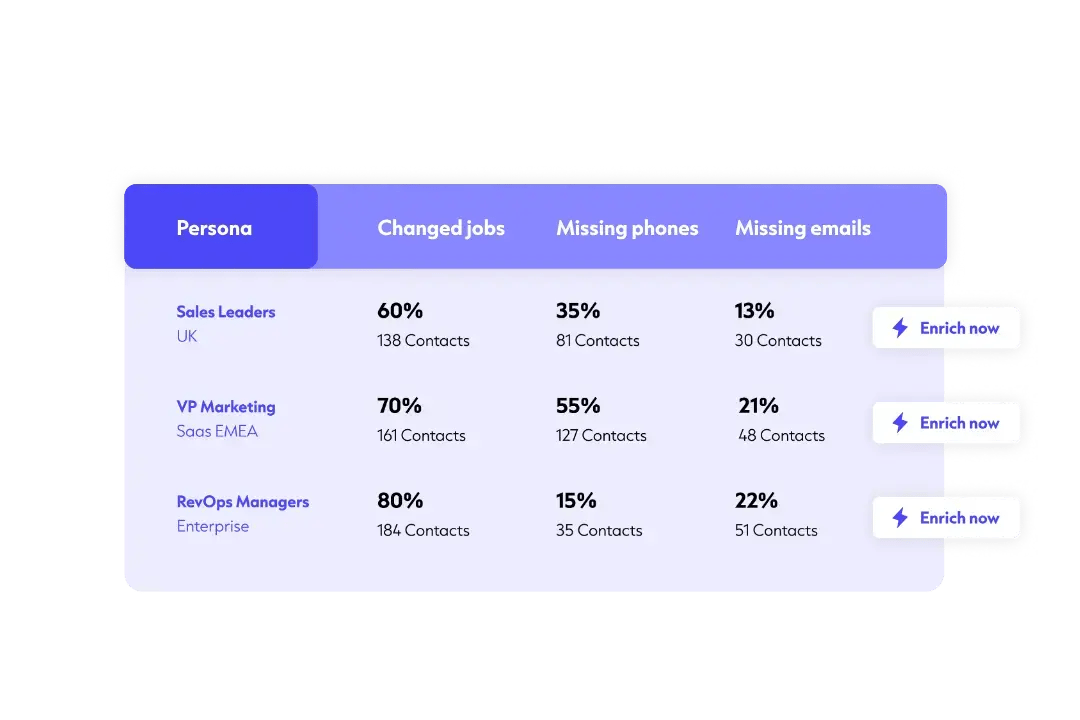
See what needs attention first
The CRM health dashboard gives marketing ops a clear view of data completeness across accounts, leads and contacts. You can identify missing, stale or incomplete data by persona, segment and region before deciding where to enrich.
This helps teams focus effort and credits on the records with the greatest commercial impact, rather than refreshing the CRM without knowing which gaps are affecting campaign performance.
Enrich on your terms
Cognism gives RevOps and marketing ops control over which fields can be updated, including custom fields. Teams can target enrichment by persona, region, segment, or priority tier, then choose the cadence that fits their workflow: one-off, scheduled, or always-on.
This governance helps protect fields such as lifecycle stage, ownership, and scoring logic while still improving the contact and company data that campaigns, routing, and segmentation depend on.
European data built for EMEA campaigns
Cognism’s strength is accurate, compliant B2B data for teams operating across Europe and the UK. For EMEA campaigns, that means better confidence in regional coverage, mobile availability, local job titles and GDPR-aligned data practices.
This is especially important in markets such as Germany, France, Benelux, the Nordics and the UK, where audience data quality and compliance directly affect campaign execution.

SDR Manager EMEA @Druva

Run a GTM data audit with Cognism to understand where audience data gaps are affecting your pipeline.
What happens after you enrich
Enrichment improves the workflows that depend on CRM data.
When audience data is complete and up to date, lead scoring becomes easier to trust because the inputs reflect real job titles, seniority levels, company sizes, and industries.
Routing improves because region, ownership and persona data are accurate. Segmentation becomes more precise because nurture and ABM campaigns are built around buyers as they are today, rather than records that have drifted over time.
For teams investing in AI workflows, this foundation matters even more.
AI scoring, propensity models and automated outreach depend on accurate, complete records. Better audience data gives these systems stronger inputs, which improves the quality of the outputs marketing and revenue teams rely on.
Getting started with audience data enrichment
You don’t need to overhaul your entire CRM on day one. Start with a focused data hygiene audit of the fields that directly affect campaign execution, such as job title, email, mobile number, company size, industry, region and seniority.
Then define which fields matter most for segmentation, scoring, routing and reporting. A field should earn its place in the enrichment workflow because it supports a specific commercial decision.
Once the priority fields are clear, run a small enrichment test on a high-value segment. This could be an active pipeline, target accounts in Europe or a recent campaign audience.
Measure changes in match rate, bounce rate, routing accuracy, and campaign performance before scaling the workflow to more records.
/CTAs%20(SEO)/Enrich%20CTA%20Banner.webp?width=2625&height=928&name=Enrich%20CTA%20Banner.webp)
FAQ
What’s the difference between data enrichment and data cleansing?
Data cleansing removes duplicates, corrects errors, and deletes outdated records. Data enrichment adds missing information or updates existing fields with fresh data. Most teams need both. Cleansing fixes what’s broken, enrichment fills in what’s missing.
What’s the difference between audience data enrichment and lead enrichment?
Lead enrichment focuses on individual inbound leads as they enter your system. Audience data enrichment is broader. It covers your entire marketable database, including existing contacts, target accounts, and dormant records that could be reactivated with fresh data.
Can audience data enrichment improve marketing campaign performance?
Yes. CRM-enriched data improves segmentation accuracy, reduces email bounce rates, increases ad match rates, and enables better personalisation. Teams using enrichment typically see higher engagement rates, faster lead routing, and more reliable reporting.