Your CRM is live. Your marketing automation platform is running. Sales engagement is integrated. Customer success has its own tooling. From the outside, it looks like a modern, well-resourced stack.
But inside the business, the reality feels different. Reps are second-guessing data before reaching out. Marketing teams are arguing over attribution. RevOps is constantly patching workflows and managing exceptions. And leadership is making decisions on data they don’t fully trust.
The stack looks modern. But it doesn’t work well in practise.
Integration vs. systems thinking
One of the biggest misconceptions in go-to-market architecture is that integration equals effectiveness. The short answer is it doesn’t.
You can integrate dozens of tools and still end up with a fragmented, inefficient system. The difference comes down to something far more fundamental - intentional design.
Jeff Ignacio, RevOps leader and advisor, draws a clear distinction between a system and a stack:
“The difference between the two comes with intentionality around your architecture. If you have a clear, specific goal, you should be able to have a system - like one entire cohesive system.”
But most teams aren’t operating at that standard. They’re closer to what Jeff describes as the alternative:
"The other one would be a patchwork, or a Frankenstein of technology. Overlapping capabilities, unused features - features that haven't been well trained."
And crucially, it’s not just about the tools. It’s about the processes that sit alongside them. B2B technology without enablement is just infrastructure nobody knows how to use.
How fragmented systems are built (by accident)
No organisation deliberately creates a fragmented architecture. It happens incrementally. A new tool has been added to solve a specific problem. Another is introduced to support a new team. A third fills a gap that the others couldn’t address.
Each decision makes sense in isolation. But over time, those decisions accumulate into something much harder to manage. As Jeff explains:
"It's natural to grow organically over time. And when you think about adding one more tool, it's usually because of some short-term pressure."
The issue is what happens next. Each tool hardens in the stack. Processes get built around it. Institutional knowledge is concentrated within it. And removing it becomes increasingly costly - technically, politically, and operationally.
"Over time, what happens is these tools harden within your stack, and so someone has to come in eventually and pay back the debt that has been accumulating across the technology stack."
That idea of technology debt is critical. Unlike financial debt, it doesn’t show up clearly on a balance sheet. It shows up in slower execution, poorer data quality, misalignment between teams, and ultimately, lost revenue.
And importantly, it’s rarely addressed continuously. According to Jeff, it tends to surface at specific moments of change - new leadership, a RevOps hire, a period of restructuring. These are the inflection points where organisations finally confront the reality of what they’ve built.
What composable architecture actually means
Composable data architecture is an approach to building your GTM tech stack where each component - data ingestion, storage, transformation, and activation - is purpose-built, independently replaceable, and connected through shared data rather than locked into a single platform.
In a B2B SaaS context, that means your CRM, product analytics, marketing automation, customer success tooling, and data warehouse can each do their specific job well while still operating as one coherent system.
Data flows between them reliably, definitions stay consistent across teams, and swapping out one tool doesn’t break everything else.
It sounds straightforward. But in practice, the concept is frequently misunderstood, and even more frequently, underbuilt.
At its core, composability is about designing a system where components can work together and evolve over time without the whole structure breaking. Jeff describes it as a layered model:
"It's generally a pyramid. Your system of record, your system of truth, and your system of engagement, or your action layer."
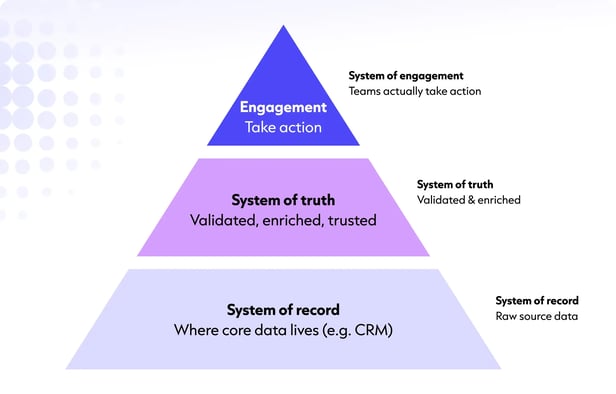
Each layer plays a distinct role:
-
System of record → where core data lives (e.g. your CRM)
- System of truth → where data is validated, enriched, and trusted
- System of engagement → where teams actually take action
The challenge is that most organisations blur these layers. A CSM checking in on a key account might need to pull contract data, usage data, and sales history - from three different places, none of which fully agree with each other.
A sales rep building pipeline might rely on marketing attribution that marketing itself doesn’t stand behind.
Composable architecture solves this by creating clarity of purpose across the stack. Each layer knows its job. And data flows between them reliably.
The role of data: from asset to infrastructure
At the centre of this model is data. Not as something you store, but as something that flows. The question isn’t whether you have data - almost every organisation does. The question is whether it moves freely, accurately, and with context across your systems.
"If you have data that is flowing between systems, then whatever your surface area, it makes it not just composable, but it makes it cohesive."
This is where most organisations fall short. They have data, but they lack shared definitions, real-time updates, consistent enrichment, and alignment across teams.
Which means the same account can look different depending on where you check. And once that happens, trust breaks down - and the value of the entire stack diminishes.
Data isn't just an output of a composable stack. It’s the infrastructure that makes composability possible in the first place.
The simplest test of composability
There’s a straightforward way to assess whether your stack is truly composable.
Ask one question: how easy is it to replace a tool?
If the answer is “very difficult", the architecture isn’t composable. But the difficulty isn’t always technical. Sometimes it’s by design.
"These companies have designed their products to intentionally raise the switching costs."
And sometimes, it’s human. Buying a tool inside most organisations requires significant political capital - multiple stakeholders, budget approval, and leadership sign-off.
If the tool doesn’t deliver, there can be a perceived career risk for the person who championed it. That creates a strong incentive to make tools work, even when it’s no longer in the company’s best interest.
Why composability breaks down
Even when organisations aim for composability, there are common failure points. These typically fall into two categories.
1. Strategic failures
"A quick selling cycle is what every company wants. A quick buying cycle for buyers is really scary, because you can skip all the details. And the devil is in the details."
Rushed buying cycles lead to tools that work in a demo but don’t solve the actual problem. Requirements go unchallenged. Edge cases get missed. And six months later, the team is either living with workarounds or starting the evaluation process again, with less credibility and more pressure.
2. Technical failures
Even with the right strategy, execution can fall apart at the integration layer. Rate limits, missing APIs, permissioning issues, and incompatible data models all create friction that compounds over time.
"Perhaps these products just don't work well together. There's no external API, there's rate limits or permissioning issues."
The result is middleware complexity, manual workarounds, and increased maintenance overhead. More fragmentation, not less.
What ‘good’ actually looks like
When composable architecture works, it feels simple. Not because it is simple, but because the complexity is handled in the background. The right data shows up in the right place, in the right context, at the right time.
Jeff describes three defining characteristics of this state:
Data shows up where work happens
Teams aren’t logging into five different tools to get a complete picture. The infrastructure layer - data providers, enrichment, CRM - works quietly in the background. You update your records, your signals, your context. People just see the output.
Every tool justifies its existence.
Every new interface - every additional tab or login - should have a visible trade-off. Does it save meaningful time? Does it enable better decisions? Does it reduce effort? If not, it shouldn’t be there. The bar for introducing a new pane of glass should be high.
Process and enablement are treated as seriously as the tools.
"It is not just the systems - it's also about process and training and then overlapping all of it is the enablement."
Technology alone doesn’t create composability. It requires clear processes, strong training, and consistent usage. The handoff between team members matters just as much as the handoff between systems.
The shift towards headless and AI-driven systems
Composable architecture is evolving quickly, and AI is accelerating that shift. The direction of travel is clear: interfaces become less important, data becomes more important, and interactions become more conversational.
Jeff describes a near-future scenario where the CRM isn’t a daily destination - it’s background infrastructure.
"There's a world where you don't even log into Salesforce anymore. It's a place where that information just gets anchored to."
Instead, work happens in email, Slack, and AI interfaces. You ask a natural language question. The system knows your accounts, your territories, and your pipeline. It tells you what to focus on. It drafts outreach. It surfaces the deal that’s going cold.
That’s not science fiction - it’s where the tooling is heading. But it comes with real implications. AI agents that are reactive are already here. The proactive layer - agents that flag risks before you ask, that suggest actions based on patterns, that operate autonomously within defined guardrails - is arriving fast.
The catch: AI depends entirely on clean data, connected systems, and clear context.
In a fragmented stack with inconsistent data, AI doesn’t solve the problem. Which means the quality of your architecture matters more, not less, in an AI-driven world.
Where to start
For most organisations, the goal isn’t to rebuild everything. It’s to introduce intentionality. That starts with a few key principles.
1. Define your system of truth
If different teams are relying on different data sources, nothing else works.
Before optimising engagement tools or adding new capabilities, establish a single source that everyone trusts. This is the foundation on which everything else is built.
2. Audit your stack honestly
Not against a benchmark - against your own workflows.
Where is data duplicated? Which tools are underused? Where are the manual workarounds?
The debt isn’t always visible until you look for it deliberately.
3. Design for workflows, not tools
Start with how work actually gets done.
Where are decisions made? What information is needed at each step? Which handoffs between teams create the most friction?
The tools should serve those workflows, not the other way around.
4. Prioritise data quality and flow
Composable architecture only works if the data works.
That means not just having the right data, but ensuring it’s accurate, timely, consistently enriched, and trusted by the people using it.
The last word
Composable architecture isn’t a technology trend. It’s a shift in how organisations think about systems - from tools to workflows, from integration to cohesion, from data storage to data activation.
The goal isn’t a more complex stack. It’s a system where data flows seamlessly, teams operate with confidence, and decisions happen without friction.
As Jeff puts it, the standard is simple to describe, even if it’s hard to achieve:
"It's as if you're logging into one platform as opposed to multiple."
That’s composability. And in an AI-driven world - where agents will increasingly act on your data, surface insights before you ask for them, and take action on your behalf - getting there isn’t optional.
The architecture you build today will determine what’s possible tomorrow.
/CTAs%20(SEO)/high-intent-cta-basic-data-sample-webp.webp?width=2625&height=928&name=high-intent-cta-basic-data-sample-webp.webp)