
Market Insights
Fluent in data: What Cognism’s data reveals about the shifting business economy
This report analyses millions of real-time signals across leadership teams, tech stacks, and buyer behaviour to reveal how the business economy is shifting in 2026. It shows a market defined not by slowdown, but by recalibration, where efficiency, data quality and speed of execution are becoming the foundations of growth.
Start reading
Introduction
Every day, our platform captures millions of live signals across companies, leadership teams, tech stacks, and buying behaviours. It’s a dataset few organisations have access to, and even fewer can interpret at this scale. That gives us a proprietary view into how the business economy is shifting beneath the surface, long before those changes appear in traditional market reports.
This data matters because the environment in which revenue teams, operations, and go-to-market leaders operate has fundamentally changed. Buying committees move faster. Tech stacks are consolidating. Leadership churn is accelerating. Data is becoming less stable over time. Intent signals are tightening around fewer, higher-impact themes. Static insights aren’t enough anymore. Teams need real-time patterns to make decisions with confidence.
Our aim is simple: to surface the signals within Cognism’s data that help business leaders stay ahead of change, and build more resilient, efficient, and intelligence-driven organisations as a result. This report covers three critical business trends: leadership, international expansion, and GTM.
Leadership and talent:-
- The path to C-suite
- Leadership churn
-
- Transatlantic expansion persists: UK is still the launchpad
-
- Buyer intent
- GTM tech stack
- Data decay and refresh
“Cognism prides itself on ensuring that our mid-market and enterprise customers have the best data available to power and accelerate their go-to-market motions. That puts us in a uniquely privileged position. We’re sitting on a treasure trove of data across the business and economic landscape. This report is designed to extract the key patterns and insights that help you keep your finger on the pulse of the changing trends and dynamics in your world."
Key findings from this report
Cognism’s data reveals a business landscape not in retreat, but in a state of recalibration. Across millions of companies, contacts, and technographic signals, one theme dominates – efficiency now defines how organisations grow.
- Leadership churn is reshaping go-to-market strategy. Over the past 12 months, 5.22% of VP+ leaders across Europe have changed roles, with higher concentrations in markets like the UK. Leadership turnover is no longer episodic. It is continuous, accelerating buying committee turnover and increasing the frequency of vendor evaluation cycles.
- Data decay is becoming a commercial constraint. C-suite data degrades faster than most organisations expect, with CMO and CRO records becoming significantly less accurate sooner than those of other leadership roles. This is redefining what “good” data looks like, not static accuracy, but real-time reliability at the point of engagement.
- Data strength is replacing tool count as the source of advantage. As stacks consolidate, competitive differentiation is moving away from the number of tools in use and toward the quality, accessibility, and interoperability of the data flowing between them.
- The UK remains the primary gateway for US expansion into Europe. With over 1.2 million employees of US-headquartered companies based in the UK, it continues to serve as the central hub for transatlantic growth, supported by language, legal alignment, and commercial infrastructure.
- Buyer intent is consolidating around productivity and intelligence. Around 1 in 5 tracked intent topics relate to AI, automation, or data-driven technologies, reflecting a shift toward solutions that increase output, improve decision-making, and drive efficiency at scale.
“Working with thousands of enterprise and mid-market companies gives us a real view of the challenges modern revenue teams face. The trends in this report come directly from those shared patterns, the data challenges, the organisational shifts, and the themes that are shaping how GTM leaders operate.”
Leadership churn is accelerating
Cognism’s contact-level data shows that leadership turnover remains elevated across Europe’s major markets. Over the past 12 months, 5.22% of VP-level and above leaders across Europe have changed roles, highlighting sustained movement at the top of organisations.
At a country level, the pattern is consistent, but not uniform. The United Kingdom has the highest churn rate, with 7.28% of leaders changing roles, followed by France at 5.17% and Germany at 4.49%. While the scale of movement varies by market, the underlying dynamic is the same. Leadership turnover is no longer an isolated event, but a continuous feature of the business landscape.
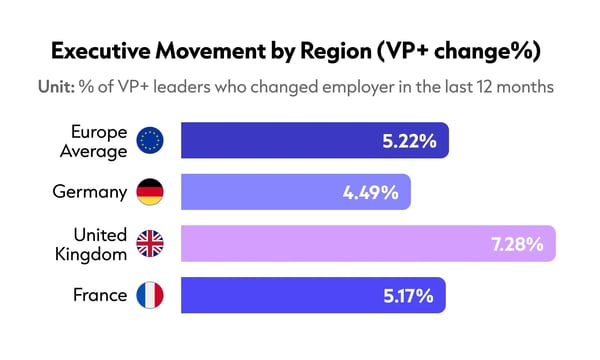
Rather than appearing as short-term spikes, this level of churn reflects an ongoing cycle of movement within leadership teams. Organisations are regularly introducing new decision-makers, new priorities, and new approaches to evaluating technology and partners.
The story becomes even more striking when viewed by function. CMOs now average less than 29 months in role, CROs around 31 months, and CEOs just under 45 months. In practice, this means the lifespan of a go-to-market strategy often outlasts the leaders who designed it.
.webp?width=608&height=664&name=COG002_Leadership%20Tenure%20(Country).webp)
That volatility has consequences. For go-to-market and revenue leaders, shorter tenures mean faster cycles of relationship-building, more frequent resets of buying committees, and a constantly moving target for account-based engagement.
Sales and marketing teams must now navigate buyer groups in flux, with decision-makers rotating in and out before long-term deals reach maturity.
.webp?width=600&height=563&name=COG002_Leadership%20Tenure%20(Line).webp)
The practical impact is clear:
- Account maps age faster. Teams can no longer rely on bi-annual refreshes of CRM data; leadership changes make job movement a critical signal for purchase intent, and businesses need their data partners to proactively deliver fresh records.
- Brand memory becomes more valuable. With executives switching companies more often, reputation and familiarity travel with them, and the brands they trusted previously often get a head start when they move. Not to mention, as LLM-based search becomes a primary discovery channel, well-established brands are more likely to be surfaced, referenced and reinforced during a leader’s first 90 days of research.
- Sales velocity compresses. Shorter leadership cycles mean decisions need to be influenced earlier, before internal change resets priorities.
What this churn tells us is that leadership stability, once a reliable constant in B2B buying, is now a variable. The companies thriving in this new reality are the ones using live data to adapt faster than their buyers can move.
*These are mean averages.
What this means for data decay
Cognism’s data shows that C-suite records decay quickly, but not evenly. Around 30% of C-suite data becomes inaccurate within 12 months. But more importantly, that decay is not distributed equally across roles.
Across major markets, it takes as little as 19–22 months for half of CMO and CRO records to become inaccurate, compared to 25–32 months for CEOs and CFOs.
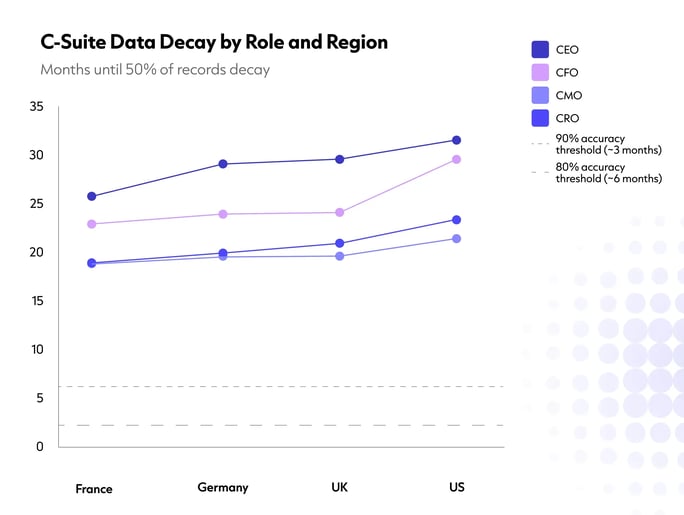
Even within the same region, the pattern holds. Revenue leadership roles consistently degrade faster than operational or financial leadership roles. This creates a clear hierarchy of volatility:
- CRO / CMO → fastest decay (highest commercial impact)
- CFO → mid-range
- CEO → slowest, but still material over time
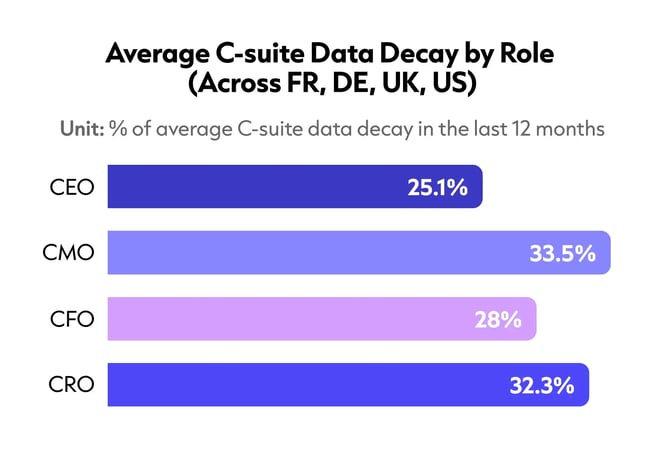
The implication is structural. The roles that drive buying decisions are the ones that become outdated the fastest.
Yet most CRM systems treat all contacts equally, applying the same enrichment cycles regardless of role, seniority, or function. The highest-value records degrade first, while refresh efforts are spread evenly across the database.
This is where the mismatch emerges.
If a third of your C-suite data is inaccurate within a year, and your most commercially important contacts degrade even faster, then refreshing your database every 6–12 months isn’t just inefficient. It’s commercially risky.
By the time many teams update their data, key decision-makers have already moved, reshaped teams, or triggered new buying cycles. For go-to-market teams, this redefines what “good” data looks like.
It is no longer enough for data to be broadly accurate at a point in time. It needs to be accurate at the moment a buying window opens.
There is no single refresh cadence that works across a database. The data shows clearly:
- Some roles can tolerate longer refresh cycles
- Revenue leadership roles cannot
Treating all data equally leads to missed opportunities, because the most commercially important contacts are the first to decay, and the most likely to trigger change.
Teams relying on static datasets or scheduled enrichment cycles are, by definition, reacting to change after it has already happened. In contrast, teams working from continuously refreshed data can engage buyers as roles change, priorities reset, and new investment decisions emerge.
In this environment, advantage doesn’t come from having more data. It comes from having data that moves at the same speed as your market.
This is where “always-on” data partners become critical, ensuring that go-to-market teams are operating from a live view of their buyers, not a historical one.
Every leadership change is a buying signal
Leadership turnover is a go-to-market signal, with the real story not just being who’s moving, but what happens next. When new leaders take the reins, they bring new playbooks, new priorities, and often, new vendors.
“When a new leader steps in, they review everything. The tech, the processes, the partnerships. Those first 90 days reset priorities, buying committees and budgets. Understanding when those changes happen is critical because it tells you exactly when problems are being re-evaluated and where new investment decisions will be made.”
Chris Evans, CRO at Cognism
A recent survey we ran revealed that 78% of Sales Directors we asked allocate a significant portion of their technology budget within the first 90 days of starting a new role, concentrating a large share of their buying activity in a short, time-sensitive window.
In practice, this means that go-to-market teams are now operating in a world of continuous reevaluation, where every executive transition can reset the buying committee. What used to be an occasional in-market moment now appears more frequently, meaning marketing must be ready to influence these short decision cycles as they open.
There's one practical implication here. Data freshness is non-negotiable if you want to strike while the iron is hot in those early days of new leadership.
The pathway to the C-suite is changing
Shorter tenures are reshaping the traditional path to the top. As leadership cycles compress, the route to the CRO chair is no longer linear, and it’s no longer owned by sales. Cognism’s decision maker data reveals that today’s Chief Revenue Officers come from a more diverse set of functions than ever before. While traditional sales leadership roles remain prominent, technical and product backgrounds now play an equally significant role in CRO transitions.
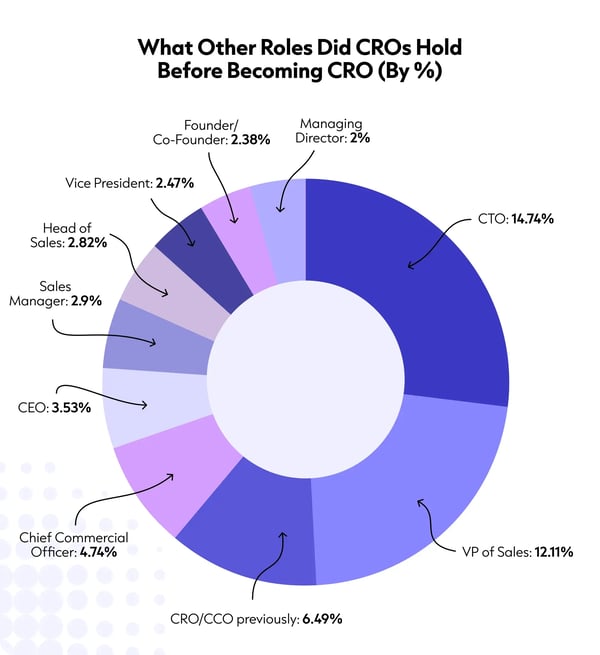
CTOs now represent the single most common feeder role into CRO positions, followed closely by VPs of Sales. Sales Managers and Heads of Sales remain important pathways, but they no longer define the route on their own.
This shift signals how revenue strategy is increasingly tied to product-led initiatives, data infrastructure, and technical visibility.
A significant percentage of CROs also previously held Founder or Managing Director titles, underscoring the growing influence of entrepreneurial and operational experience in revenue leadership.
The picture that emerges is one of cross-functional evolution. As businesses unify data, marketing, product, and sales around shared revenue goals, the modern CRO is no longer a single-track salesperson – they’re a systems thinker, balancing commercial acumen with technical and operational oversight.
“The CRO role has evolved into a full end-to-end customer experience function. It now spans brand, demand generation, sales execution, retention, expansion, and the partnership with product and engineering. A modern CRO needs to connect the go-to-market roadmap with the product roadmap and align every touchpoint across the customer lifecycle.”
Chris Evans, CRO at Cognism
The GTM tech stack is consolidating
The era of sprawling, disconnected toolchains is giving way to greater focus.
Cognism’s technographic data continues to show a clear consolidation trend at the top of the go-to-market stack, with a small number of platforms accounting for a disproportionate share of adoption.
The consolidation we observe is not uniform. Rather than a single standardised stack emerging, the market is segmenting.
In CRM, the pattern is consistent at the highest level. HubSpot and Salesforce dominate across all major regions, appearing repeatedly as the core systems underpinning GTM teams. But beneath this, adoption diverges significantly by company size.
HubSpot has become the default platform for Micro and SMB segments, driven by its usability and all-in-one ecosystem. Salesforce continues to anchor the enterprise, cementing its role as the system of record for large-scale, multi-region organisations. The mid-market sits between the two, with a more mixed landscape that includes Microsoft Dynamics and, in some regions, Zoho.
This creates a layered ecosystem rather than a fully consolidated one. At the top, a small number of platforms dominate. Beneath that, a long tail of tools remains active, particularly in lower segments and specific regional markets.
In sales engagement, a similar dynamic is emerging. Teams are consolidating around primary platforms, embedding them more deeply into their workflows. But as with CRM, this is less about eliminating choice entirely and more about reducing fragmentation within a defined stack.
This shift reflects a broader move toward maturity. Rather than experimenting with multiple point solutions, teams are prioritising integration, performance visibility, and systems that can support multiple workflows within a single environment.
“Many organisations optimise their tech stack quarter-to-quarter rather than on a one-to-three-year horizon. Consolidation isn’t just about cutting tools – it’s about understanding where the market is moving and where long-term efficiency gains can actually come from.”
Chris Evans, CRO at Cognism
This rationalisation has important implications for GTM strategy. With stacks becoming more structured and integrations deepening, competitive advantage is moving away from tool count and toward data strength – the quality, accessibility, and interoperability of the information flowing between platforms.
This shift is underpinned by a more fundamental reality, Chris said:
“The pattern we see in the market is clear: systems and workflows can change, but the requirement for clean, accurate data flowing through them does not. As stacks consolidate, data strength becomes the foundation that determines how well the rest of the GTM ecosystem performs.”
Alongside this, a related emerging pattern is the rise of conversational interfaces as a central access layer across systems. As AI assistants increasingly sit between users and their tools, vendors will need to integrate more tightly into these environments, reinforcing the shift toward deeper connectivity rather than broader tool expansion.
But this consolidation also raises a question for the future. If all-in-one ecosystems continue to dominate, will suppliers risk becoming generalists, sacrificing depth for breadth? For now, buyers appear comfortable trading specialisation for simplicity, but the next wave of innovation may depend on how seamlessly these platforms can stay open, integrated, and intelligent without losing focus.
Governance, privacy, and the new trust economy
As companies consolidate their go-to-market stacks, they are also tightening their control and governance of data.
Organisations are dedicating a workforce equivalent to 11% of their legal function specifically to data governance, privacy, and compliance. This reflects a structural change in how businesses manage risk.
Rather than expanding traditional legal teams alone, companies are building a parallel layer of capability focused on how data is collected, used, and governed across the organisation.
This shift is being driven by an increasingly complex regulatory environment. From GDPR and the EU Data Act to the EU AI Act and NIS2, organisations are facing expanding requirements that extend beyond legal interpretation into operational execution.
Hiring data reinforces this dynamic. While legal hiring remains relatively modest compared to functions like technology and operations, investment in data governance is not disappearing – it is being embedded across the business.
The result is a new model of trust. Compliance is no longer defined by the size of the legal team, but by the organisation’s ability to operationalise data governance at scale.
“There’s been a wave of major compliance events, the EU AI Act, NIS2 for cybersecurity, ongoing GDPR evolution, the EU Data Act, and the UK’s Data Use and Access Act. Every region now carries different requirements, which is why privacy and governance roles have become a critical part of modern legal teams.”
Chris Evans, CRO at Cognism
As tech stacks consolidate, so too are market strategies. Efficiency isn’t just shaping the tools companies use; it’s influencing where they build and grow.
Transatlantic expansion and the UK as a launchpad
Even amid ongoing trade and regulatory uncertainty, the transatlantic corridor remains remarkably resilient. Cognism’s employment data shows that US companies are not pulling back from Europe – they are becoming more deliberate in how and where they scale.
The United Kingdom remains the primary entry point for US firms expanding into Europe. Over 1.2 million employees of US-headquartered companies are now based in the UK, more than double the number in France (840k) and significantly ahead of Germany (599k), Spain (350k), and Italy (356k).
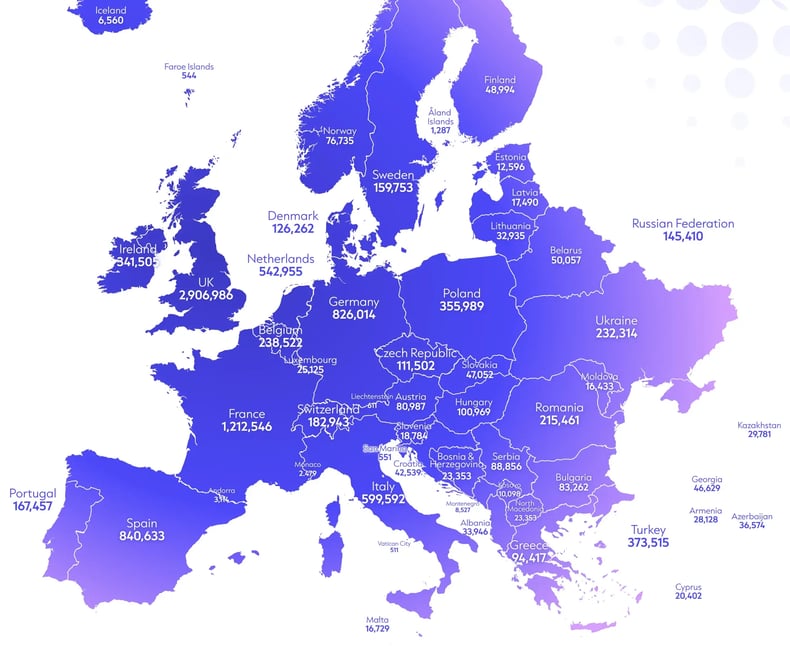
This reinforces the UK’s position not just as a strong market, but as the central operational hub for transatlantic expansion. Despite Brexit’s lasting political and regulatory impact, it has not materially slowed US investment. For many organisations, the UK’s shared language, legal familiarity, and mature commercial ecosystem continue to outweigh the additional complexity of operating outside the EU.
However, what has changed is the shape of expansion. Where pre-2020 growth was driven by geographic coverage and market presence, today’s expansion is focused on efficiency, proximity, and operational performance.
Rather than building evenly distributed teams across every market, expansion is increasingly concentrated in fewer key locations. Headcount data shows a clear clustering of employees in markets such as the UK, France, and Germany, with a long tail of smaller presences across the rest of Europe.
This indicates a shift toward more structured expansion strategies, where companies prioritise a handful of core markets to anchor their European operations, rather than replicating full teams country by country.
This reflects a shift from expanding everywhere to designing a more intentional European footprint. Teams are placed based on where they can deliver the greatest impact, balancing access to talent, cost efficiency, and proximity to key markets, rather than simply where customers are located.
The UK remains the starting point, but not always the final destination. It is increasingly used as a staging ground to access customers, talent, and infrastructure across EMEA. The result is a Europe strategy built less on coverage and more on coordination: leaner, more data-driven, and anchored around a small number of strategically chosen locations.
“The UK is the natural starting point for US businesses because of language, consumer behaviour similarities and the ability to establish a presence before navigating the different language and compliance requirements across Europe.”
Chris Evans, CRO at Cognism
These structural shifts echo in buyer behaviour. The topics attracting the most interest – automation, AI, and sustainability – are the same forces redefining how and where businesses expand.
Buyer intent: AI and automation
Cognism’s intent data highlights a clear throughline in global buyer priorities. Efficiency, intelligence, and impact.
Analysis shows that around 1 in 5 B2B intent topics relate to AI, automation, or data-driven technologies, spanning machine learning and predictive analytics, workflow automation, and revenue intelligence. This reflects a fundamental shift in how buyers evaluate software, not as standalone tools, but as systems designed to increase output, improve decision-making, and drive efficiency at scale.
Rather than emerging as a distinct category, AI is becoming embedded across the technology stack. Buyers are not searching for AI in isolation. Instead, they're prioritising solutions that deliver more intelligent outcomes across sales, marketing, security, and operations.
This pattern is consistent across regions. The UK, US, France, and Germany all show similar levels of AI and automation-related intent, reinforcing that this is not a regional trend, but a baseline expectation for modern B2B technology.
Alongside this, adjacent areas such as cybersecurity, data governance, and sustainability remain closely linked to buyer priorities. As organisations increase automation, they are also placing greater emphasis on control, resilience, and responsible data usage, ensuring that efficiency gains do not come at the expense of risk.
These patterns closely mirror broader structural shifts across leadership, stack consolidation, and governance.
Taken together, the intent data paints a picture of buyers optimising, not expanding. Rather than chasing new categories, organisations are prioritising technologies that increase output per headcount. Productivity, intelligence, and cost efficiency remain the dominant value levers in 2026.
“As AI-powered tools become embedded in daily GTM workflows, the real differentiator won’t be the models themselves, but the data infrastructure beneath them. Without high-quality, secure data, AI models will fail. It is not a case of just putting AI on your current workflows – if your data quality is not strong, the model will fail.”
Chris Evans, CRO at Cognism
Expert perspectives: what it all means
The signals in this report point to a business environment defined by continuous movement. Leadership turns over more quickly, buyer priorities shift mid-cycle, and tech stacks evolve faster than most organisations can evaluate them. What was once a predictable GTM landscape is now a set of interdependent changes happening simultaneously across people, platforms, and processes.
Chris Evans, Cognism's CRO, notes that the biggest challenge for revenue organisations today is the growing gap between how fast markets change and how slowly many companies adapt. Annual plans built on last year’s assumptions lose relevance when teams cannot see, understand, or respond to organisational shifts in real time.
Cognism’s dataset makes the pattern clear. GTM resilience now depends on the ability to interpret live signals and act on them quickly. Without visibility into who has moved, which systems are consolidating, or where intent is emerging, strategies drift out of sync with buyer reality. The companies that struggle to adapt miss the brief windows where priorities reset and decisions are made.
The rise of AI intensifies this pressure. The challenge isn’t the tools themselves, but the workflows, processes, and decision cycles that remain anchored to outdated information. As leadership turnover accelerates and data decays faster, the cost of operating on stale or incomplete data compounds. This places greater expectations on RevOps, product, legal, and leadership teams to build stronger, more unified data foundations.
Across leadership churn, tech consolidation, governance growth, AI adoption, and evolving CRO pathways, one theme stands out. Organisations are rebuilding their go-to-market foundations around clarity, precision, and interoperability. Leaders need information that reflects what’s happening now inside the accounts they're targeting, and systems capable of acting on that information without friction.
As Chris highlights, the companies that will outperform are the ones that treat change as a strategic input. They track movement continuously, align teams around shared data, and design workflows that move at the same pace as their buyers.
In a market defined by speed, advantage belongs to the organisations whose data moves as fast as the market itself.
Conclusion
2026 isn't shaping up to be the year of slowdown. It's still very much the year of recalibration. Cognism’s data shows that even in a climate of caution, business leaders are building smarter, leaner, and more resilient foundations for the next growth cycle.