PILLAR REPORT
The Cold Calling Competitiveness Gap: Can AI Replace Your Sales Team?
In an AI-first world, cold calling hasn’t died; it’s split the market in two.
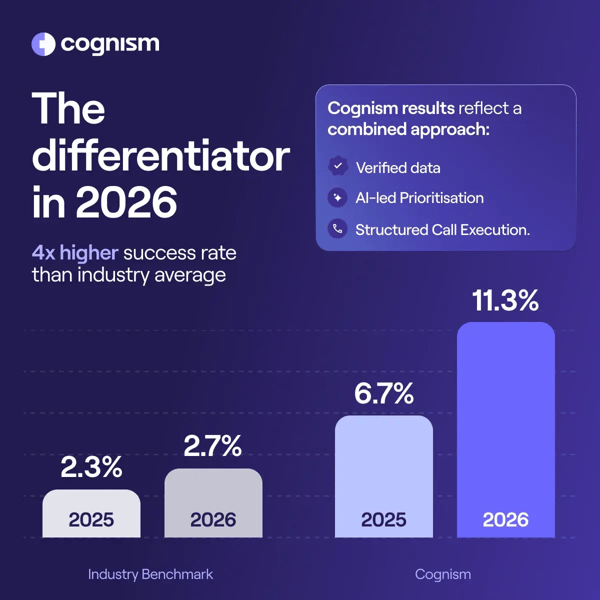
Industry benchmarks show success rates edging up from 2.3% in 2025 to 2.7% in 2026. Within Cognism, a phone-first outbound model that combines verified contact data, AI-led signal prioritisation and disciplined call execution is currently converting at 11.3%, with cold answer rates approaching warm outreach levels and nearly nine in ten outbound meetings going ahead.
The difference isn’t just better talk tracks; it’s how top teams combine AI, verified compliant data and human-led calling to lower cost per conversation, raise pipeline per sales development representative (SDR) and rethink how big their sales team really needs to be.
This report breaks the gap down for C-suite and Sales VPs, and tackles the real 2026 questions: not just “Can AI replace my sales team?”, but “What model do we need to compete with a 10-11% cold calling success rate?”
Start reading
TL;DR
AI is augmenting humans, not replacing them: In 2026 and beyond, leaders expect AI to automate the work around cold calls, with 80% opting to use AI for list building and enrichment, and only 13% believing AI will match humans on cold calling in the future.
The shift to AI-assisted prospecting teams: Over 60% of CROs and Sales Leaders believe AI will have a marginal impact on sales headcount in the future, with over a third of respondents (33%) in favour of shifting towards centralised outbound AI-assisted prospecting team vs a traditional SDR model.
Cold call efficiency is improving, and AI is part of the reason: The average number of attempts needed to reach a prospect has dropped from 2.9 to 1.55, with 93% of CROs embedding AI into sales workflows for prospecting research and account prioritisation to deliver stronger meeting-booked conversion rates.
AI isn’t the differentiator in 2026 on its own - it’s how teams combine accurate data, AI-supported prioritisation and disciplined outreach execution. At Cognism, layering verified phone data with AI-assisted research and structured call methodology resulted in a 13.3% answer rate and an 11.3% success rate in 2026.
Data methodology
Our report uses data from 200,000+ cold calls from various industries via WHAM, a survey of 15 Chief Revenue Officers (CROs) and Sales Leaders across the SaaS and IT services industry, and additional data from Cognism’s State of Outbound in 2026 report; showing that the gap runs through every part of the motion, from pick-up rates to meetings held.
Cold calling performance is rebounding, but most teams are still average
The latest industry benchmarks show cold call success rates recovering from 2.3% to 2.7%. The channel clearly still has its place. But in an environment where AI can automate more tasks than ever, staying at 2-3% is increasingly hard to justify, with the cost of headcount.
At Cognism, the picture looks very different: SDRs using verified contact data combined with AI-driven company research achieved a 13.3% answered rate on cold calls in 2025, almost identical to AEs calling warm opportunities at 14.4%.
In other words, when the data and targeting are right, a “cold” call behaves much more like a warm one, and the phone is a predictable way to reach buyers, not a speculative volume play.
Top performers are pulling away by combining AI, data and humans
Cognism’s outbound team has increased from 6.7% to an 11.3% cold call success rate, more than 4x the industry average. At that level, a revenue leader can either generate far more pipeline from the same headcount, or hit similar targets with fewer reps and a lower cost of sales.
The difference is an operating model where verified data, AI workflows and human conversations work together. Across 196,000 prospects contacted by Cognism in 2025, our outbound model, where we combine human-led outreach, quality data and AI for efficiency improvement, produced a 16.06% conversion from prospect to booked meeting and an 85.9% meeting held rate; almost nine out of ten meetings actually took place.
That’s what an 11.3% cold call success rate engine looks like in commercial terms: more conversations with the right people, and far less leakage between “meeting booked” and real pipeline.
Efficiency is improving, and AI is part of the reason
Across the latest industry dataset, the average number of attempts needed to reach a prospect has dropped from 2.9 to 1.55, cutting wasted time and labour cost per conversation. The average cold call duration has decreased from 93 seconds to 82 seconds, indicating sharper, more focused exchanges.
Cognism data shows the same pattern: SDRs still anchor most of their tasks on the phone, with LinkedIn and email in short 3-5 touch cadences, while AI handles research and admin, so more of each day is spent in live conversations.
AI is amplifying GTM, not replacing it
The teams performing at 10-11% are not those who have replaced SDRs with AI “bots”. They are the ones who use AI to: build and prioritise better lists, compress research and prep time, and analyse call and objection patterns at scale.
Humans still run the conversations; AI makes sure those conversations are happening with the right buyers, for the right reasons. An AI-only outbound motion might send more messages, but it rarely matches the conversion of a human-led call supported by the right signals.
When Cognism analysed thousands of calls from 2025, the top performers had one thing in common: SDRs and AEs ran genuinely two-way conversations. SDRs opened with short, focused intros, AEs picked up the thread, and together they asked more questions, kept monologues short, and let buyers do most of the talking, the kind of human interaction AI can’t reliably replace.
That’s what AI can’t do on its own: run a high-quality, two-way commercial conversation that uncovers real priorities and moves deals forward.
Regional performance shows where this model is working best
Cognism’s cold calling success rates stand at 16% in Europe, 11% in the US, and 7% in the UK. These differences reflect more than just cultural nuance; they show where strong regional data, local representation and AI-assisted workflows are aligned. When this combination is in place, cold calling achieves double-digit success and becomes a reliable driver of the pipeline, rather than a speculative activity.
Underneath the numbers is the same backbone everywhere: verified, region-specific contact data and phone-first cadences. Reps are coached to use the phone across the whole revenue cycle, to open deals, qualify faster, unblock mid-funnel opportunities and protect late-stage forecasts.
The competitive gap between cold calling will widen in 2026
This report unpacks these trends in detail, showing how AI, data quality, and call strategy are reshaping cold calling, and why the gap between average and high-performing outbound teams is widening in 2026.
For leaders, the central question is no longer “Can AI replace our SDRs?” but “Are we stuck at 2-3% performance, or are we building the kind of AI-augmented, locally executed cold calling motion that delivers a 10-11% success rate?”
The state of cold calling in 2026: AI hasn’t killed it, it’s repriced it
With the rise of AI, many leadership teams are asking the same question:
“If AI can research accounts, write emails and even generate call scripts, why do we still need a cold calling team at all?”
Both the latest industry benchmark figures and Cognism data suggest a clear answer:
AI hasn’t made cold calling irrelevant. It has changed what “good” looks like and made mediocre performance much more expensive.
In last year’s report, cold calling was under pressure. The data showed the average success rate had dropped to 2.3%, down from 4.82% in 2024, and many organisations were questioning whether the channel could still justify its cost, especially with AI promising cheaper, automated outreach at scale.
Our survey of Chief Revenue Officers and Sales Leaders across SaaS and IT services backs this up.
When asked which sales activities AI will be able to perform at least as well as humans within the next 24 months:
- 93% pointed to prospect research and account prioritisation.
- 93% pointed to CRM hygiene and note-taking.
- 80% expect AI to match humans on list building and enrichment.
- Around 75% expect AI to match humans on email copy generation and outbound sequencing.
However, only 13% believe AI will be able to handle outbound cold calling at the same level, and under a third selected live objection handling or call coaching. In other words, leaders are happy for AI to automate the work around the call, but are far less confident about replacing human SDRs on the phone itself.
A Chief Revenue Officer from an enterprise SaaS/software organisation says:
“Anything around research, prioritisation and workflow management will move to AI. Anywhere there is a human ingenuity needed, will stay as it is. So human touch is not going away.”
The 2026 cold calling numbers from WHAM and Cognism tell a nuanced story.
- The industry average cold calling success rate has risen to 2.7%, indicating that outbound teams are adapting and that live conversations continue to drive results.
- At Cognism, it’s worth reiterating that the broader data shows the same pattern as above: SDRs using verified contact data now achieve a 13.3% answered rate on cold calls, almost matching AEs calling warm opportunities at 14.4%. In practice, that means “cold” calls are often real conversations with the right people, not blind dials into the void.
- At the same time, Cognism’s outbound team has increased its cold call success rate from 6.7% to 11.3%, operating in a completely different tier of performance from the market as a whole.
To put that into economic terms, consider this scenario:
- Assume a team of 10 SDRs, each making 80 dials a day.
- At 2.7%, that’s roughly 22 positive outcomes per day.
- At 11.3%, it’s closer to 90.
The exact conversion from “positive outcome” to meeting, opportunity and revenue will vary by company, but the direction of travel is clear:
Teams operating around 10-11% can generate a similar pipeline with far fewer heads, or materialise more pipeline without increasing headcount.
That uplift isn’t theoretical: this is reflected in Cognism’s SDRs contacting around 196,000 prospects in 2025.
They averaged just over three touches per person and still converted 16% of them into meetings, with almost 86% of those meetings actually held. For a leadership team, that’s what a high-performing engine looks like in practice: fewer, better touches that reliably turn into conversations and commercial opportunities.
The key question for leaders is what sits behind that uplift.
For Cognism, the improvement hasn’t come from pushing more calls. It has come from:
- High-quality data. Verified decision-maker contact details that reduce time spent on switchboards and dead ends.
- AI-supported workflows. Automating research, account context and email follow-up, so SDRs can spend more of their day on the phone.
- Stronger call strategy. Using intent signals and interaction data to focus human effort where there is a genuine chance of a commercial conversation.
As Jack, Co-Director at WHAM, puts it:
“The best sales teams are learning to adapt; they know the challenges that come with data and technology, so rather than spending hours wasted speaking to switchboards, they’re thinking outside of the box, leading with problems and adapting to the current world of saturation.”
From a C-suite perspective, this means cold calling in 2026 is no longer a binary yes or no decision.
- A 2-3% success rate cold calling engine, with little AI or data behind it, will struggle to compete with automated channels and may be hard to justify on cost.
- A 10-11% success rate engine, where AI, data and humans are working together, becomes a high-yield part of the go-to-market mix, capable of delivering a more predictable pipeline without scaling headcount at the same pace.
Cold calling in 2026 is therefore less about whether the channel survives, and more about how you choose to run it:
- As a low-yield, human-only volume motion.
- As a purely automated AI experiment that lacks real buyer engagement.
- Or as a deliberately designed, AI-augmented, human-led motion that turns the phone into a competitive advantage.
The rest of this report focuses on that third option and what distinguishes teams that are pulling away from the pack from those that are standing still.
Connection efficiency and the size of your sales team
One of the clearest signs that cold calling economics are shifting is how many attempts it now takes to reach a prospect. As data and AI make each seller more productive, that number becomes less about operational efficiency and more about how you design the size and shape of your outbound team.
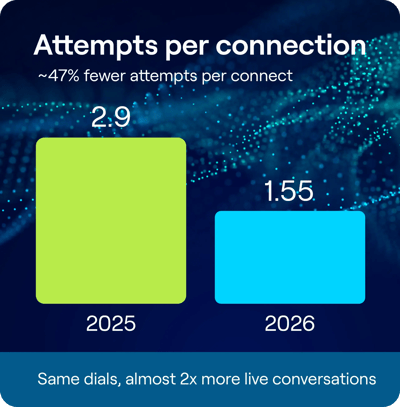
The latest industry data shows that most prospects who are likely to answer an unfamiliar number now do so on the first attempt, with 1.55 calls the average needed to reach a prospect across the board. In the previous period, it took an average of 2.9 call attempts to get through.
Further data tells the same story from another angle: Cognism SDRs made over 449,000 calls in 2025 and still achieved that 13.3% answered rate on cold outreach. That’s what happens when connection efficiency is built on accurate data and disciplined, phone-first cadences, not just more dials.
At a surface level, that appears to be a minor operational improvement. In practice, for a CRO or CFO, it has direct economic implications:
- Fewer dials per connection = less wasted effort and lower labour cost per live conversation.
- More connects per SDR per day = more chances to qualify or disqualify accounts quickly, which tightens your funnel and improves forecast reliability.
To make this more tangible, here’s a simple example:
- Assume 10 SDRs are each making 80 dials per day, 20 days a month.
- At 2.9 attempts per connection, you get roughly 552 live conversations a month.
- At 1.55 attempts per connection, that jumps to around 1,032 live conversations a month from the same team and dial volume.
Even before you look at the success rate, you’ve almost doubled the number of real conversations your organisation can have with the market, without adding headcount.
Looking back at the 2025 data, that efficiency translated directly into outcomes: across the previously mentioned 196,000 prospects contacted, SDRs averaged just 3.36 touches per person, converted about 16% into meetings, and saw nearly 86% of those meetings actually go ahead. Fewer wasted attempts, more held meetings, that’s what lowers cost per conversation and improves the reliability of outbound-sourced pipeline.
Better inputs and smarter infrastructure are doing a lot of the heavy lifting. Verified mobile numbers and cleaner lists mean far fewer dead dials. AI-powered workflows sequence outreach by fit, intent and recent engagement instead of a static list, and modern call screening strips out a lot of noise.
The effect is that when your reps do get through, it’s far more likely to be a relevant, live buyer conversations, not wasted effort.
From a team design perspective, this matters because it changes what one SDR can reasonably own:
- At 2.9 attempts per connect, you need more heads to hit a given number of live conversations.
- At 1.55 attempts per connect, each SDR can cover more of your target market, or you can maintain coverage with a leaner team.
For leadership, the significance of this efficiency gain isn’t about pushing SDRs harder; it’s about what becomes possible at a commercial model level.
When each rep can generate more live conversations from the same activity, you have these options: maintain coverage with a leaner team, redeploy headcount to higher-value segments, or reinvest the saved cost into better data and AI to compound the effect.
That’s also where the AI question becomes financial rather than a theoretical issue. As AI and data make each seller more productive, the question isn’t “Do we still need humans?” It’s how far you can redesign team size, structure and focus around an AI-augmented outbound engine without losing the quality of human conversations that actually create pipeline.
A CRO from a mid-market SaaS/Software company in our survey adds:
“Our goal is to make each seller, etc, 20% more efficient. We are measuring time savings per week per person with some of our AI tooling, and we are consistently tracking 3-4 hours 'saved' per week.On top of that, we will force changes to the overall process by inserting AI agents in the process to be followed, thus ensuring time savings in an easy-to-measure way - Process A vs Process B.”
AI vs humans: Can AI replace the sales team?
For many leadership teams, the most uncomfortable question in outbound right now isn’t “How do we improve cold calling?” but “Do we need people doing it at all?”
If AI can research accounts, write emails, draft call scripts and automate follow-up, why carry the cost of a sales team?
The industry benchmark data in this report, combined with Cognism’s performance, points to a pragmatic answer:
AI alone is cheap per touch, but human-led conversations, supported by AI and good data, are still extremely effective per opportunity created.
Our survey of CROs and Sales Leaders backs this up. When asked about AI’s impact on sales headcount over the next 24 months, 40% said AI will not materially change headcount, and the remaining 60% expect a 1-25% reduction. No one in the survey expects AI to wipe out more than a quarter of their sales team or to increase headcount.
Therefore, the majority of leaders are betting on AI to make existing cold calling and prospecting more efficient, rather than replacing human sellers outright.
Cognism’s 2025 data reinforces that gap: even with email reply rates far above typical B2B benchmarks, the majority of outbound meetings still originate from phone-led cadences. Email, social and automation lift engagement, but when it comes to actually creating qualified opportunities, live conversations still do the heavy lifting.
To illustrate the trade-off, picture this:
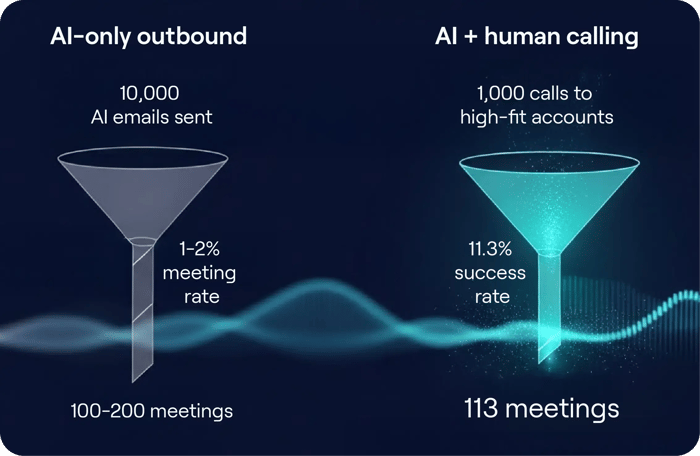
- Imagine an AI-led outbound email motion that converts 1-2% of contacts into meetings.
- In parallel, your human-led cold calling motion converts at 11.3%, as Cognism’s team does.
On a cost-per-send basis, the AI-only motion looks attractive. But when you look at how many touches are required to create the same number of meetings, and the quality of those meetings once they reach AEs, the economics look different.
A human on the phone, supported by AI and high-quality data, is:
- Speaking to fewer people.
- Converting a far higher percentage.
- Capturing richer context that improves qualification, forecasting and win rates downstream.
And what happens in those meetings matters. Having analysed thousands of discovery calls, Cognism found the best performers weren’t the ones talking the most; they ran balanced conversations (roughly 45-55% talk share), asked around 35-45 questions per hour and avoided long monologues.
That kind of real-time judgement, when to probe, when to stay quiet, when to reframe, is exactly where humans still create value AI can’t reliably replicate today.
For the C-suite, three key principles emerge:
- AI should remove manual effort, not commercial judgment. AI is excellent at automating certain tasks, such as account research, basic personalisation, drafting emails, logging and summarising calls. This reduces the amount of human time needed to get to a first conversation, but it doesn’t replace the judgment, nuance and trust-building that happens in that conversation.
- Humans still create the value in complex B2B sales. In most mid-market and enterprise motions, progress hinges on understanding organisational politics and hidden constraints, framing the problem in a way that resonates with multiple stakeholders, and managing risk, timing and next steps in real time. Those are skills exercised live, in conversation. AI can support them; it doesn’t reliably replace them today.
- The efficient model is AI-augmented, not AI-only or human-only.
Teams hitting double-digit cold calling success, like Cognism at 11.3%, aren’t running old-school, manual outbound. They’re combining verified data (to avoid wasted dials), AI workflows (to build and prioritise lists, surface insights quickly, and automate follow-up), and human-led calls that turn those better inputs into qualified opportunities.
A Chief Revenue Officer from a mid-market SaaS/software organisation says:
“I'm a firm believer that human-human interaction will remain incredibly important for sales for the foreseeable future. AI will play a valuable role in making teams more efficient with better account targeting/prioritisation, marketing feedback loops, sales messaging optimisation, etc. But for mid-market and above, I think human sales will remain the status quo for successful orgs.”
Cognism’s internal data shows that when that system is in place, it doesn’t just lift conversion at the top of the funnel; it also improves meeting quality.
Held rates on outbound meetings sit close to 86% because buyers arrive better qualified and with clearer expectations, the compound effect of good data, AI-enabled prep and strong human conversations.
The result is a model where each seller has more, better conversations per day, which is why these teams are pulling away from the 2-3% pack.
And when we asked those same CROs and Sales Leaders which future sales org model they’re most likely to adopt, a third (33%) chose a centralised outbound AI-assisted prospecting team. Smaller groups favoured more inbound/product-led models where outbound becomes narrower and more targeted (20%), or classic pods (AE, SDR, Sales Engineering, and Customer Success Specialists) supported by AI (13%).
Only 13% expect to run with fewer SDRs and more full-cycle AEs. The signal is clear: AI is being used to redesign how prospecting and cold calling are organised and supported, not to remove the motion or the team entirely.
So, can AI replace the sales team? In most modern B2B motions, the honest answer is no. But it should change how you design and staff that team:
- Fewer people are tied up in low-value, manual tasks.
- More people focused on high-impact conversations with the right accounts.
- A deliberate investment in data and AI to raise pipeline per head.
The real competitive advantage isn’t choosing between AI and humans. It’s building an outbound engine where AI, data and local sales teams work together to deliver the kind of 10-11% performance that fundamentally changes your cost of sales.
How top teams organise an AI-augmented outbound engine
If the last few years were about whether to keep funding cold calling, 2026 is about how to organise it.
The teams that consistently operate at a 10-11% cold call success rate don’t necessarily have better SDRs. They have a different operating model: one where data, AI and human conversations are designed to work together, and where structure and incentives reflect that.
Further analysis backs this up: when the right structure is in place, phone-led outbound becomes a predictable system, not a heroic effort from a few standout reps, with consistent meeting conversion across high-quality activity rather than a handful of lucky sequences.
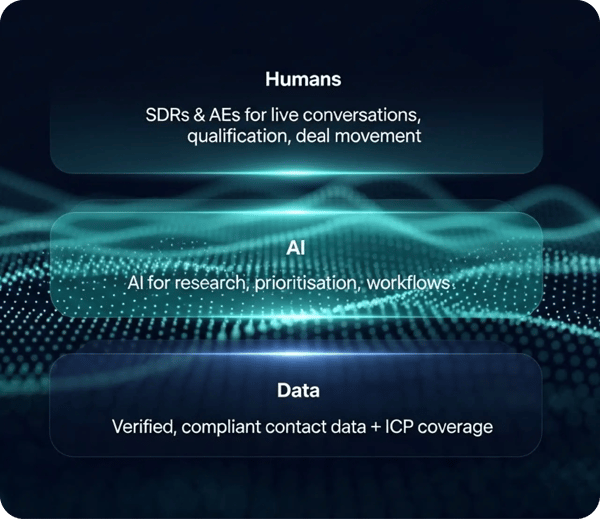
At a high level, that model has five defining features.
1. Data first, structure second
In low-performing teams, org design often starts with headcount: “How many SDRs do we need?”
In high-performing teams, it starts with data quality and region-specific coverage:
- Which markets and segments matter most?
- Do we have verified decision-maker contact data in those segments?
- Can we reliably reach enough of that market to justify a pod, region or segment team?
Only once that is clear do leaders decide:
- Where to place sales reps.
- Which territories justify local representation.
- Where AI-led outreach alone is sufficient, and where it would simply create noise.
This is how Cognism can sustain a 16% success rate in Europe, 11% in the US and 7% in the UK: teams are built where data coverage and market potential support a high-return calling motion, not just where there is theoretical TAM.
The same pattern shows up in Cognism’s broader outbound data. SDRs using verified, enriched contact lists don’t just increase activity, they turn more of that activity into answered calls, replies and meetings.
Focus that effort on accounts with strong decision-maker coverage, and meeting conversion rates land in the mid-teens across large prospect volumes.
2. AI as infrastructure, not a side project
In top teams, AI is an integral part of the core workflow, not an experiment running in isolation.
Practically, that means:
- AI research and summaries feed into every call block, so reps don’t spend time assembling basic context.
- AI-assisted list building and prioritisation, using fit and intent signals to decide which accounts and contacts should be worked on first.
- AI-generated follow-ups and call notes, so post-call admin doesn’t consume an outsized share of the day.
From a leadership perspective, this changes what you’re buying when you invest in outbound:
You’re not just paying for “SDR hours”; you’re paying for a system in which each hour is worth more, because much of the low-value work has already been automated.
In Cognism’s outbound motion, for example, AI now condenses company research into short briefs and helps reps prioritise which accounts have the strongest buying signals, cutting prep time from minutes to seconds per contact.
That doesn’t change what good sounds like on a call, but it does mean that more of each seller’s day is spent in live conversations rather than preparing for them.
3. The phone across the whole revenue cycle, not just top-of-funnel
In average organisations, the phone is treated as an SDR channel for first touches, then sidelined once opportunities move into the pipeline.
In top-performing organisations, it’s treated as a revenue lever across the whole cycle:
- Top-of-funnel: to create net-new opportunities with target accounts.
- Mid-funnel: to align stakeholders quickly, test urgency and remove blockers without waiting for the next scheduled meeting.
- Late stage: to reconfirm intent, manage risk and keep deals moving when email and other digital channels stall.
The organisational implication is simple: responsibility for live customer contact doesn’t sit with SDRs alone. AEs and, where needed, sales leadership are part of a deliberate strategy to use calls wherever they reduce cycle time, de-risk deals and improve forecast confidence.
Cognism’s data supports that full-funnel view: outbound meetings are still overwhelmingly created off the back of phone-led cadences, and once those meetings are booked, close to nine in ten actually go ahead.
That held-rate is a sign that calls are being used not just to “get something in the diary”, but to qualify properly and set clear expectations for what happens next.
This reduces dependence on any single role and ensures that real-time customer insights sit with the people accountable for the number, not just the team generating the first meetings.
4. Metrics and incentives built around pipeline, not tasks
High-performing teams don’t incentivise people to “do more”. They incentivise them to create more of the right things.
That typically means:
Measuring:
- Success rate (e.g. 11.3% vs 2.7%).
- Meetings and qualified opportunities per rep.
- Pipeline created and progressed, not just meetings booked.
Rewarding:
- Multi-threading into key accounts.
- Progressing real opportunities through defined stages.
- Using calls to qualify out weak deals early, not carry them for vanity.
In that model, AI and automation aren’t tools for pushing task counts higher; they’re tools for increasing pipeline per head and reducing the amount of human effort wasted on low-yield activity.
5. Team design that reflects focus, not historical habit
Finally, the way teams are organised in top-performing environments tends to look different from a traditional “SDR: AE ratio” conversation.
Instead of asking “How many SDRs do we need per AE?”, leaders ask:
- Which segments and regions warrant dedicated, locally represented pods because the data and success rates justify it?
- Where can we centralise effort (for example, smaller markets) and lean more on AI-assisted digital outreach, with selective calling on top accounts?
- How can we structure SDR and AE roles so that AI handles the repeatable work, and humans spend their time where they add the most value: high-intent accounts, complex deals, and key stakeholders?
In practice, that often results in:
- Fewer people are doing broad, shallow outreach.
- More people focused on a defined patch of the market where data, AI signals and local context give them a real chance of performing closer to 10-11% than 2-3%.
For example, Cognism tiers accounts based on data coverage and buying signals, this means there’s a concentrated effort on tiers with multiple decision-makers and verified mobiles. The result is that the sales teams work to those ideal customer profiles in depth rather than chase a bloated TAM.
In commercial terms, this approach means a more robust pipeline from a tighter focus area, rather than spreading human capacity thinly across markets where the fundamentals aren’t yet in place.
For the C-suite, the key takeaway is that organising the team in 2026 is less about adding or removing SDRs, and more about designing an outbound system where:
- Regional data quality dictates where you build.
- AI increases the value of each human hour.
Local representation is used where it makes a difference, not by default.
That’s the operating model which sits behind the numbers in this report, and it’s a very different proposition from simply asking SDRs to “make more calls”.
Regional performance: why localised representation still beats global automation
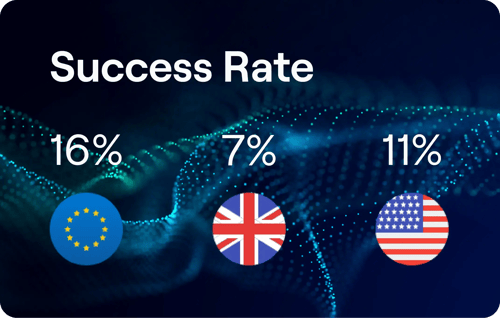
Cognism’s overall cold calling success rate going into 2026 is 11.3%, but the real story sits underneath that global average. Performance varies by region:
- Europe: 16% success rate.
- US: 11% success rate.
- UK: 7% success rate.
On paper, everyone has access to similar AI tools and automation. The gap, therefore, isn’t explained by technology alone. It reflects where data quality, local representation and AI-assisted workflows are aligned, and where they aren’t.
That gap shows up in our survey of senior leaders, too. When we asked how regional cold calling is performing versus 12 months ago, 47% said it’s slightly worse, and 40% reported no change, with only 14% seeing any improvement.
In other words, most organisations aren’t yet seeing regional gains from cold calling, while a smaller group, like the teams hitting 16% or 11% in this report, are pulling away because they’ve already aligned data, local coverage and AI-assisted workflows.
Two patterns stand out.
1. Regions win where data, timing and local execution align
In Europe, Cognism’s team is converting at 16%, the highest of any region. That uplift hasn’t come from simply “dialling harder”; it’s come from a tighter combination of:
- High-quality, Diamond Data® contacts in target accounts.
- A strong focus on buying signals and event triggers to time outreach.
Local reps who understand how those signals actually show up in their market.
As Felix Scholl, SDR Leader in Germany, explains:
“From my perspective, recognising and converting buying signals and event triggers are super important. Our focus on these has been pivotal to calling prospects at the right time.
Additionally, the increased number of Diamond Data® contacts made sure we’re not missing out on these opportunities, and in doing so, we’ve boosted our cold call success rate to a massive 16%.”
In the US, performance is also strong at 11%, matching Cognism’s global average. Here, the emphasis has been on prospecting discipline and efficient execution:
A CRO from a mid-market SaaS organisation reiterates the need for the correct data:
“Data quality is a huge issue, and if it’s not right, there’s no sense in using it to power AI. The other big barrier is employee education and helping people understand all of the places we can use it.”
Cognism’s Sales Director in North America, Jon Dolan, says:
“It all starts with prospecting. We’ve been prioritising Diamond Data® when doing cold outreach, ensuring we’re focusing our efforts on the highest-quality prospects.
By measuring and optimising our output, we’ve been able to identify the best times to connect, make smarter calls, and ultimately boost our success rate across the US. It’s all about efficiency and fewer wasted calls.”
The UK, at 7%, is also outperforming the 2.7% market average, showing that the same data, AI and phone-led model is working across regions, with clear headroom to keep pushing those numbers up.
2. What this means for how you organise your sales team
If you’re a CRO, it’s clear that the regional picture has direct implications for org design and investment, especially in an AI-first world, so:
Don’t assume a global AI motion will perform equally everywhere. AI can scale messaging and workflows, but it doesn’t replace local context, language nuance, buying culture or regulatory environments. Where Cognism has aligned local teams, strong data and AI support, success rates move into double digits. Where one of those pieces lags, performance follows.
A CRO from a mid-market SaaS/software business adds:
“AI is driving more personalisation than we’ve achieved before. We’re moving past broad ICPs to specific personas within those ICPs, using real data from existing customers and stories of similar customers to speak to new prospects.
It’s also helping us globally to use the right terminology and spelling by region, for example, UK versus US.”
Allocate headcount where local representation actually moves the needle. Regions already converting at 10-16% are clear candidates for:
- Dedicated SDR/AE pods.
- Deeper investment in local data quality.
- Closer integration between sales, marketing and customer teams.
In emerging or lower-performing regions, it may make more sense to either:
- Start with a leaner local footprint.
- Use AI-assisted digital outreach as the first line, or
- Layer in calling for high-value accounts and proven segments rather than trying to replicate the largest regions from day one.
Use regional data to decide where AI can safely extend, and where people must lead. In markets where success is already strong, AI should be used to amplify what local teams are doing, prioritising accounts, compressing research, and standardising follow-up.
In markets that are underperforming, AI can help you test messaging and coverage quickly, but local feedback from real conversations is still what tells you whether the strategy is right.
The core point is simple:
AI provides scale, but local representation yields conversions.
The teams that are pulling away are not the ones trying to run a single, fully automated global playbook.
They’re the ones using AI and data to support regional teams who understand their markets, as well as structuring headcount, targets and investment around where that combination is already delivering double-digit returns.
Cold calling, motion design and team decisions for 2026
The data in this report tells a clear, commercially relevant story.
- Cold calling is still working, but the economics have shifted. The market has recovered modestly to around 2.7% success. At that level, even with AI in the stack, outbound is an expensive way to create pipeline.
By contrast, further analysis shows that a phone-first motion, underpinned by accurate data, generated close to 40,000 outbound meetings in a year at a 16%+ conversion rate from contacted prospects, proof that when the model is built well, it behaves like a predictable growth engine, not a speculative bet.
- Top teams are operating in a different band. Cognism’s outbound engine is converting at 11.3%, with regional performance of 16% in Europe, 11% in the US and 7% in the UK. At those levels, leaders can generate materially more pipeline from the same headcount, or maintain current pipeline with fewer reps and a lower cost of sales.
It’s important to remember too, that meeting quality is keeping pace as well, with almost nine in ten outbound meetings going ahead, giving leadership far more confidence that what’s on the forecast will actually materialise.
- AI is widening the competitiveness gap, not closing it. Average teams are using AI to send more low-yield touches. Top teams are using AI and high-quality data to make each unit of human effort more valuable.
At the C-suite and VP level, that rolls up into three practical decisions.
1. How you organise teams
The question is no longer “How many SDRs per AE?” but:
- In which segments and regions do we have the data coverage and demand to justify a dedicated outbound pod?
- Where can we centralise effort and rely more heavily on AI-assisted digital outreach, with selective calling for target accounts?
How do we design roles so that AI handles low-value tasks (research, admin, basic sequencing), and human GTM capacity is focused on the accounts and stages that move revenue?
Put simply, if you assume:
- A 2.7% team with 10 SDRs might create roughly 430 meetings a month from their outbound calls.
- An 11.3% team with the same 10 SDRs can create around 1,800 meetings a month from the same activity.
You can either:
- Hold headcount flat and grow pipeline
or - Hold pipeline flat and reduce headcount/cost, depending on your growth vs efficiency priorities.
The org question is which of those outcomes you’re designing for, and whether your current structure, metrics and tech stack support it.
A Chief Revenue Officer from a mid-market SaaS/software organisation says:
“I would not initially reduce headcount. I would use it to empower better targeting and improve the quality of outbound, in terms of better content, to the right people and closer to their buying cycles.”
2. Where localised representation is non-negotiable
The regional picture is clear:
- Europe at 16%, the US at 11%, the UK at 7%, all outperforming the 2.7% market benchmark to varying degrees.
Those numbers don’t come from a single global AI playbook. They come from:
- Local teams working from accurate, region-specific data.
- AI and intent signals used to prioritise accounts and timing.
- Messaging and outreach that reflect local norms and buying behaviour.
From a resourcing standpoint, that means:
- Invest more in regions where local teams, data and AI are already combining to deliver double-digit success.
- Be cautious about over-investing headcount in regions where data is weak, or success rates are still close to market average; there, AI-assisted digital plays plus selective calling may be a better starting point.
- Don’t expect an AI-only global sequence to replace the performance of a well-structured, locally represented outbound pod in a priority market.
3. Can AI replace the sales team, and where should it sit instead?
The short answer, based on the data and examples in this report, is no. Not in any complex B2B motion where deal value, risk and internal politics matter.
What AI can do today is:
- Compress the cost of doing the wrong work. By removing manual research, admin and first-draft writing from human workloads.
- Raise pipeline per head. By ensuring your GTM team spends more of its time on the right accounts, at the right moments, with the right context.
- Standardise execution. By embedding best practices, cadences and messaging into workflows that are easier to follow and measure.
What AI cannot yet do reliably is:
- Own quota in mid-market and enterprise.
- Navigate complex internal dynamics.
- Carry accountability for commercial judgment.
The most competitive organisations in this report are not choosing between AI or cold calling.
They are designing a model where:
- Data and AI decide where human GTM capacity is applied.
- Local teams execute in the markets where that capacity matters most.
- Cold calling, at 10-11%+ success, becomes an efficient, predictable input into pipeline and revenue, rather than a blunt volume lever.
The funding decision for 2026, therefore, is not:
“Should we still have a cold calling team?”
It’s:
“Are we comfortable running an outbound engine at our current success rate in a market where 10-11% is achievable, and if not, where do we need to invest in data, AI and org design to move up that curve?”