
STUDY
Fluent in data: what Europe’s CXO data highlights about female leadership
On International Women’s Day this year, we took a snapshot from Cognism’s B2B dataset, focusing on the United Kingdom, mainland Europe and the Nordic region, analysing how women are represented in executive leadership roles across company size, industry and geography.
The dataset provides a view of how leadership titles are distributed across millions of organisations. And the picture is mixed.

Female CEO representation
Across the dataset, fewer than one in five CEOs are women, with female representation in CEO roles at 18.1%.
At first glance, this represents an improvement compared with earlier snapshots of corporate leadership. Female CEO representation across major European economies is now significantly higher than the 6% recorded among FTSE 100 CEOs in 2019, and also exceeds the 9% reported in 2026.
However, the figure remains low when viewed across the broader business landscape. The imbalance cannot be explained solely by the composition of elite corporate boards. It appears consistently across the broader business ecosystem.
Even where women are better represented in certain executive functions, such as HR, marketing, and finance, that stronger representation does not fully translate into CEO roles.
Diane Abela Hardy, CISO at Cognism, said:
“It doesn’t surprise me that fewer than one in five CEOs are women. When I reflect on my own career, I can see the number of blockers and challenges I faced simply because of my gender – from unconscious bias to working in environments where I was often the only woman in the room.”
Rerunning the 2019 name test
In 2019, one of the most widely cited findings from the FTSE 100 analysis was that there were more CEOs named Stephen than there were female CEOs in total.
To see whether similar patterns exist across the wider European business landscape, we analysed naming patterns among CEOs across the United Kingdom, mainland Europe, and the Nordic region.
Expanding the data set beyond 100 UK headquartered companies naturally increased the variety of names, but in both the United Kingdom and mainland Europe, David is the most common name amongst CEOs.
Combined, that means there are more than 8,000 CEOs named David across these markets, which is equivalent to roughly 11% of the entire female CEO population in the dataset.
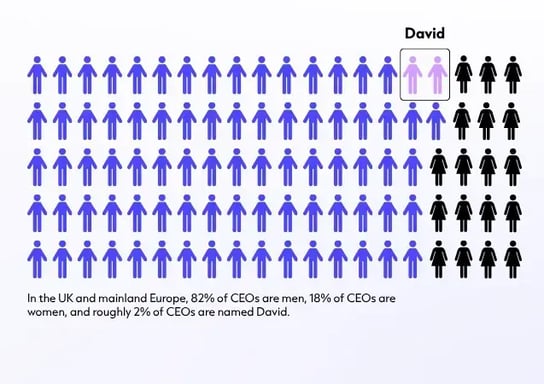
While, thankfully, we can’t replicate the 2019 ‘CEOs are more likely to be named Stephen than be a woman’ test, a single male name represents over one in ten of all female CEOs combined.
Female representation across executive roles
Beyond the CEO role, the distribution of women across executive roles is not uniform. It clusters heavily by function.
| Category | Role | Female Representation |
|---|---|---|
| People Leadership | CHRO | 58.90% |
| Financial & Operational Leadership | CFO | 26.20% |
| COO | 24.99% | |
| CDO | 22.09% | |
| Revenue Leadership | CRO | 19.52% |
| CMO | 33.79% | |
| CPO | 17.62% | |
| Top Executive Leadership | CEO | 17.61% |
| Technology Leadership | CIO | 13.25% |
| CTO | 6.01% |
Human Resources leads on gender diversity, with women representing 58.90% of CHRO roles. This is the only C-suite position where women hold a clear majority. HR has historically been a female-dominated profession, and that dynamic appears to extend into executive leadership.
Marketing is the most gender-diverse commercial leadership function, albeit still far short of gender parity, with women accounting for 33.79% of CMO roles. This suggests that creative, brand and customer-focused leadership pathways may currently offer more accessible routes to executive representation than many other commercial functions.
Finance shows moderate progress, with women holding 26.20% of CFO positions. Finance has often been considered one of the most common pathways to the CEO role. However, the data shows that stronger female representation at CFO level does not yet translate proportionally into CEO leadership.
Operational and revenue leadership roles remain more constrained. Female representation falls below a quarter in positions such as COO (24.99%), CRO (19.52%), and CPO (17.62%). These roles often sit closest to operational execution and revenue ownership, areas historically associated with traditional leadership pipelines.
The most pronounced imbalance appears in technology leadership roles. Just 13.25% of CIO positions are held by women, and only 6.01% of CTO roles are female.
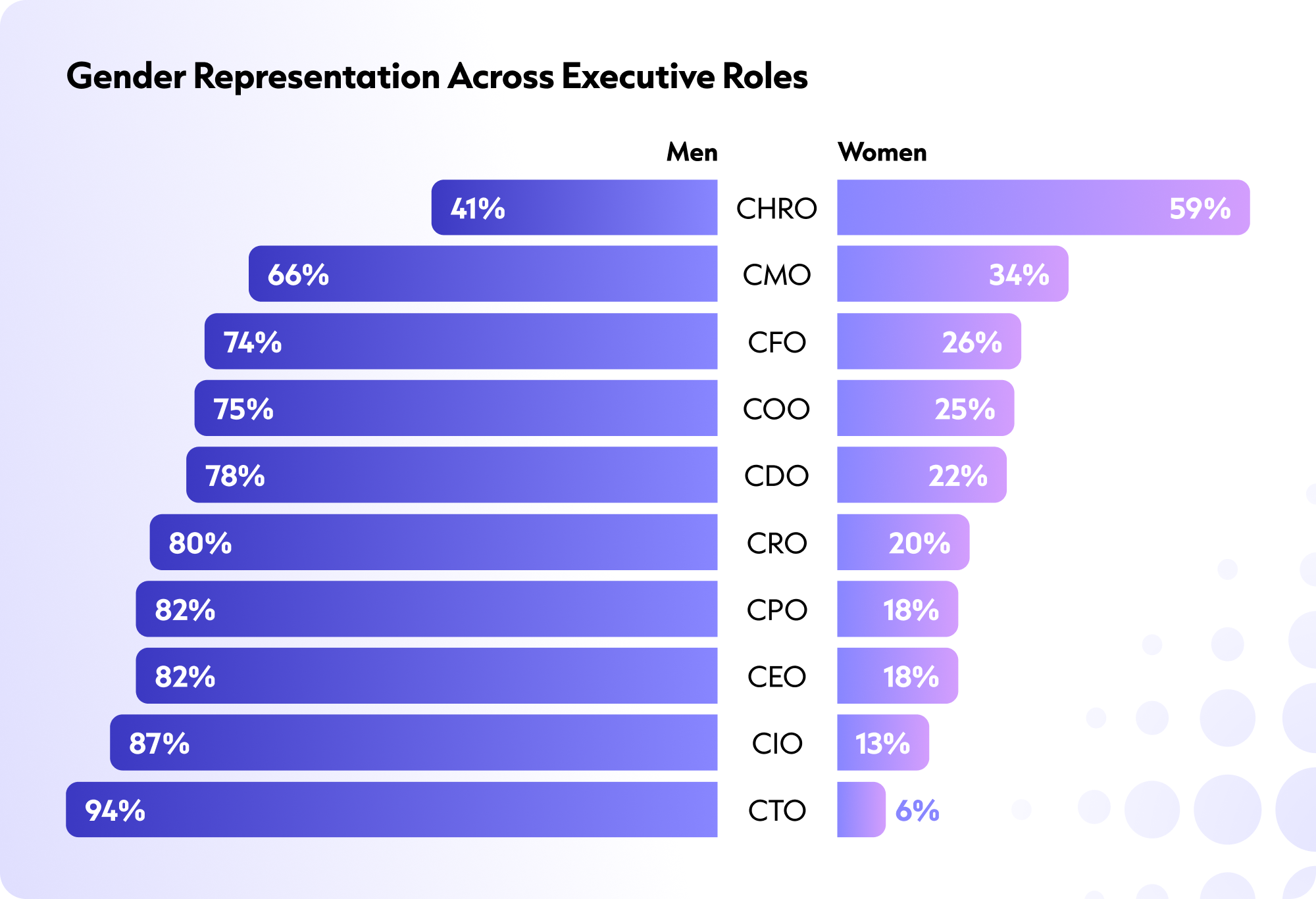
Technology-focused executive positions remain overwhelmingly male-dominated, even as digital transformation becomes central to corporate strategy. This gap is particularly significant given that technology leadership increasingly shapes long-term competitive advantage, product direction and capital allocation.
Women in STEM and the leadership pipeline
One factor that may help explain the leadership patterns observed in the dataset is the composition of the wider talent pipeline, particularly within science, technology, engineering and mathematics (STEM) fields.
Across Europe, women remain underrepresented in many technical disciplines that traditionally feed into technology and infrastructure leadership roles. According to Eurostat data, women account for roughly one-third of STEM graduates across the European Union, with even lower representation in fields such as engineering, computer science and information technology.
This imbalance at the early stages of technical careers has long-term implications for leadership composition. Roles such as Chief Technology Officer and Chief Information Officer are typically filled by individuals who have progressed through technical or engineering pathways over many years. When fewer women enter these fields, the pool of candidates for senior leadership positions is correspondingly smaller.
However, pipeline alone does not fully explain the scale of the imbalance.
As Lindsey Grossman, Chief Strategy Officer at Cognism, explains, the issue is not just who enters the pipeline, but how talent is sourced and assessed:
“Especially in innovation companies, many CEOs grew their career in product and technology roles, and these functions have some of the lowest representation of women leaders.
We must ensure that leaders in these functions proactively widen the top of funnel when they recruit across all levels, tapping into networks outside of their usual circles.
Additionally, hiring managers need to lead structured, unbiased hiring processes that can weed out unconscious bias that often prevents women from being hired into these technical roles.”
Viktoria Ruubel, Chief Product, Data & Technology Officer at Cognism, adds that the definition of technical leadership can also narrow representation:
“What I've seen is that technology leadership is often defined very narrowly – deep engineering background, years in infrastructure or architecture roles – and that definition filters out talented leaders who came through product, data, or cross-functional paths. If we keep defining the role the same way, we'll keep getting the same results.”
As Diane Abela Hardy, Chief Information Security Officer at Cognism, adds, perception and positioning also influence who enters these pathways in the first place:
“I think there’s still a perception problem when it comes to technology roles. It’s not that women or girls don’t want to work in tech – it’s how these roles are presented and described.
We often communicate careers in technology in a very narrow way, as engineering or development-heavy roles, and because these functions have historically been male-dominated, the way they’re described can unintentionally reflect that.
There’s evidence that even the language used in job descriptions can influence who applies. It’s not about the role itself. It’s about how the role is framed.
So what happens is a cycle: these roles are male-dominated, they’re described in ways that reflect that, and that in turn makes them less attractive to the next generation of women entering the workforce.
If we want to change representation in technology leadership, part of the solution is broadening how we define and communicate what working in tech actually looks like, and making those pathways more visible and accessible.”
What emerges from these perspectives is a clear conclusion: pipeline alone cannot explain the imbalance. How roles are defined, communicated, and evaluated plays an equally important role in shaping who progresses into leadership.
Representation across career seniority
When we look beyond specific executive roles and instead examine leadership representation across the full career ladder, a clear pattern emerges: female representation declines steadily as seniority increases.

At the entry level, gender representation is close to equal. Women account for 46.75% of roles, compared with 53.25% men, indicating that the workforce begins with a relatively balanced gender split.
However, this balance begins to shift as careers progress into leadership positions. At the team lead level, female representation falls to 41.30%, with men holding 58.70% of roles. The gap widens further at middle management, where women represent 37.78% of positions, and remains similar at senior leadership, where women account for 37.32% of roles.
The most significant disparity appears at the executive level, where female representation drops to 28.73%, compared with 71.27% men. This marks the widest gender gap across the leadership pyramid.
These figures illustrate a familiar pattern: representation narrows at each stage of progression.
But this is not simply a pipeline issue. It reflects how progression decisions are made, how opportunities are distributed, and how careers evolve over time.
As Viktoria Ruubel, Chief Product, Data & Technology Officer at Cognism, explains, the drop-off does not originate at entry level, but at the points where progression is determined:
“The data in this report shows that the drop-off happens at each promotion gate. So the fix isn't about hiring more women at the bottom and hoping it works out.
It's about looking hard at how you promote, who gets visibility on high-stakes projects, and whether your leadership criteria are actually measuring what matters or just pattern-matching to what's worked before.”
This highlights the importance of how organisations identify and advance talent. Access to high-impact projects, internal visibility, and the criteria used to assess leadership potential all shape who progresses, and who does not.
However, organisational processes alone do not fully explain the scale of the gap. Progression is also shaped by structural and societal factors that sit beyond the workplace.
As Diane Abela Hardy, Chief Information Security Officer at Cognism, explains:
“It’s not just about what happens inside the organisation – a lot of this comes down to what happens across different stages of a woman’s life and career.
For example, when a woman goes on maternity leave, she is often missing out on opportunities, and it can be much harder to re-enter the workforce. At the same time, in many countries, paternity leave is still very limited, which creates an imbalance in how careers progress over time.
Even beyond that, there are wider structural gaps – whether it’s access to childcare, the level of support available for two working parents, or how workplaces handle things like menopause. These aren’t always accounted for in how organisations think about progression, but they have a real impact.”
These factors often influence not whether women remain in the workforce, but how their careers progress within it.
Caroline Drake, Chief People Officer at Cognism, adds that for many women, the impact is not attrition, but a temporary plateau at a critical stage of progression:
“In many cases, women don’t leave the workforce, but their career progression slows as they take on more childcare responsibilities.
Until we see more balanced co-parenting, where both the physical and mental load is shared, it’s unlikely that representation at senior leadership levels will shift meaningfully.
In my own experience, having that balance has made a real difference. My husband reduced his working week and takes on the majority of childcare, which has enabled me to operate in C-suite roles while raising a young family.”
Female representation by company size
Leadership representation shifts meaningfully depending on company size.
| Company Size | % Female CEOs |
|---|---|
| 1–10 | 19.64% |
| 11–50 | 15.46% |
| 51–200 | 15.11% |
| 201–500 | 15.21% |
| 501–1000 | 16.10% |
| 1001–5000 | 17.04% |
| 5001–10000 | 18.69% |
| 10000+ | 21.61% |
Female CEO representation varies across company size, and the pattern is more nuanced than a simple increase or decrease as organisations scale.
At the smallest end of the spectrum (1–10 employees), women represent 19.64% of CEO roles. However, this proportion drops once companies move into the 11–50 employee range, where female representation falls to 15.46%.
Representation remains relatively flat across the mid-sized segments. In companies with 51–200 employees, women hold 15.11% of CEO positions, rising only slightly to 15.21% in organisations with 201–500 employees.
From this point onwards, representation gradually increases as company size grows. Women account for 16.10% of CEOs in companies with 501–1,000 employees, rising to 17.04% among organisations with 1,001–5,000 employees.
The upward trend continues among larger companies. Female representation reaches 18.69% in organisations with 5,001–10,000 employees, and peaks at 21.61% in enterprises with more than 10,000 employees. Looking at this data on a graph, it forms a U-shaped pattern.
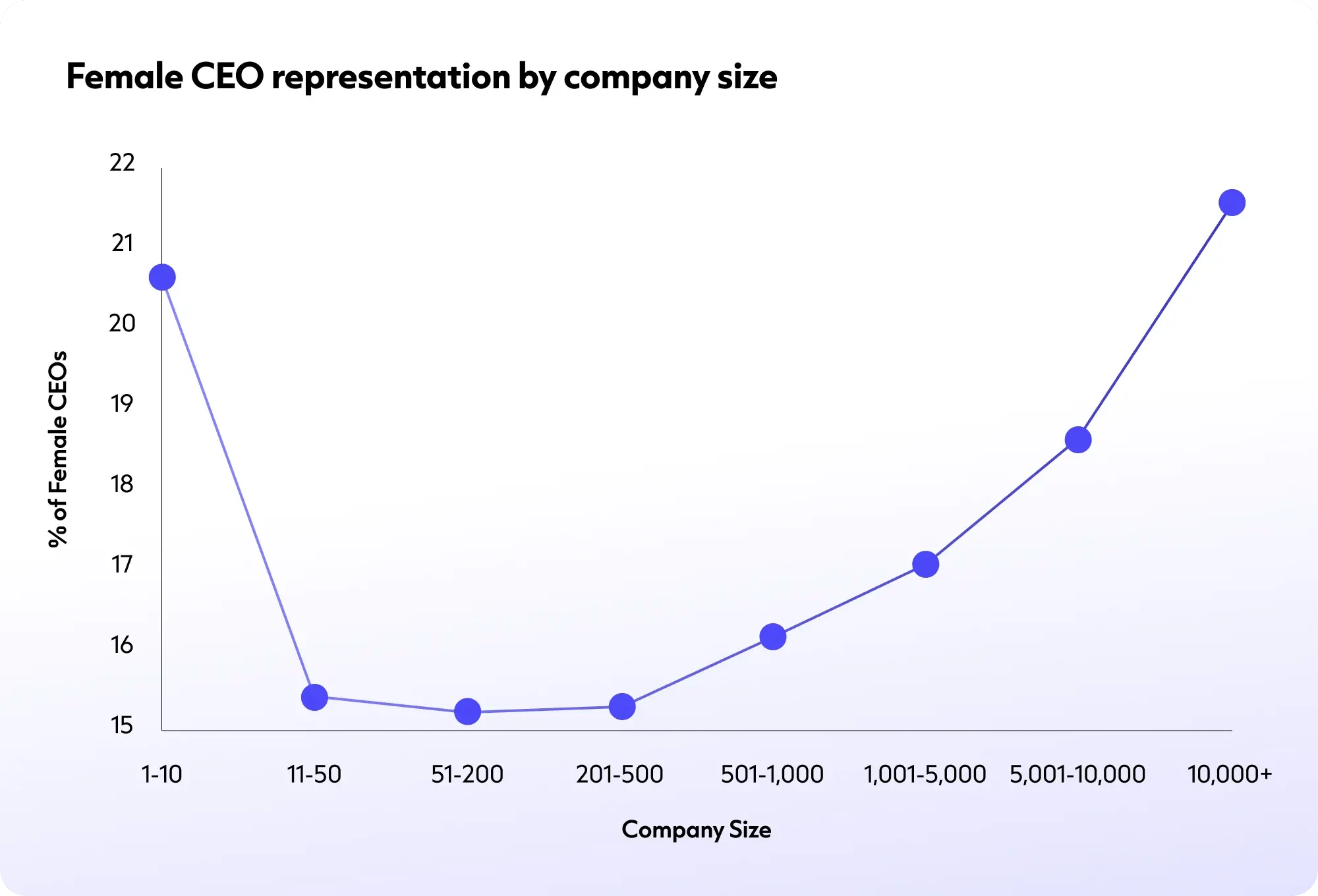
This early-stage dip is particularly notable. It suggests that the transition from micro, founder-led businesses to more formalised management structures may coincide with a narrowing of leadership diversity.
One explanation for this pattern lies in how companies hire during periods of rapid growth.
As Viktoria explains:
“I've seen this play out firsthand. When a company is scaling fast, hiring speed wins over everything else. You default to your network, you clone what's worked before, and you optimise for immediate execution over long-term team composition.
Nobody sets out to narrow diversity – but the urgency of growth does it quietly if you're not paying attention. The companies that maintain diversity through scaling are the ones that treat it as an operating discipline, not an afterthought.”
Sandy Tsang, VP of RevOps at Cognism, adds:
“It comes down to trust, doesn’t it? Large enterprises don’t have a lot to lose because they have so many people. Small businesses don’t have a lot to lose because they’re small. It’s the scale-up stages where growth is critical, where success could hinge on one excellent leadership hire, that companies become hesitant.
There is so much at play here with the subversive biases in our world, and it’s uncomfortable. It’s where I hope we, as a society, can really embracing unlearning these subtle biases so that our children and our children’s children can grow up never giving gender a second thought when they discuss world leaders and business leaders.”
In very small companies, leadership roles are often held by founders or early employees, where hiring decisions may be more flexible and less constrained by traditional corporate career pathways.
As organisations grow beyond 50 employees, however, leadership teams often become more formalised. Recruitment processes, management hierarchies, and external hiring for senior roles can begin to mirror more traditional leadership pipelines, which historically have been less gender-balanced.
As companies scale further, representation improves again. Larger organisations typically have more structured governance, clearer promotion pathways, and greater scrutiny around leadership diversity. These factors may contribute to the gradual increase in female representation seen across the upper mid-market and enterprise segments.
Female representation at the wider C-suite level
When expanding the analysis beyond CEOs to include the broader C-suite, a similar structural pattern emerges.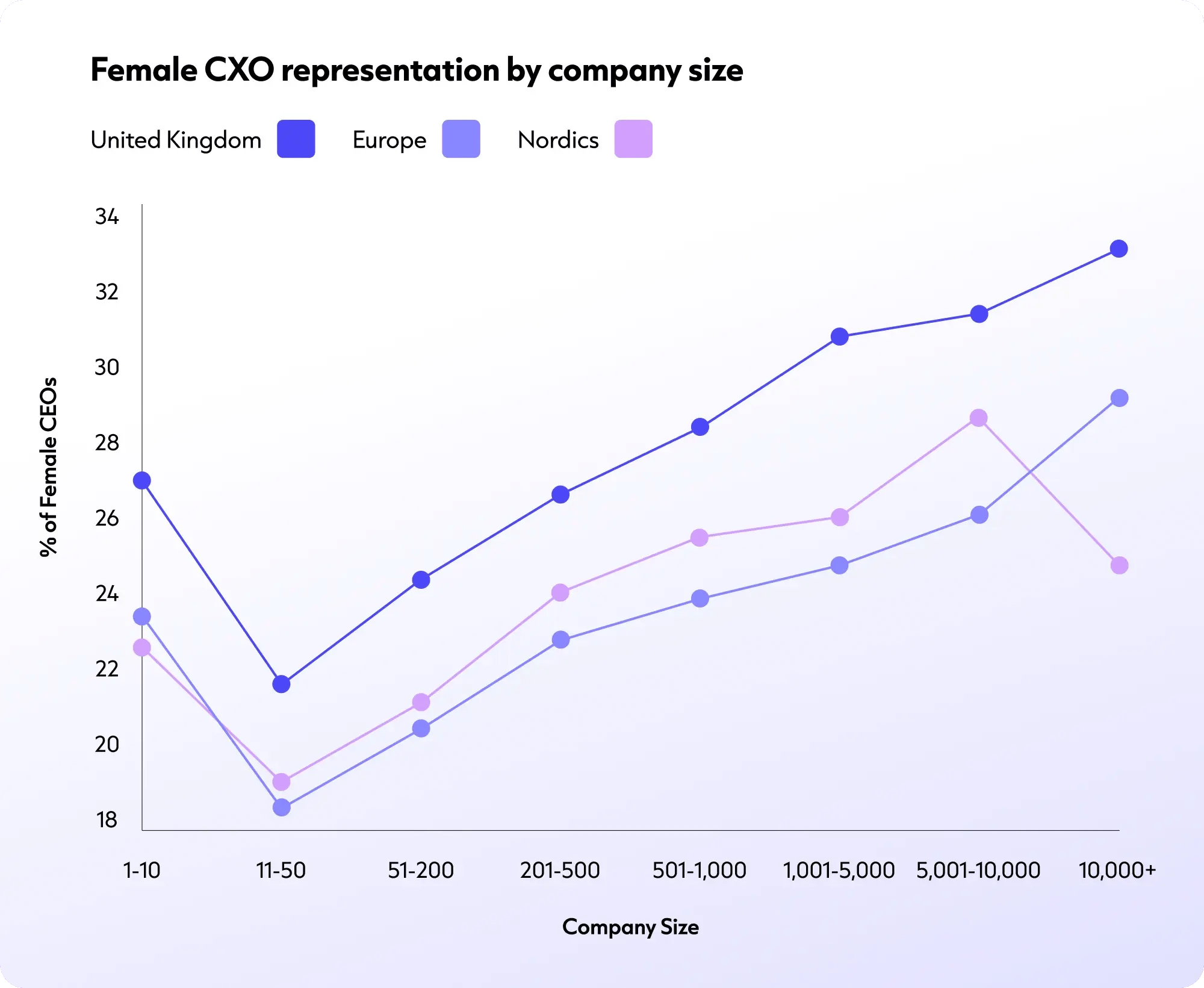
Across the United Kingdom, Europe, and the Nordic region, female representation at the CXO level also dips during the earliest growth stage of companies before rising steadily as organisations scale.
These patterns suggest that the early growth phase of companies may represent a critical inflection point for leadership diversity, not only at CEO level but across the wider executive team.
However, the CXO data also reveals an important distinction. While female CEO representation rarely exceeds one quarter of leadership roles, even in the largest organisations, female representation across the wider C-suite approaches one third in large enterprises. This indicates that women are more strongly represented in functional leadership roles than in the chief executive position itself.
Female representation by industry
Industry variation is stark.
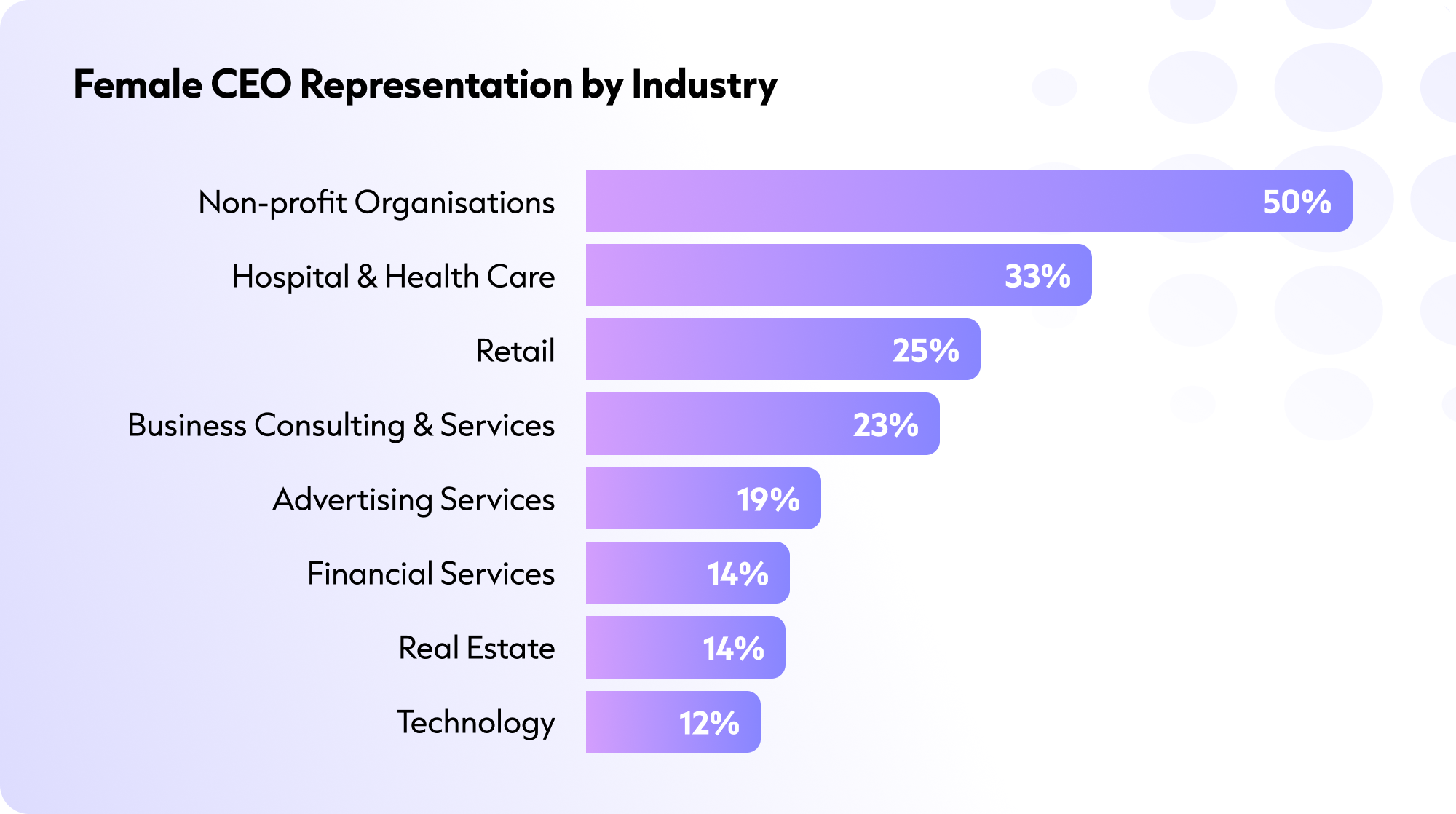
Female representation in the C-suite is not evenly distributed across sectors. Instead, it clusters strongly by industry type.
Across the dataset, some industries demonstrate relatively strong female leadership representation, while others remain heavily male-dominated.
Industries with the highest female CEO representation
Several sectors show comparatively stronger female representation at CEO level:
- Non-profit organisations: 49.87%
- Hospitals and Health Care: 32.99%
- Retail: 25.47%
- Business Consulting and Services: 23.10%
These sectors all share common structural characteristics. Many are historically people-focused industries centred around services, community outcomes, or consumer engagement.
Industries with the lowest female CEO representation
At the other end of the spectrum, several industries remain significantly less gender balanced:
- Technology (Software, IT Services and Internet): 12.40%
- Financial Services: 13.95%
- Real Estate: 13.91%
The contrast between sectors is substantial. A CEO in Hospitals and Health Care is nearly three times more likely to be a woman than a CEO in Technology.
This highlights how strongly industry context can shape leadership demographics.
Industries with the highest female CxO representation
Several sectors show comparatively stronger female representation across the wider C-suite:
- Professional Training and Coaching: 35.04%
- Retail: 28.52%
- Advertising Services: 23.75%
- Business Consulting and Services: 23.56%

These industries share characteristics with those that have stronger CEO representation. Many are service-led sectors centred around advisory work, customer engagement, and professional services.
Industries with the lowest female CxO representation
At the other end of the spectrum, several industries remain significantly less gender balanced at the executive level:
- Construction: 11.35%
- Technology (Software, IT Services and Internet): 15%
The contrast between sectors is clear. In Professional Training and Coaching, more than one in three C-suite roles are held by women. In Construction, that figure falls to just over one in ten.
Female representation by location
| Country / Region | % Female CEOs | % Female CxOs |
|---|---|---|
| United Kingdom | 21.61% | 26.49% |
| Italy | 19.99% | 26.59% |
| Spain | 17.99% | 21.98% |
| Nordics (Denmark, Sweden, Norway, Finland) | 17.55% | 22.31% |
| France | 16.47% | 21.94% |
| Germany | 13.23% | 19.18% |
United Kingdom
The United Kingdom records the highest level of female executive representation among the markets analysed, with 26.49% of C-suite roles held by women.
This places the UK slightly ahead of many major European economies – a trend reflected in broader external research – suggesting progress across executive leadership, even if parity has not yet been reached at the very top.
The gap between CEO and CXO representation is also notable. While 21.61% of CEOs are women, the wider executive layer shows stronger representation.
Italy
Italy records one of the strongest levels of female representation across the executive leadership team, with 26.59% of C-suite roles held by women, slightly ahead of the United Kingdom.
However, representation at the very top remains lower, with 19.99% of CEO roles held by women. This creates one of the larger gaps between CEO and broader C-suite representation across the dataset.
This pattern suggests that while women are increasingly present across senior leadership teams, the final step into the CEO role remains more restricted.
Spain
Spain shows a more moderate level of female representation within executive leadership, with 21.98% of C-suite roles held by women.
This places Spain slightly behind the leading European markets but still within a relatively similar range. At the CEO level, 17.99% of roles are held by women, indicating a consistent drop between representation across the wider executive team and the chief executive position.
Overall, the Spanish data follows the broader regional trend: female representation improves across the wider C-suite, but declines at the CEO level.
France
France records 21.94% female representation across C-suite roles, placing it almost identical to Spain in terms of executive leadership composition.
At the CEO level, representation drops to 16.47%, reinforcing the wider pattern across the dataset where female participation declines at the most senior leadership position.
France sits close to the European midpoint: stronger representation than Germany, but still behind markets such as the UK and Italy.
Germany
Germany records the lowest level of female representation across both CEO and C-suite roles among the markets analysed.
Only 19.18% of executive leadership roles are held by women, and the share falls further to 13.23% at the CEO level.
This places Germany noticeably behind the other major European economies in the dataset and highlights a more pronounced gender gap within senior leadership. Compared with markets such as the UK and Italy, where more than one in four C-suite roles are held by women, Germany remains closer to one in five.
Nordics (Denmark, Sweden, Norway, Finland)
Across the Nordic countries, 22.31% of C-suite roles are held by women, placing the region broadly in line with other Western European markets such as Spain and France.
Despite the region’s strong reputation for gender equality in the workplace, representation at the CEO level remains comparatively modest, with 17.55% of CEOs being women.
This suggests that while the Nordics perform relatively well across broader executive leadership, the progression into the very top role still reflects many of the same structural barriers seen elsewhere in Europe.
Cognism's own leadership team
While the data highlights structural challenges, it also makes something else clear: progress is possible. And in some organisations, it’s already happening.
As Diane Abela Hardy, Chief Information Security Officer at Cognism, explains:
“At Cognism, there’s a clear focus on recognising people for their impact rather than their gender. That kind of infrastructure is what enables people to step into leadership roles.”
At Cognism, women hold a majority of roles across the C-suite, representing two-thirds (66.7%) of the executive team – 6 out of 9 leaders. This representation spans product, strategy, people, security, and legal leadership functions, all of which play a central role in shaping company strategy, product development, governance, and organisational culture.
Viktoria Ruubel, Chief Product Officer, leads the evolution of the company’s product platform and innovation strategy, overseeing the development of data and intelligence capabilities that power the business.
Diane Abela Hardy, Chief Information Security Officer, leads Cognism’s global security posture, ensuring that data protection, infrastructure security, and regulatory compliance are embedded into the organisation’s operations.
Nadia Haque, General Counsel, oversees legal governance and regulatory leadership, guiding the company through an increasingly complex global compliance landscape while supporting responsible go-to-market expansion.
Women also lead several other core functions within the executive team. Antonia Williams, Chief of Staff, drives executive alignment and strategic execution, while Caroline Drake, Chief People Officer, leads the company’s global people strategy. Lindsey Grossman, Chief Strategy Officer, is responsible for long-term corporate strategy and growth, with a focus on technical innovation.
Together, these leaders demonstrate that female representation at Cognism extends beyond a single function. It spans product innovation, security, legal governance, strategy, people operations, and executive leadership, areas that directly influence the company’s long-term direction and operational success.
Conclusion
Across the data, a consistent pattern emerges: while women enter the workforce in near-equal numbers to men, their representation declines steadily at each stage of seniority, resulting in a significant gap at the executive level.
This drop-off is not driven by a single factor. Instead, it reflects a combination of influences that compound over time. From how leadership potential is identified and evaluated, to how technical roles are defined, to how careers evolve alongside major life stages, progression is shaped by both organisational decisions and wider societal structures.
As the perspectives in this report highlight, addressing this imbalance requires action at multiple levels. For organisations, this means:
- Re-examining how leadership potential is defined and assessed
- Ensuring equitable access to high-impact projects and visibility
- Building structured, unbiased hiring and promotion processes
- Broadening how technical and leadership roles are defined, communicated, and recruited for
But addressing these challenges requires more than process changes. It requires deliberate leadership. As Sandy Tsang explains:
“Where companies can really take leadership is in acknowledging the realities that lead women to feel like they have to choose, and proactively removing those obstacles.
It’s difficult to balance work and personal life, but not impossible. When companies actively support women in leadership, that’s when we see them stay and progress.”
However, change is not driven by organisations alone.
As Diane Abela Hardy notes, support systems, both formal and informal, play a critical role in progression, and the presence of strong networks, mentorship, and allyship can materially shape career outcomes.
For women navigating these environments, this reinforces the importance of:
- Building supportive networks and communities
- Seeking out environments that recognise and reward impact over convention
- Being proactive in pursuing opportunities for visibility and progression, even when they feel beyond immediate reach
At the same time, as Viktoria Ruubel highlights, organisations and leaders must take responsibility for widening access to those opportunities, ensuring that progression is not limited by narrow definitions of leadership or unconscious bias in decision-making.
Ultimately, the findings in this report suggest that meaningful change will not come from a single intervention. It will require a sustained, collective effort to rethink how talent is identified, supported, and progressed over time. Because the leadership gap is not created in a moment, it is built over the course of a career.
