
PILLAR REPORT
GTM's technical turn: what hiring data shows
New data from Cognism's B2B database shows go-to-market (GTM) work is becoming much more of a technical discipline.
Among enterprise organisations in Europe, 47% with a GTM Engineer added one in the past nine months – a rate that holds steady across the US, UK, France, and Germany, regardless of company size.
The pattern extends to AI leadership hiring too: senior data and AI leaders and technical GTM roles are emerging at the same companies, at comparable rates, in the same window. GTM Engineer hiring is one part of the same structural shift that's putting AI leaders in place.

Cognism analysed hiring activity across its own B2B database, covering Europe, the US, the UK, France, and Germany, then checked the pattern against independent job-market research.
The question was simple: as companies invest in AI, is the technical backbone behind it a separate hiring trend, or part of the same one?
Key takeaways
- Technical roles are becoming a larger part of GTM teams, with a new class of roles sitting between RevOps, data, and engineering.
- The trend holds regardless of company size: GTM Engineer hiring barely shifts between small and enterprise organisations, unlike traditional sales roles.
- AI leadership and technical GTM roles are showing up together at the same companies – different people, not fewer people, doing the work of making a revenue org's data trustworthy enough for AI to use.
Executive summary
Go-to-market organisations are increasingly investing in more technical roles. Across five markets, a consistent share of enterprise companies have added a GTM Engineer in the past nine months – 47% in Europe, 43% in the US, 50% in the UK, 40% in France, 41% in Germany – holding within a tight band regardless of company size, unlike traditional sales roles.
Three things distinguish this shift from previous hiring cycles:
- It doesn't follow the usual adoption curve. New technical roles typically start in startups and travel upstream to large organisations over several years. GTM Engineer hiring shows no such lag: enterprise organisations (1,001+ employees) are adopting the role at close to the same pace as smaller ones, and in the UK, faster (50% enterprise adoption, the strongest figure of any market).
- AI leadership and technical GTM roles show up at the same companies. In the US, enterprise organisations with a senior AI leader are around 13 times more likely to also have someone in a GTM operations-type role than the wider market (6.3% versus 0.5%, on a base of 544 companies) – a pattern that holds at scale. It's even more pronounced in Europe (40x) and the UK (33x), though on far smaller bases (8 of 272 companies, and 2 of 40, respectively). Enterprises showing the overlap include Databricks, Google, Snowflake, JPMorgan, Microsoft, Cisco, Amazon, Salesforce, EY, and Deloitte.
- The role itself splits by company size. Smaller organisations hire GTM Engineers to build a motion from scratch; larger ones hire them to industrialise and govern one already running – a finding echoed by GTM Engineer Search's Shortlist newsletter.
Independent job-market data reinforces the scale of this shift. According to a Financial Times analysis of LinkedIn job-posting data, US job listings for titles such as Growth Engineer, Go-to-Market Engineer, Solutions Architect, and Operations Engineer grew 54% between 2023 and 2025, with more than 400,000 new roles posted (Chaddah, 2026). What’s more, French postings for the role have roughly doubled year-on-year (Talma, 2026).
Cognism's data shows which roles are typically hired within the same nine-month period, rather than the order in which those hires happen. Read that way, the finding is about team composition. Companies are building AI leadership and technical GTM capability in parallel, with both roles addressing the same challenge: AI is only as effective as the data, systems, and workflows behind it.
What does a GTM Engineer do?
Strip away the title inflation, and the role centres on owning the GTM systems stack rather than just using it: writing code to automate outreach and lead scoring, and turning product usage data into signals sales teams can act on. As explored below, the role evolves with company size, shifting from building a GTM motion from scratch to industrialising and governing one that's already running.
GTM Engineer hiring is happening at scale
Cognism hiring data shows that revenue teams are adding a new technical function alongside AI leadership hiring. Among enterprise organisations (companies with 1,001+ employees) in Europe, 47% with a GTM Engineer added one in the past nine months, compared with 36% that added a senior Data & AI leader.
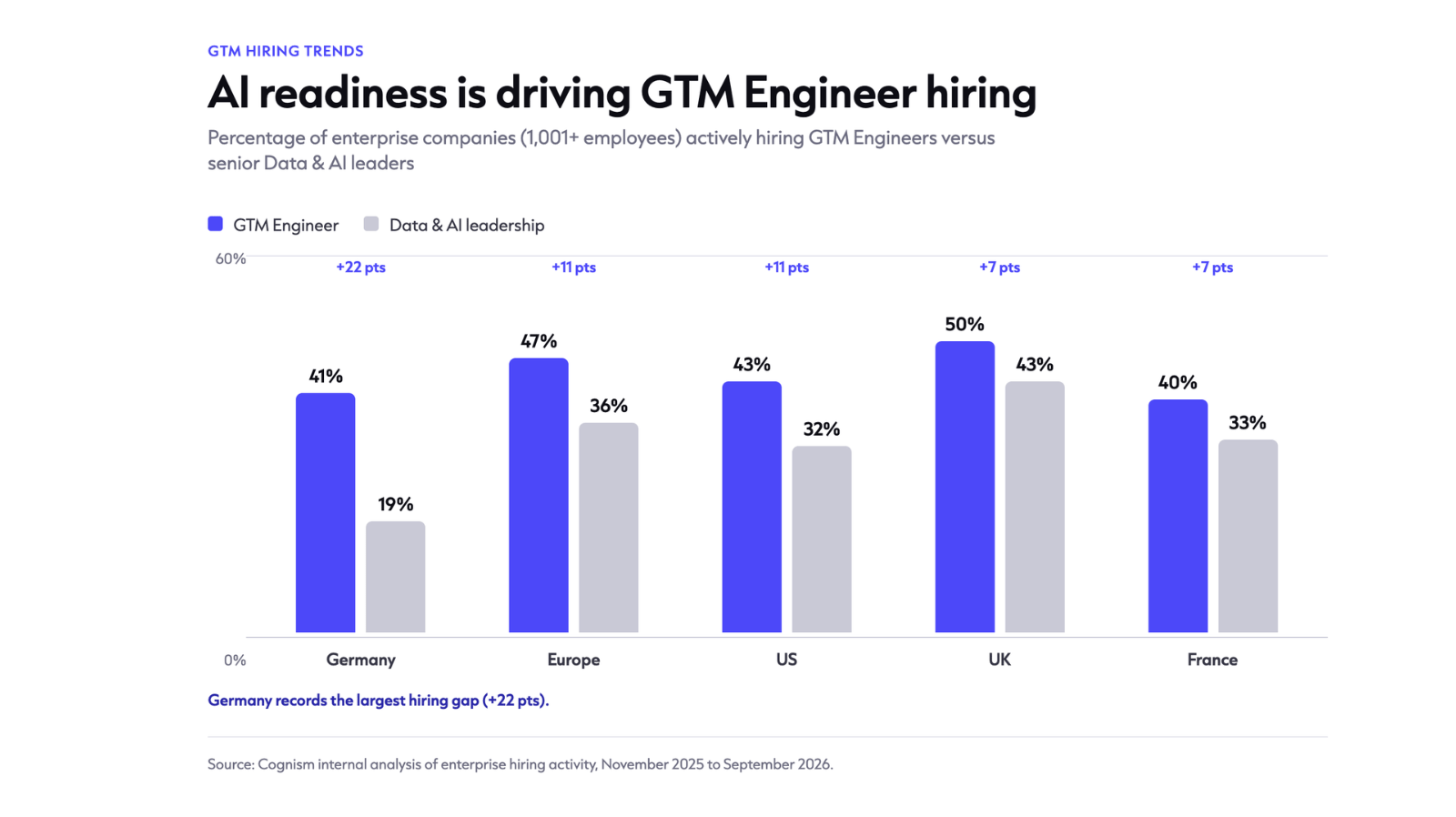
The same pattern shows up in the US (43% versus 32%), the UK (50% versus 43%), France (40% versus 33%), and Germany (41% versus 19%).
This helps explain why tools such as Cognism's MCP are emerging: an AI assistant is only as useful as the data it can access, and someone still has to make that data reachable in the first place.
The implications go beyond technology. As technical roles become a larger part of GTM teams, revenue leaders are rethinking how they build and scale their organisations.
As Dominic Allon, CEO at Cognism, puts it:
"When a revenue organisation starts hiring engineers, the CRO's job changes. You're no longer just scaling through people and managing a stack of SaaS tools; you're building a revenue system.
That brings data, operations and engineering much closer together and changes the capabilities you need around the leadership table. The next step for CROs is to stop viewing technical GTM roles as operational support and start treating them as essential infrastructure for AI-enabled growth."
The hiring patterns in Cognism's data reflect that shift. Companies aren't just investing in AI leadership. They're also investing in the technical capability needed to operationalise AI and support increasingly complex GTM systems.
The trend looks the same in every market
GTM Engineer hiring runs at almost exactly the same pace across all markets studied: between 39% and 43% of companies with the role have added someone in the past nine months, whether in Europe, the US, the UK, France, or Germany.
Sales Operations Analyst hiring, by contrast, swings from 9% in the UK to 17% in the US. GTM Engineer hiring holds steady within a four-point range across every market studied.
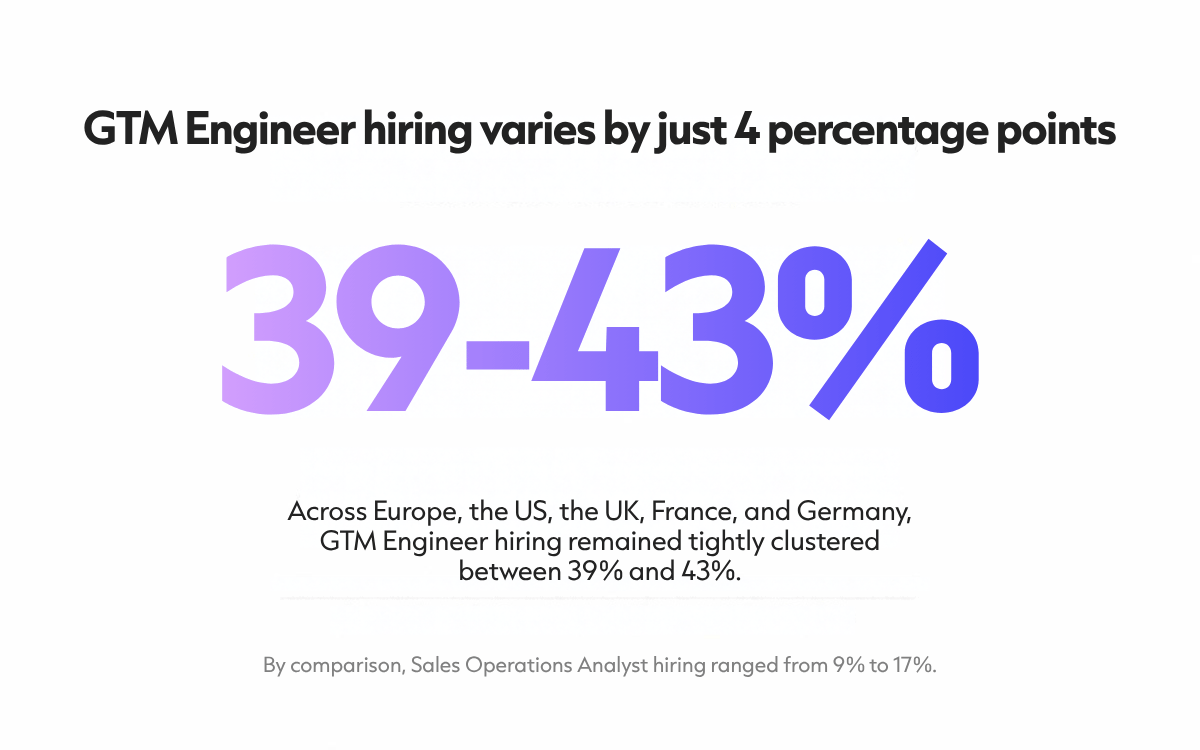
When a pattern is this consistent across markets with different laws, languages, and company profiles, it's usually structural rather than driven by a handful of companies.
It's also an unusual pattern by historical standards. New technology-adjacent roles typically emerge in startups first and travel upstream to larger organisations over several years.
GTM Engineer hiring doesn't follow that curve: enterprise organisations are adopting the role at a pace that matches, or in the UK's case, exceeds the wider market from the outset – 50% of UK enterprise organisations have added the role in the past nine months, which is the strongest enterprise figure of any market studied.
SDR hiring jumps at enterprise scale while GTM Engineer hiring holds steady
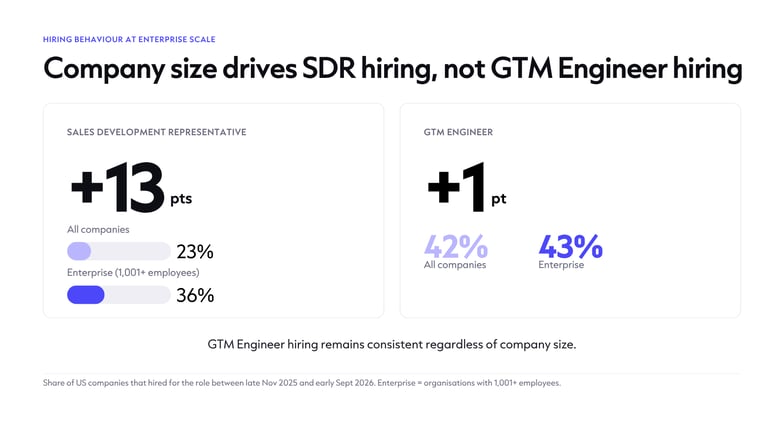
That consistency holds even at the top end of company size, which is where traditional sales roles start to diverge sharply. In the US, 36% of enterprise organisations recently hired a Sales Development Representative, against 23% of companies overall – a 13-percentage-point jump. GTM Engineer hiring stays flat by comparison: 43% among US enterprise organisations, against 42% across companies of every size.
How the role changes with company size
The role changes shape with scale. Smaller companies hire GTM Engineers to build; larger ones hire them to industrialise, govern and scale what's already running.
Independent research from recruitment firm GTM Engineer Search shows the same shift from a different angle. Its Shortlist newsletter compared 25 GTM engineering job postings and found the mandate itself shifts with company size.
At companies with fewer than 201 employees, postings cluster around building the motion – outbound, sequences, deliverability, experimentation. At companies with 201 or more employees, the language shifts to optimising an existing motion – quality controls, guardrails, executive cadence, documentation, production ownership. (This size cut comes from the Shortlist newsletter's own posting sample and uses a different threshold – 201+ employees – from the 1,001+ enterprise definition used elsewhere in this report.)
Bitsight, a 501- to 1,000-person company, shows this directly: its first-ever GTM engineering hire, announced in the same edition, was brought in to build automation, AI workflows, and system integrations that a smaller company would already have running.
Enterprise organisations hire a different version of the role: less building from scratch, more governing and scaling what's already running.
Cognism's MCP is built for exactly this person – a RevOps lead or GTM Engineer connecting AI assistants to the tools their team already relies on.
New sales tools and new GTM roles go together
Cognism looked at companies already using modern sales automation tools – Clay, Attio, and n8n, three platforms built to automate outbound sales and CRM workflows. Around one in 10 of these companies also employs someone in one of the emerging technical GTM roles Cognism tracked, showing that tool adoption and role adoption are clearly connected.
The relationship between tool adoption and technical hiring is not accidental. As Viktoria Ruubel, Chief Product, Data and Technology Officer at Cognism, explains:
"When a revenue organisation starts hiring engineers, the CRO's job changes. You're no longer just scaling through people and managing a stack of SaaS tools; you're building a revenue system. That brings data, operations and engineering much closer together and changes the capabilities you need around the leadership table. The next step for CROs is to treat that technical capability as core GTM infrastructure, not a support function."
Attio, the AI-powered CRM company, appeared on its own technology-adoption list, alongside Scalum and Qobra on the GTM Engineer side and Lucanet on the Revenue Intelligence side. The companies buying next-generation sales tools are, largely, the same companies creating new in-house roles to run them.
The hiring data shows the same tool-sprawl problem Cognism hears about directly from customers. Companies are already juggling multiple data providers and automation tools without a single workflow connecting them, and they're hiring people specifically to manage this fragmentation.
Cognism's MCP helps by bringing trusted Cognism data into the AI tools and workflows teams already use, reducing context switching and making data easier to access where work happens.
AI leadership hiring and GTM engineering hiring move together
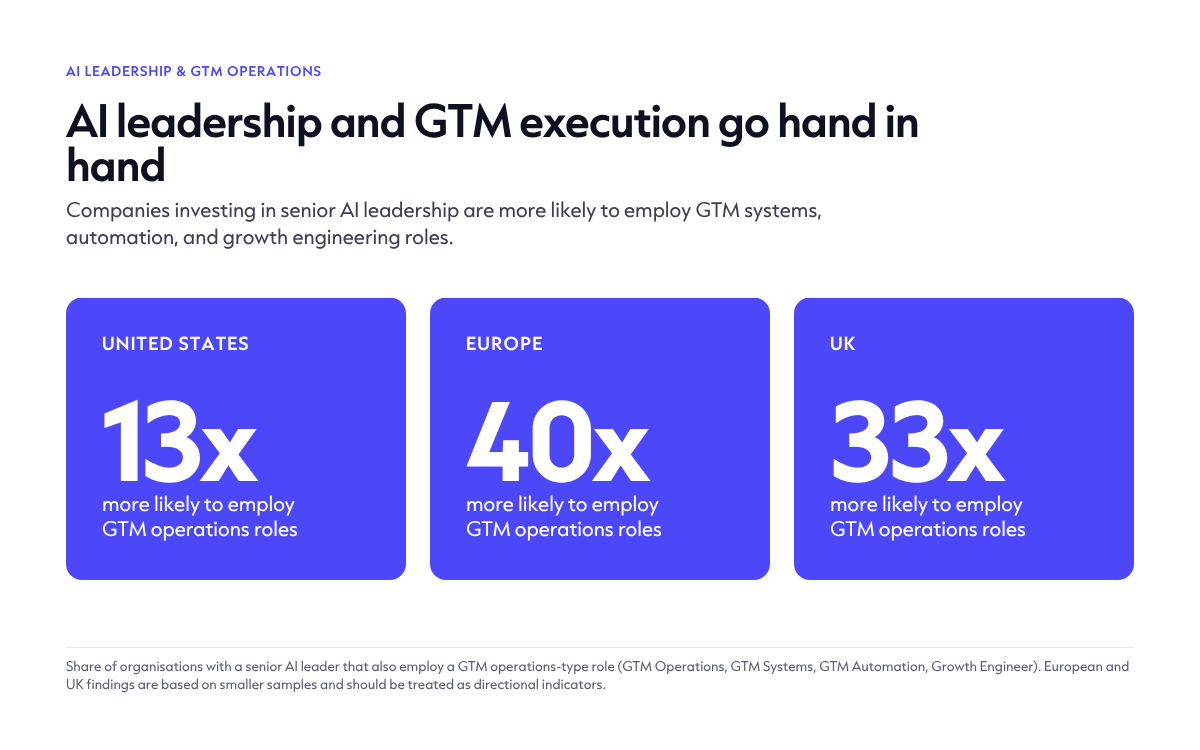
In the US, enterprise organisations with a senior AI leader are around 13 times more likely to also have someone in a GTM operations-type role than the wider market (6.3% versus 0.5%, on a base of 544 companies). That overlap shows up in enterprise organisations such as Databricks, Google, and Snowflake, which all combine AI leadership with GTM systems roles. Meanwhile, JPMorgan, Microsoft, and Cisco pair AI leadership with Growth Engineer roles, and Amazon and Salesforce pair it with GTM Automation roles.
The multiplier is even larger in Europe (40x) and the UK (33x), though on far smaller bases (8 of 272 companies, and 2 of 40, respectively). In the UK, EY and Deloitte show the same overlap.
This data shows that AI leadership and technical GTM hiring emerge as part of the same organisational trend. This is the same pattern of simultaneous hiring seen above. Companies aren't simply hiring one then the other, but are building both sides of the same team at once. Both roles ultimately address the challenge of making a company's data trustworthy enough for AI to work with.
As Viktoria highlights:
 This data shows that AI leadership and technical GTM hiring emerge as part of the same organisational trend. This is the same pattern of simultaneous hiring seen above. Companies aren't simply hiring one then the other, but are building both sides of the same team at once. Both roles ultimately address the challenge of making a company's data trustworthy enough for AI to work with.
As Viktoria highlights:
"The shift is from people moving between software interfaces to AI moving data between systems. That makes trusted, connected data much more important, because AI can only make good decisions and take useful actions when the information it is working with is accurate and current. The better the data foundation, the more value companies can get from AI."
What the wider job market shows
Independent research points in the same direction as Cognism's own data. French recruitment firm Talma tracked GTM Engineer job postings, which roughly doubled over the past year. In France, salaries range from around €60,000 for newer hires to more than €100,000 for experienced practitioners, underlining how valuable technical roles that connect data, systems, and revenue workflows have become.
Further job-market data backs this up on a larger scale. According to LinkedIn, US job listings for titles including Growth Engineer, Go-to-Market Engineer, Solutions Architect, and Operations Engineer grew 54% between 2023 and 2025, with more than 400,000 new roles posted (Chaddah, 2026). This is a different measure from Cognism's own hiring-rate figures, as LinkedIn is counting job postings – not confirmed hires – but it points in the same direction. Demand for technical GTM talent is growing at scale, not just within a select number of AI-native or headline-grabbing companies.
Independent job-board tracking shows this scale holding. Cargo's GTM Engineer job tracker counted 1,056 open GTM Engineer postings across 1,228 companies as of 7 September 2026, with a median US salary of $159,000. A stricter, hand-qualified count from GTME Pulse's newsletter (which excludes postings where the title is a relabelled sales or marketing role with no real systems remit) put the qualified opportunity set at 206 active listings as of 14 September 2026.
AI Forward Deployed Engineer
Talma's research also flagged a closely related, newer title: the AI Forward Deployed Engineer, a role that embeds an engineer directly inside a customer's environment to take an AI deployment from pilot to production.
The Forward Deployed Engineer title itself predates the AI wave. It traces back to Palantir, which used it for embedding engineers with clients on complex deployment work. It has since been adopted by OpenAI, Google, and Salesforce as they push AI products from proof of concept into live customer use.
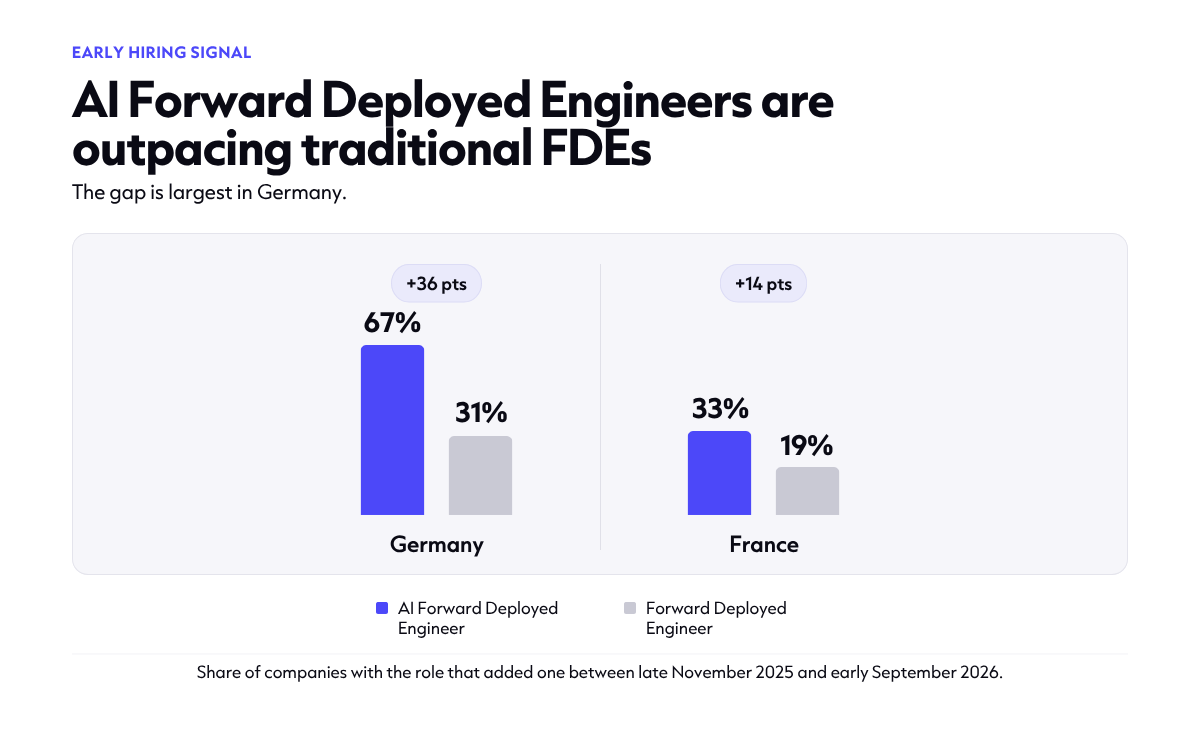
Cognism's own data backs up the idea that the AI-specific version of this role is the faster-growing one, on a smaller base. In Germany, two-thirds of companies with an AI Forward Deployed Engineer added one in the past nine months, against 31% for the broader, longer-established Forward Deployed Engineer title.
France shows a smaller but similar gap: 33% for the AI-specific title against 19% for the broader one. The AI-flavoured version of the role is still rare, so we can look at this as an early signal rather than an established trend, but it's an example of a job splitting into two, with the AI half moving faster.
Two further findings from GTM Engineer Search's Shortlist newsletter complete the picture. Of 29 GTM engineering roles disclosing compensation in one edition, 25 were individual-contributor positions, not management roles.
This matches Cognism's own data: companies are hiring for the role at a high rate, but with low headcount per company – solo, founding hires rather than entire teams. Job titles in this space are already splintering into specialisms, from 'Director of GTM System and Applied AI' to 'GTM AI Revenue Enablement, Senior Manager' – a sign that a genuinely new job family is still working out its own shape.
The regional snapshot
The overall pattern holds across every market Cognism studied, but each one has its own details that are worth a closer look. Here's how GTM Engineer hiring, and the roles growing alongside it, break down region by region.
Europe
GTM Engineer hiring runs at 39% overall, climbing to 47% among enterprise organisations. Booking.com and Finnair both appear among enterprise organisations that have made recent Revenue Intelligence hires.
United States
The US shows the sharpest enterprise skew in classic sales hiring: Sales Development Representative hiring jumps 13 percentage points at enterprise organisations, while GTM Engineer hiring stays essentially flat. Enterprise names with a strong GTM Operations presence include Google, Snowflake, and LinkedIn.
United Kingdom
The UK has the strongest enterprise-tier GTM Engineer hiring of any market studied, at 50%, with Deloitte, EY, Unilever, Sage Group, and Pearson all adding GTM Operations hires in the last nine months. Enterprise organisations with senior data and AI leaders include Shell, Lloyds Banking Group, NHS England, and Virgin Media O2.
France
GTM Engineer hiring in France, at 40%, tracks closely with the wider European trend, backed up by Talma's finding that postings for the role have roughly doubled over the past year. FinOps Engineer hiring is also notably strong, at 35%, with L'Oréal, AXA Group Operations, Doctolib, and Carrefour among recent adopters.
Germany
In Germany, 41% of companies studied added a GTM Engineer in the past nine months, closely matching the broader trend seen across other markets. However, FinOps Engineer hiring has stalled entirely: there have been no recent hires among the companies studied, including at Mercedes-Benz and Allianz Technology, despite a healthy existing population of FinOps roles. This contrasts with the momentum seen in France for the same title.
Why this matters for AI adoption
Companies are not waiting for AI agents to sort out their GTM data for them. They are hiring people, right now, to build the plumbing an agent will eventually need: clean CRM records, connected outreach tools, and data infrastructure built to automate against.
An AI assistant can sound fluent and still be useless if it can't reach data it can trust. Building that foundation – clean, connected, compliant data – is the day-to-day job of a GTM Engineer and similar roles. Companies are building this foundation alongside their AI leadership hiring, reinforcing the importance of getting the data and systems right at the same time as embedding AI into the workflow.
Revenue teams are turning technical
Across five markets and other independent sources, we're observing the same pattern. Companies are building the technical backbone of their GTM motion at the same time as they're appointing people to run AI strategy on top of it – different people, not fewer people, doing work that's part of the same shift. The roles are new, the titles are still settling, and the job changes shape as companies grow, but the underlying behaviour is consistent: someone has to make a company's data reachable and trustworthy before an AI assistant can do anything useful with it.
Cognism's MCP is built for that person. It brings verified, EU-compliant B2B data directly into the AI assistants your team already uses, so the systems are in place and the AI has something trustworthy to work with. [Find out more about the Cognism MCP.]

Sources
- Rhew, J. (2026a). Edition 005: GTM Engineer Jobs. The Shortlist. https://shortlistgtm.substack.com/p/edition-005-gtm-engineer-jobs
- Rhew, J. (2026b). Edition 007: GTM Engineer Jobs. The Shortlist. https://substack.com/home/post/p-212273748
- Talma. (2026). AI Forward Deployed Engineer, FinOps, GTM Engineer: les 5 métiers tech qui redessinent les organigrammes en 2026. https://www.talma.ai/ressources/ai-forward-deployed-engineer-finops-gtm-engineer-les-5-metiers-tech-qui-redessinent-les-organigrammes-en-2026
- Uplers. (2025). The Forward Deployed Engineer (FDE): A Guide. https://www.uplers.com/article/forward-deployed-engineer-guide/
- Chaddah, K. (2026). "When is an engineer not an engineer?" Financial Times, 1 September 2026.
- Cargo. (2026). GTM engineer jobs. https://www.getcargo.ai/jobs
- GTME Pulse. (2026). GTM engineer jobs: Pay, scope, and live openings. https://gtmepulse.com/jobs/
Methodology
Cognism analysed hiring activity across its own B2B contact and company database between 24 August and 3 September 2026.
-
- Markets covered: Europe (all countries with a European HQ), the United States, the United Kingdom (tracked both as its own market and as a subset of the wider Europe figures), France, and Germany.
- Company location basis: every cut uses a company's head office (HQ) location, not the location of any individual office or contact.
- Enterprise definition: "enterprise organisations" means companies with 1,001 or more employees, based on Cognism's headcount field. The enterprise company universe used as the denominator for these cuts totals 48,707 companies in Europe, 35,320 in the US, and 7,237 in the UK.
- The nine-month window: all "recent hire" figures use Cognism's Job Changes filter, set to a rolling nine-month window.
- Because pulls were run on different days across the collection period, the exact start date of that window shifts by a few days from cut to cut, but every cut covers late November 2025 to early September 2026.
- Definition of a "recent hire": a contact whose current role matches the target job title and whose Job Changes record shows they moved into it within that nine-month window. A company counts toward a "% of companies hiring" figure if at least one contact matching the title moved into it within the window.
- How job titles were grouped: each role in this report (for example, GTM Engineer, GTM Operations, Revenue Intelligence, FinOps Engineer) was pulled as a single keyword search with exact-match matching switched off, so that close variants of a title are captured under one role family. Every population was then manually reviewed and cleaned: "Automation Specialist" was excluded entirely from the core comparison due to persistent title contamination unrelated to GTM, "Growth Engineer" in France was excluded from clean company counts after review showed most matches were front-end or software development roles rather than GTM roles, and "Revenue Intelligence" figures exclude contacts matched to "Ministry Of Finance," a government customs entity rather than a company.
- Scale of the underlying pulls: in total, this research ran several hundred individual filtered queries against Cognism's platform, covering combined populations of more than 134,000 contact records and 32,000 company records. This total reflects overlapping cuts. For example, enterprise-tier populations sit inside the wider no-floor populations, and UK figures sit inside the wider Europe figures, so it should be read as total query volume analysed rather than a single deduplicated headcount.
- External sources: independent research from Talma and GTM Engineer Search's Shortlist newsletter was used to corroborate, not replace, Cognism's own data. Where a finding relies on an external source, it's linked to in the text and listed in full at the end of this report.