STUDY
Top LinkedIn ad creative performers: [761 Ads analysed]
From analysing 761 creatives across all our campaigns in 2025 (each with at least 1,000 impressions), a clear pattern emerged: LinkedIn creatives fall into four predictable ad roles by funnel stage, and each archetype excels at a different type of “quality signal”: click-through rate (CTR), engagement rate (ER), dwell time (Dwell), or conversion rate (CVR).
Start reading
Data methodology
We analysed 761 LinkedIn ad creatives run across our campaigns during 2025. To ensure statistical reliability, we included only creatives with ≥1,000 impressions and evaluated performance using four creative “quality signals”: click-through rate (CTR), engagement rate (ER), dwell time (Dwell), and conversion rate (CVR).
To reduce metric distortion, thought-leader (boosted) ads were excluded from CTR analysis, as “see more” expansions can inflate click behaviour. Engagement benchmarks were therefore calculated separately for thought-leader vs non-thought-leader ads.
For each metric, we summarised results using distribution-based benchmarks (median, top quartile, top 10%, and best observed performers). Finally, we classified creatives into performance archetypes by mapping each ad’s relative strength across the four signals, producing the 2026 creative archetype model and identifying rare “hybrid” and “super-hybrid” creatives that over-index across multiple metrics.
The four LinkedIn creative quality signals that actually matter
As we mentioned, four creative quality signals matter for LinkedIn ads:
- CTR = as top-of-funnel efficiency.
- ER = the impact signal.
- Dwell = a creative diagnostic signal.
- CVR = the intent signal.
👉 Learn more about how we run our ad accounts in the DG playbook module.
Now, let’s go through each quality signal, one by one.
CTR as top-of-funnel efficiency
CTR answers a crucial creative question: “Did this ad cause an action?” Social platforms like LinkedIn aim to keep users in-platform, and user behaviour typically implies that this is preferable too. To cause a click off, the ad must have piqued interest.
To avoid misleading conclusions, thought leader ads (boosted ads) were removed as they can inflate CTR with ‘see more’ text expansions.
Across our dataset:
- Median CTR: 0.47%
- Top quartile: ≥0.59%
- Top 10%: ≥0.74%
- Best performers: 1.46%+
Creatives that reliably hit >0.74% CTR used:
- Punchy, curiosity-led headlines.
- Lists and numbers.
- High contrast visuals.
- Clean framing (“7 mistakes”, “Why X is broken”).
CTR doesn’t always mean intent. However, it reveals everything about the quality of the hook used in your ad.
Engagement rate as an impact measure
Engagement rate measures a deeper reaction, including likes, comments, shares, and those who expanded the content to read more.
Across our dataset for non-thought leader ads:
- Median ER: 0.90%
- Top quartile: ≥1.22%
- Top 10%: ≥1.81%
- Best performers: 3.98%+
Across our dataset for thought-leader ads:
- Median ER: 1.72%
- Top quartile: ≥3.16%
- Top 10%: ≥6.21%
- Best performers: 9.42%+
Engagement-heavy creatives tend to be:
- Opinion-led.
- With a human point of view.
- Emotion or contrarian takes.
- Infographic-style posts.
- High-value single statics from a subject matter expert.
Engagement is the clearest indicator of content resonance.
Dwell time as a creative diagnostic signal
Dwell time answers: Did they stick around? Attention spans are short these days, especially for unengaging ads; your users will simply scroll past unless your ad piques their interest from the start.
Across the dataset:
- Median dwell: 4.21s.
- Top quartile: ≥5.18s.
- Top 10%: ≥6.81s.
- Best performers: +13.81s.
High dwell creatives tend to be:
- Talking head videos.
- Insight-rich carousels
- Analyst-style statics.
- Strong narratives.
- Content with depth.
- Multiple “micro-insights” in one frame.
If CTR is the first handshake, dwell time is the actual conversation.
CVR is the ultimate intent signal
CVR measures pure demand capture. We expect to convert across our remarketing campaigns. These audiences have been nurtured over time, and they’re therefore most ready for the next step.
Across the dataset:
- Median CVR: 3.03%
- Top quartile: ≥8.33%
- Best performers: 53.7% *result taken from ads with at least 20 conversions
Only ~25% of creatives convert at all. High-conversion creatives tend to be:
- Lead magnets.
- Pricing pages.
- Comparison content.
- Pain-point statics.
- Retargeting assets.
CVR is where revenue happens, but it’s not where creative “quality” happens. It’s where audience intent and offer clarity meet.
An overview of what the full dataset reveals (all 761 creatives)
Here’s what stands out across the entire dataset of all our 761 audited LinkedIn ads in 2025.
- CTR clusters tightly, but the top end is sharp: Most creatives fall between 0.40-0.60% CTR (normal band). And then there’s a steep spike above 1.46% where the strongest hooks sit.
- Engagement rate spreads wider: While CTR compresses, ER spreads, and the top 10% begin at 1.81% for non-thought leader ads. Top-tier equals ~4%. Engagement rate differentiates narrative power, not just hook strength.
- Dwell time reveals who is actually engaged: A good dwell time is ~5 seconds (not too long, is it?). These creatives are your educational engines.
- CVR is extremely bottom-heavy: Most creatives do not convert at all. This reinforces what every marketer eventually learns - conversions come from targeting, offer, and timing, not creative charm. LinkedIn is primarily a demand creation, and not a capture channel.
The rebuilt creative archetype model
Based on the full dataset and all four signals, your creatives can be categorised into six distinct archetypes.
This is the most accurate version of LinkedIn’s creative behaviour patterns.
1. Reach engines
Characteristics: Low CTR, low ER, low dwell, low CVR. High impressions.
Examples include:
- Brand bursts.
- Light message statics.
- High-frequency TOFU ads.
These creatives achieve breadth but not depth. Think digital billboards.
Role: Awareness shaping.
2. Click magnets
Characteristics: High CTR, low dwell, low CVR.
These creatives excel at stopping the scroll but not at deepening attention.
Patterns:
- Curiosity-led hooks.
- Problem-first headlines.
- High contrast visuals.
Role: Attention generation.
3. Efficiency flyers (deep engagement ads)
Characteristics: High ER, and high dwell
These are the educational powerhouses.
They deliver:
- Deep content consumption.
- Scroll depth.
- High interaction.
- High resonance.
But little conversion.
Role: Mid-funnel value creation.
4. Intent converters
Characteristics: Low CTR, moderate dwell, high CVR.
These ads convert because:
- Audience = high intent.
- Offer = clear.
- CTA = direct.
- Creative = simple.
They don’t need engagement. They just need clarity.
Role: Driving conversion.
5. Hybrid creatives
Characteristics: These creatives sit at the extreme top end of the dataset.
They:
- Capture.
- Engage.
- Hold.
- Educate.
But rarely convert, they’re educational, not transactional.
Role: Brand authority and deep education.
6. Super-hybrid creatives
Characteristics: These ads excel across multiple creative-quality signals.
Examples include assets that combine:
- CTR and ER.
- ER and dwell.
- CTR and dwell.
- Dwell and CVR.
Role: Multi-KPI performance.
Real creative examples (high-performers across our dataset)
These examples are taken directly from our data. We’ve mapped them across the six archetypes we’ve explored and outlined all the metrics that fit into each category. Think of this as your own scrapbook and reference for when you’re briefing ad creatives for your campaigns.
Reach engine example #1
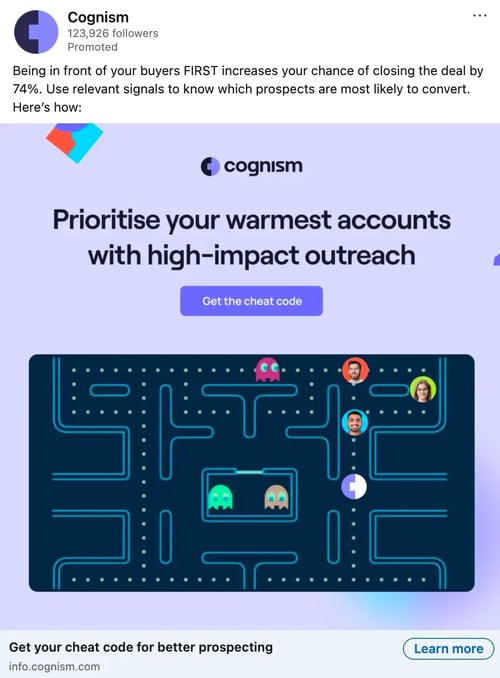
Performance:
- Impressions: 76,411
- CTR: 0.28%
- Engagement Rate: 0.28%
- Dwell: 3.62s
- CVR: 2.82%
Why it works:
- Perfect for mid-funnel education.
- Clear hooks to communicate the benefit across.
- Eye-catching graphics.
Click magnet example #2
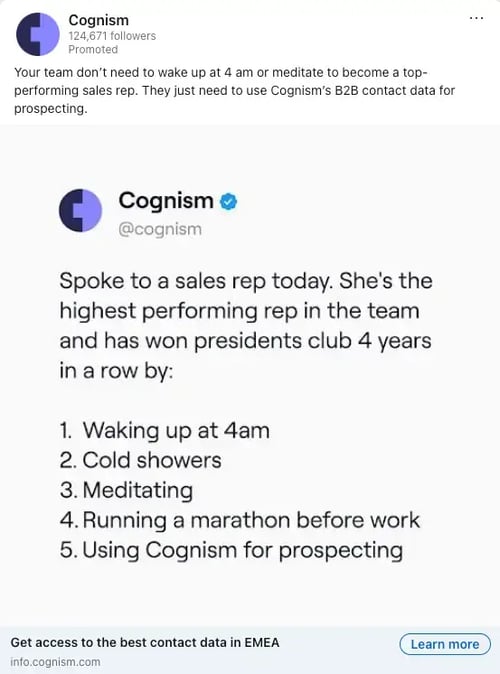
Performance:
- Impressions: 1,606
- CTR: 1.93%
- Engagement Rate: 1.93%
- Dwell Time: 5.14s
- CVR: 0%
Why it works:
- Uses humour to communicate a point across.
- Desirable outcomes for SDRs: achieving the President's Club status.
- Communicates the ease of just using Cognism instead.
Efficiency flyer example #3
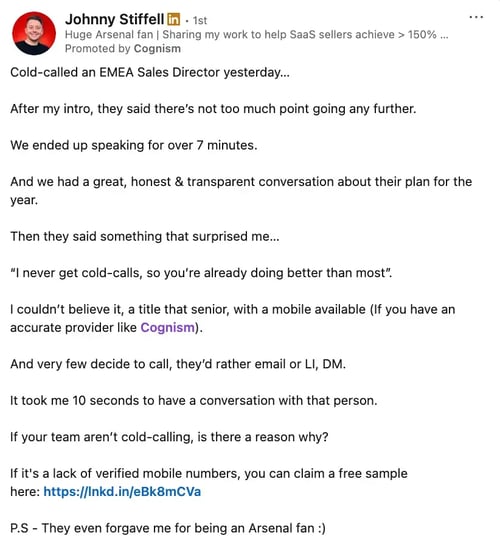
Performance:
- Impressions: 726,403
- CTR: 9.14%
- Engagement Rate: 9.16%
- Dwell Time: 14.66s
- CVR: 0.27%
Why it works:
- Insight-dense static with enough value to earn attention.
- Strong clarity and relevance for sales personas.
- Strong storytelling from a user perspective.
Intent converters example #4
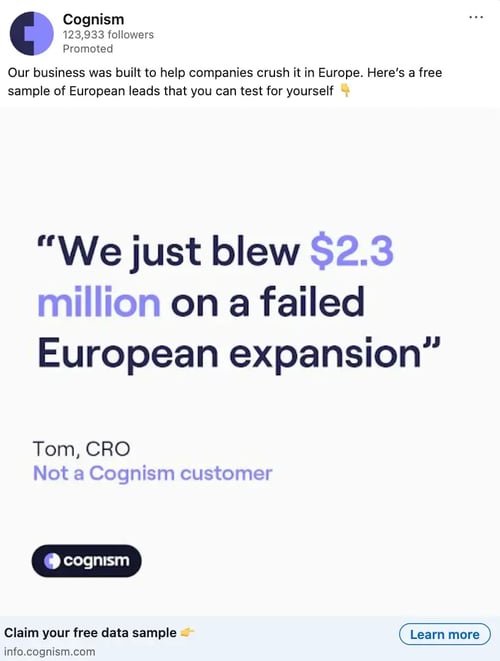
Performance:
- Impressions: 239,971
- CTR: 0.64%
- Engagement Rate: 1.47%
- Dwell Time: 4.10s
- CVR: 5.25%
Why it works:
- Insight-dense static with enough value to earn attention.
- Strong clarity and relevance for sales personas.
- Strong storytelling from a user perspective.
Hybrid creative example #5
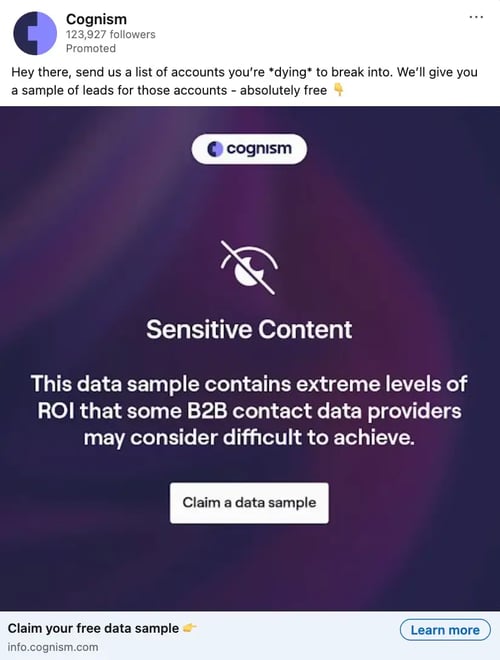
Performance:
- Impressions: 291,629
- CTR: 0.74%
- Engagement Rate: 1.42%
- Dwell Time: 4.39s
- CVR: 6.05%
Why it works:
- Strong hook to grab the user's attention.
- Interesting graphic to provoke interest.
- It doesn’t look like a typical ad.
Super-hybrid example #6
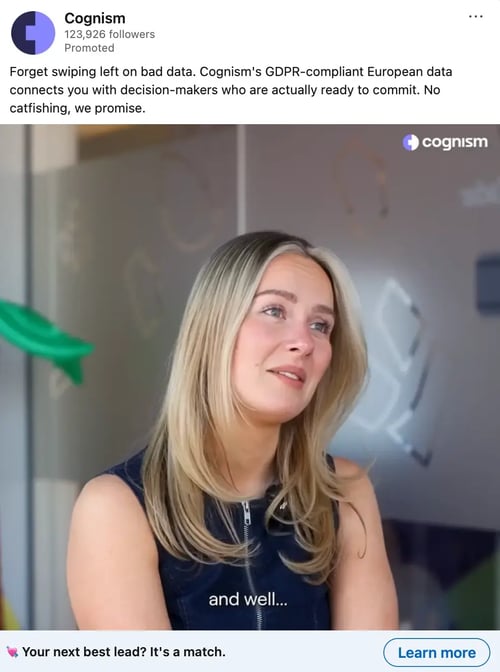
Performance:
- Impressions: 1,971
- CTR: 1.07%
- Engagement Rate: 5.58%
- Dwell: 6.87s
- CVR: 33.33%
Why it works:
- Interesting concept and video format to stop the scroll.
- Emotional framing to hook attention.
- Product tour that teases clear value tied to the hook.
The 2026 LinkedIn ad creative strategy playbook
Here’s what this means for your creative strategy moving forward.
If you want to increase CTR (hook quality):
Do this:
- Use curiosity-led hooks.
- Use measurable numbers.
- Use contrast.
- Use benefit-first headlines.
Avoid:
- Dense statics.
- Multi-insight content.
- Long narratives.
CTR is not about depth. It’s about the first 1–2 seconds.
If you want to increase engagement rate:
Do this:
- Use POV or opinion.
- Use emotion.
- Use industry tension.
- Use social currency.
Avoid:
- Neutral tone.
- Data without narrative.
Engagement happens when posts feel worth reacting to.
If you want to increase dwell time:
Do this:
- Create video content to stop the scroll.
- Build value-dense statics.
- Use “information blocks”.
- Use insights, stats, benchmarks.
- Use carousels with 4-10 panels.
- Use mixed narrative and data.
Avoid:
- Minimalist statics.
- Low-information content.
Dwell time is the best indicator of perceived value.
If you want to increase conversions:
Do this:
- Use simple statics.
- Focus on one pain point.
- Add one CTA.
- Add trust signals.
- Use BOFU audiences.
- Push demo/trial/pricing.
Avoid:
- Trying to be clever.
- Trying to be educational.
Conversion happens when offer meets intent.
How to build a full creative portfolio
A winning creative portfolio needs a mix of:
- Reach engines to scale visibility.
- Click magnets to build mid-funnel demand.
- Efficiency flyers to educate.
- Intent converters to capture pipeline.
- Hybrid creatives to deliver multi-metric performance.
- Experiments to keep improving.
Final word on LinkedIn ad creatives
Creative performance on LinkedIn is not random. It’s structured, and our dataset proves it.
Most creatives live inside predictable performance bands. A minority breakout with strong hooks, narratives, or offers. An elite, tiny fraction becomes super-hybrids that win across multiple signals.
This report gives you a blueprint to:
- Build better hooks.
- Create deeper engagement.
- Drive longer attention.
- Capture more intent.