
PILLAR REPORT
The state of cold calling in 2026
Welcome to Cognism’s analysis of 2025 cold calling data, designed to inform how teams should approach cold calling in 2026.
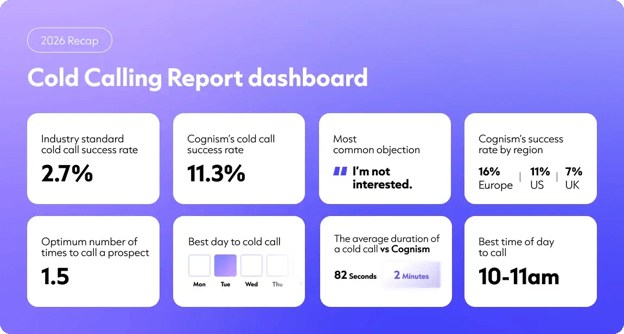
The latest data shows cold calling is far from obsolete. In fact, it’s making a comeback. After a challenging 2025, when industry success rates dropped to 2.3%, the average has now climbed to 2.7%. Meanwhile, Cognism's sales team are converting at 11.3% – more than four times the benchmark. With just 1.55 calls now needed on average to reach a prospect, outbound is becoming more precise, efficient and data-driven.
In this report, we break down: the best days and times to make calls, how many attempts it really takes to connect, which objections are becoming more common, and why Europe, the US, and the UK are seeing different outbound patterns. Consider it your practical guide, packed with real data, real examples, and actionable insights to help your team improve performance and drive better results.
Start reading
Being a salesperson today means showing up consistently, reading the situation, and adapting your approach in real time. But as buyer behaviour changes, many traditional sales tactics are struggling to keep up.
That’s why we’ve come back with a 2026 edition of our cold calling report in collaboration with WHAM. This time with a sharper, more data-led perspective.
In this year’s report, we break down:
- How 2025’s predictions played out
- What worked – and didn’t – on the phones
- How sales teams can improve performance throughout 2026
Because in sales, performance is everything. And the best teams? They learn, adapt, and improve with every interaction.
In 2025, we kicked off with some strong predictions about cold calling trends. We said reps were under pressure, that call effectiveness was declining, and that success would depend on smarter, more targeted approaches.
The industry average cold call success rate stood at 2.3%, down from 4.82% in 2024.
But in 2026, the picture has shifted.
-
We’re now seeing a clear improvement in results
-
Average call durations have increased
- Connection-to-meeting ratios are trending upward
And for Cognism? Performance has stepped up significantly.
This year’s data tells a very different story, which is worth analysing in detail.
Cold calling success rates in 2026
When it comes to cold calling, there’s no denying that trends and tactics are starting to shift.
After a tough 2025 where cold calling took a hit, these stats show signs of recovery.
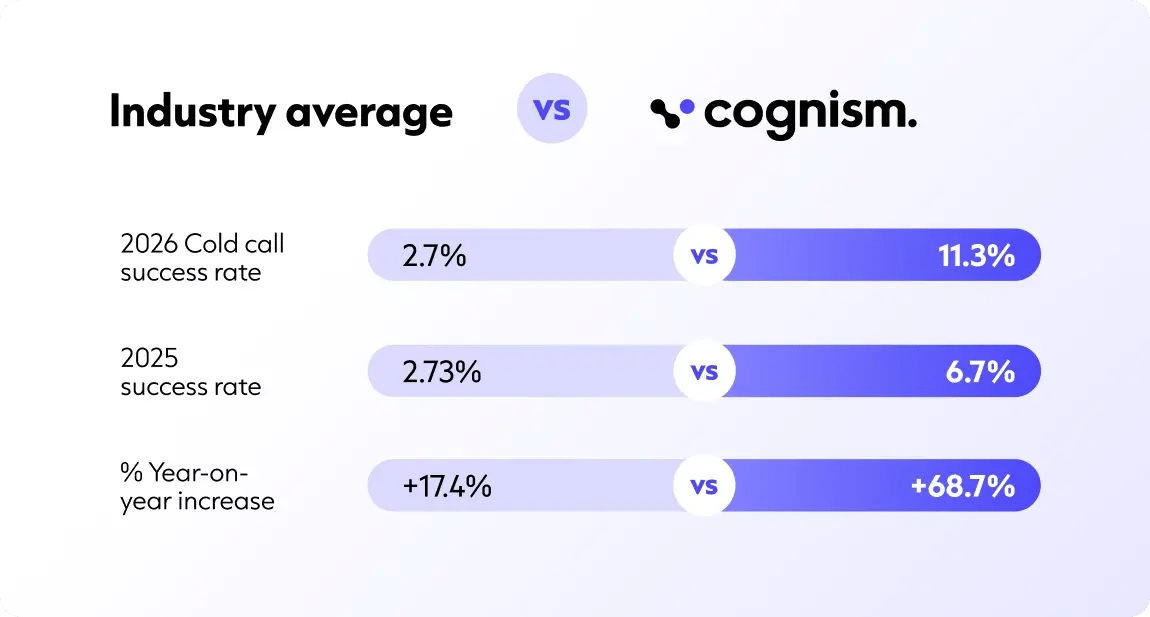
The industry average cold calling success rate has climbed to 2.7%, up from 2.3% last year. It’s not a profound change, but it shows the tides have turned.
Jack Frimston (WHAM) says:
“The best sales teams are learning to adapt. They know the challenges that come with data and technology, so rather than spending hours wasted speaking to switchboards, they're thinking outside of the box, leading with problems and adapting to the current world of saturation.”
And at Cognism, we’re not just playing catch-up. Our team carries a cold call success rate of 11.3%, which is over four times higher than the industry average – and a significant jump from our 6.7% performance in the previous report.
So, how have we managed such a strong year?
- We’ve doubled down on calling the right accounts at the right time
- We've prioritised quality conversations over quantity
- And we’ve built a playbook around strategic calling, using intent, tech and timing to get results
Call Attempts: How many calls does it take to get an answer?
Some conversations happen instantly. Others take persistence and multiple attempts to get through. Cold calling is no different.
So, how many call attempts does it take to reach a prospect in 2026?
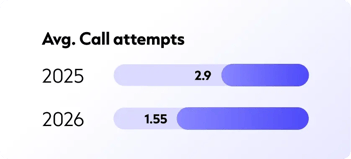
The data shows that most prospects who are likely to answer an unfamiliar number do so on the very first call, with 1.55 calls now the average needed to reach a prospect.
Compare that to the 2025 data, where it took an average of 2.9 call attempts to get through.
That’s a huge improvement in efficiency, and a clear sign that teams across the board are adapting their tactics.
Junis Seger, Head of Sales @ calltime, says:
“With inboxes more saturated than ever, the phone has quietly become the most dependable channel again. Pair that shift with more intentional dialling and sharper timing, and it’s no surprise call attempts are dropping while results improve.”
The dials are smarter, the timing’s tighter, and reps are focusing their energy where it counts. The result? Fewer wasted efforts. More one-on-one conversations with the gatekeeper.
Nia Secker, SDR Manager @ MySalesCoach, says:
“There are a few surprising reasons why it’s actually becoming easier to connect on a cold call. Spam filters and call screening tools are doing a great job of blocking nuisance callers – which means sales reps who call with a genuine purpose are now getting through more often.People are also spending more time on social media and email, so their phones aren’t ringing off the hook like they used to. That makes a thoughtful, well-timed call stand out even more.
And finally, calls themselves are becoming more targeted. With the help of AI, we’re reaching the right prospects at the right time – so there’s less “spray and pray” and more intentional, relevant outreach.”
Best days to pick up the phone
Every good manager knows when to make their move. And in cold calling, timing is everything.
Looking at the latest data, Thursday remained the standout day to get through to prospects. However, Wednesday, previously the second-best day, was overtaken by Tuesday this year, which saw a noticeable bump in connect rates.
Friday still trails behind the rest of the week, but don’t rule it out entirely. With fewer reps making calls, it can be the perfect moment to break through.
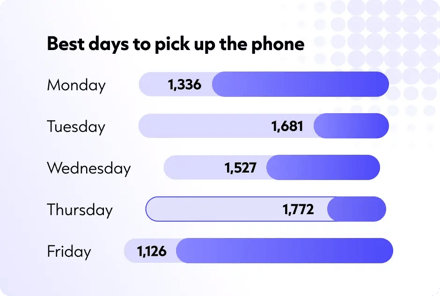
This shift in weekday performance suggests that sales teams are adjusting their strategies, avoiding saturated time slots and focusing on opportunities where they can stand out.
And while Monday continues to sit around the middle in terms of cold calling performance, it remains a solid option for building early momentum at the start of the week.
Ultimately, it comes down to what works best for your team and your audience.
Jack (WHAM) adds:
“I honestly think when it comes to best performing days we overthink it. So many reps are waiting for the right moment to call when actually the best time to call is now. I know more people have work from home days so I'm not sure if that plays into it. If you're not in the office, you're more likely to pick up the phone in case it's one your colleagues.”
Best time of day to call
Timing is critical in cold calling. Reach out too early, and prospects aren’t ready. Too late, and you’ve missed the window. Success often comes down to engaging at the right moment.
So when should SDRs kick off their calls to maximise chances of making contact?
According to the WHAM data, the most effective window is between 10am and 11am. This is when reps consistently have the longest, most meaningful conversations, indicating peak prospect engagement.
That said, it’s not the only strong window. The 2pm to 3pm slot also delivers solid connection rates and call durations, making it another reliable time to reach prospects after lunch.
In contrast, early mornings and late afternoons (before 9am and after 4pm) show a clear drop-off in performance. Lunchtime (12pm–1pm) also sees lower engagement, as prospects are typically unavailable or distracted.
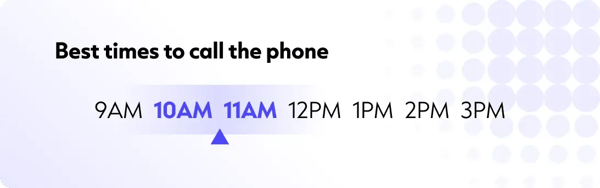
💡 Remember: Regional tactics matter too. While 10am might be golden in London, it won’t work when calling Sydney or San Francisco. Sales teams need to adjust their pressing based on time zones.
Bryan Mulry, sales coaching extraordinaire, says:
“10am tends to work best because people are properly settled into “work mode” by then. It’s far enough away from all the usual distractions: getting kids to school, grabbing coffee, etc. Between 10 and 11am, you can be confident a "professional" is working and at their desk.
By 11–12, people start heading into calls or lunch. Same thing later in the day. 2–3pm can also work well, but outside of that, you’re competing with people finishing up for school runs or wrapping their day.
In short: 10–11am and 2–3pm are the sweet spots because people are actually working and mentally “in it” rather than juggling personal admin.
Cold calling veteran & transformational speaker, Niraj Kapur, adds:
“I have most success calling 2–3pm. People spend the mornings on Zoom/Teams/Google Meet. Lunchtime they’re on their phone. They’re looking to speak to a human voice at 2pm. I have tried first thing, I just annoyed people, so I stopped. It also shows the importance of testing.”
Cold call duration
Call duration is a strong indicator of engagement. The longer you keep a prospect on the phone, the more opportunity you have to build interest and move the conversation forward.
In 2026, the average cold call lasts 82 seconds, according to WHAM data. That’s slightly down from 93 seconds in 2025, suggesting that reps are being more focused and getting to the point faster, or that prospects are quicker to disengage.
Cognism SDRs, however, average two minutes per call, 38 seconds longer than the industry benchmark.
More on Cognism’s performance below.
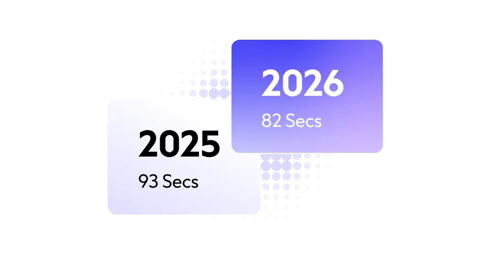
It could also indicate that with tighter lists and better targeting, sales teams are skipping the warm-up and getting straight to the point.
But context is key. In cold calling, quality always beats quantity. Whether a conversation lasts 60 seconds or 3 minutes, it’s what you say and how relevant it is that makes the difference.
And long-time SDR leader, Chris Ritson, says:
“Shorter call times don’t always mean less impact – it’s a reflection of sharper targeting and faster pattern recognition from reps. The best SDRs are getting to the point quicker, qualifying faster, and respecting the prospect’s time without losing depth.My internal data shows a 14% YoY lift in meeting rates even as average call time shortened.
It’s a natural evolution, quality conversations, just delivered at higher speed.”
Sian Taylor, Sales Manager at Klaviyo, adds:
“For the majority of managers in my network, cold calling is still a huge part of outbound success and a big focus of coaching efforts. Couple a deep understanding of your prospect with a concise, problem-centric led opener & pitch and reps are already having snappier more effective conversations with prospects.
When you add in the layer of all of the tools out there for finding prospects that might have better connect rates, auto diallers & AI coaching, it's unsurprising to me that calls are getting shorter.”
Most common objections
Every salesperson knows they’ll face resistance in conversations, and cold calling is no different.
When reps engage a prospect, they’re often met with a consistent set of objections. To move the conversation forward, they need to know how to navigate these effectively with a thoughtful, well-structured approach.
In last year’s report, the most common objections were the usual man-markers: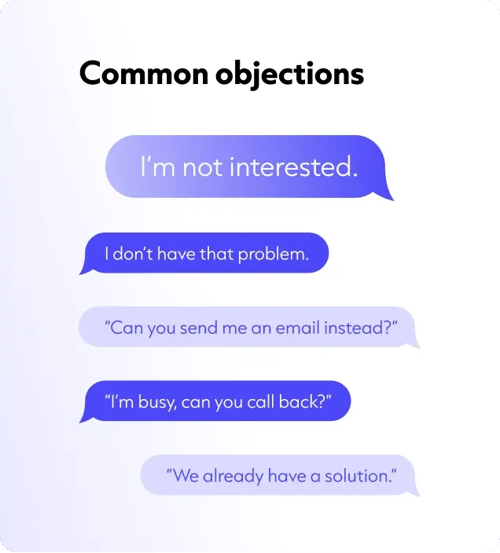
Fast forward to 2026, and while some familiar objections are still present, new ones have emerged, offering a clear signal of how the landscape is evolving.
Top five cold call objections and responses
“I’m not interested.”
Jordan’s workaround: “Ok, just for my notes, is that not interested due to not needing a tool like this at the moment, as you already have the right tool, or is that because budgets aren't available, so I've caught you at a bad time?”
Zac’s workaround: “No worries. Mind if I ask you a question before you go? Is that because you’ve already got something in place or it’s not on your radar at all?”
These responses turn a shutdown into a chance to uncover context. Jordan offers specific reasons for the disinterest, making it easier for the prospect to respond with clarity, and potentially reopen the conversation.
Zac’s is softer and more conversational, inviting one final moment of engagement with minimal friction. Both approaches are great examples of pressing the pause button rather than accepting the red card.
“We have other priorities at the moment.”
Jordan’s workaround: “If you don't mind me asking, you mention other priorities. What did you mean by that, and would there be anyone else you recommend I speak to whilst you focus on [X] priority?”
Zac’s workaround: “Ah makes sense. Can I ask you a quick question. What would make this a priority?”
Both Jordan's and Zac’s responses show a keen awareness of timing and tone. They don’t challenge the objection; they work with it.
Jordan’s approach acknowledges the prospect’s focus while smartly probing for internal referrals or future opportunities, keeping the door open.
Zac’s question goes deeper into the “why”, prompting reflection on what conditions might make the solution relevant later. Both demonstrate composure under pressure, turning a defensive block into a setup for the next attack.
“I'm too busy to talk – send me an email.”
Jordan’s workaround: Start of a call – "Sounds like I've caught you at a bad time, so happy to send over an email. Does it make sense for me to briefly explain what we do? To make sure it's something worth your time reading more about.
Midway through a call – "Happy to send over an email. From what we've discussed, what parts were you most interested in? So I can tailor the email... Why is that so important to you?”
Zac’s workaround: “Of course – quick one before I go, just so I know what to send over: what’s the biggest problem out of everything we talked about and I’ll focus on that?”
These responses show how to handle a common brush-off with a more thoughtful approach. Jordan’s early-call technique uses a respectful tone and delivers value before the email is even sent, a strong way to earn permission without being pushy. His mid-call tactic shifts the focus to personalisation, making it harder for the prospect to disengage.
Zac takes a similarly effective approach, treating the objection as a pivot point and inviting the prospect to share their main challenge. Both strategies turn a potential dead end into an opportunity, setting up a more meaningful follow-up conversation.
“We've tried businesses like yours before.”
Jordan’s workaround: “What was the business challenge you were trying to solve out of interest ... It sounds like the tool didn't hit the mark... Do you mind me asking who you used? What was missing from your perspective?”
Zac’s workaround: “Ah I see, sounds like it was the worst thing you ever did?”
Both of these comebacks approach the objection with curiosity and confidence, which is exactly what’s needed when facing cynicism.
Jordan’s response tactfully uncovers context and encourages reflection, helping the prospect articulate what went wrong before. It’s empathetic but also positions him to highlight what makes his solution different.
Zac’s is bold and disarming. By exaggerating the sentiment, he breaks the tension and invites the prospect to clarify. This kind of humour, when delivered well, can build rapport fast and open the door to a more honest conversation.
“We already have a solution for this problem.”
Jordan’s workaround: “Great to hear you have something in place. What are you using? Just so I can update my notes… Ok, I know this is a very salesy question, but if you had to rate that tool out of 10 what would you rate it? What’s that missing X% linked to?”
Zac’s workaround: “Makes sense. Can I ask something before you go? What’s one thing you’d improve if you could?”
Both responses do a strong job of reframing the “we already have a solution” objection as an opportunity to uncover gaps or dissatisfaction.
Jordan’s approach is structured and strategic. By asking for a rating, he quantifies satisfaction and smoothly pivots to what might be missing, creating space to position his solution as a potential improvement.
Zac’s approach is more conversational but equally effective. He encourages the prospect to reflect and articulate a challenge they may not have fully considered. Both techniques open the door without directly challenging the existing solution.
So, what’s changed? We’re seeing fewer outright rejections and more resistance rooted in caution, mistrust, or shifting priorities. These aren’t quick dismissals, but rather signals that buyers are becoming more selective and more considered in how they engage.
For reps in 2026, success isn’t about pushing harder. It’s about being more thoughtful and precise.
That might mean:
- Using relevant case studies to build credibility
- Asking insight-led questions to guide the conversation
- Timing follow-ups more strategically
The most effective sales teams understand that objections are far from the end of the conversation. They’re the start of a different one.
So, is cold calling getting harder or smarter? In any competitive environment, when things become more challenging, you either adapt or fall behind. And cold calling is no exception.
In last year’s report, cold calling was the subject of scrutiny. With crowded inboxes, more sceptical buyers, and tighter budgets, many were quick to dismiss it altogether. But the data, and Cognism’s performance, tell a different story.
It’s not that cold calling is dead. It’s that the old tactics are. Sales teams still relying on high-volume, low-context, “spray and pray” approaches are seeing diminishing returns. Buyers are more informed and quicker to filter out irrelevant outreach. This means only the most targeted, well-prepared teams are breaking through.
Stuart Taylor, says: “Cold calling isn’t getting harder, it’s always been hard. It’s just evolved, and today’s reps need to be smarter. The best reps aren’t blindly working through lists anymore, they’re using intent data, revisiting past conversations, sharing content, building a voice on LinkedIn, and using real signals to reach the right people. The A players know their prospect’s world inside out, because if you don’t bring real insight to that one conversation, you lose credibility fast.”
At Cognism, our jump from a 6.7% to 11.3% cold calling success rate shows that it’s not the channel that’s broken – it’s the strategy.
We’ve moved away from volume-first, unfocused approaches and shifted to precision:
- High-intent targeting
- Data-backed calling cadences
- Personalised messaging that cuts through
- Reps empowered to build value, not just chase activity
And while the industry benchmark has only edged up from 2.3% to 2.7%, it signals that the market is starting to adapt.
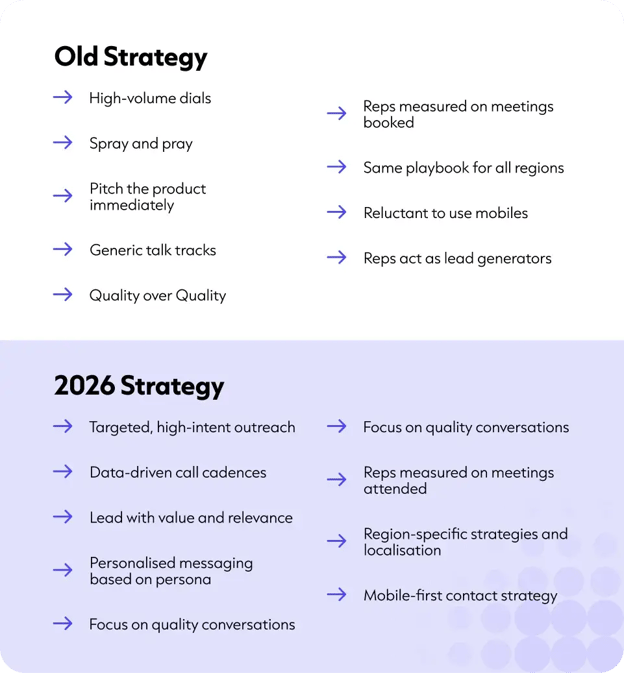
The tactics are shifting. The approach is evolving. The best teams? They’re not just making more calls, they’re making better ones.
Why Cognism’s tactics work
Cognism’s cold calling success rate hit 11.3% this year – more than four times the industry average of 2.7%. It’s a top-performing result. So what’s behind it?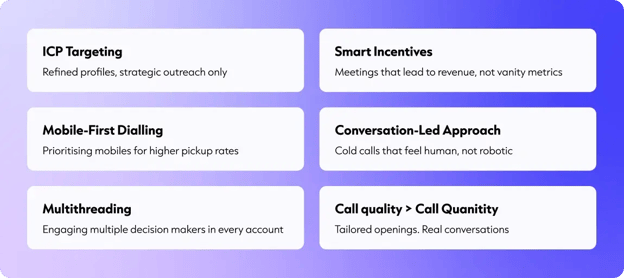
It comes down to the playbook we’ve been building and refining over time. The fundamentals haven’t changed, but they are being executed with greater discipline, sharper focus, and stronger intent.
We’ve moved away from measuring success by sheer volume and started prioritising what actually drives results: quality conversations, stronger alignment, and consistent momentum throughout the deal cycle.
Here’s a breakdown of the core principles behind that performance:
1. Targeting
No more spray-and-pray. We’ve refined our Ideal Customer Profile (ICP), so reps focus on prospects who genuinely fit the strategy – right industry, right seniority, right need. The result: tighter lists, higher relevance, and more impactful conversations.
2. Prioritising the phone
We don’t treat cold calling as a one-touch channel. Whether it’s opening a deal, building mid-funnel alignment, or re-engaging a late-stage buyer, the phone plays a role throughout the entire cycle. It helps us move faster, uncover blockers, and maintain momentum.
3. Ditching outdated metrics
Instead of focusing on vanity metrics like total dials or meetings booked, we prioritise behaviours that actually impact pipeline: multi-threading, uncovering real pain points, and creating qualified opportunities. It’s quality over quantity.
4. Making calls that count
Cold calls are no longer pitch monologues. The best reps lead with curiosity, anchor on relevance, and adapt in real time. Conversations feel more human and helpful – and that’s where trust starts to build.
5. Backing reps to make an impact
Our incentive model reflects this shift. Reps are rewarded not just for activity, but for creating meaningful value — the kind that drives real revenue, not just booked meetings. This keeps the team focused on outcomes that matter.
These pillars haven’t just guided our strategy, they’ve redefined what success looks like. And with another season of data behind us, it’s clear: this isn’t just a new tactic, it’s a winning formula.
Phone-first strategy
Too many teams treat the phone as a tool for just one stage of the sales process – the initial outreach.
But the best teams use it end-to-end. At Cognism, the phone isn’t just for prospecting. It’s a core channel that supports every stage of the sales cycle.
From opening conversations, to building relationships mid-funnel, to helping progress and close deals, we use calls to multi-thread across stakeholders and keep momentum moving. It’s direct, immediate and human.
Calls build trust faster than email, surface objections in real time, and help align decision-makers around a shared objective. It’s how we maintain progress and prevent deals from stalling.
As Jack puts it:
“The phone has and will always be the number one tool to drive communication. Things in email can get missed, lost and misconstrued. When you pick up the phone, you can hear what people are saying, not saying and all the context that gets missed in written form. The best way to build a human connection is to have a human conversation – the phone is the pathway to this.”
Booking a meeting isn't the only goal
Not every interaction leads to an immediate opportunity or meeting booked, but that doesn’t mean it wasn’t valuable.
Sometimes, the goal isn’t to convert straight away. It’s to open the conversation, create space for future engagement, and start building a relationship with the prospect. That’s where a strong callback strategy comes in.
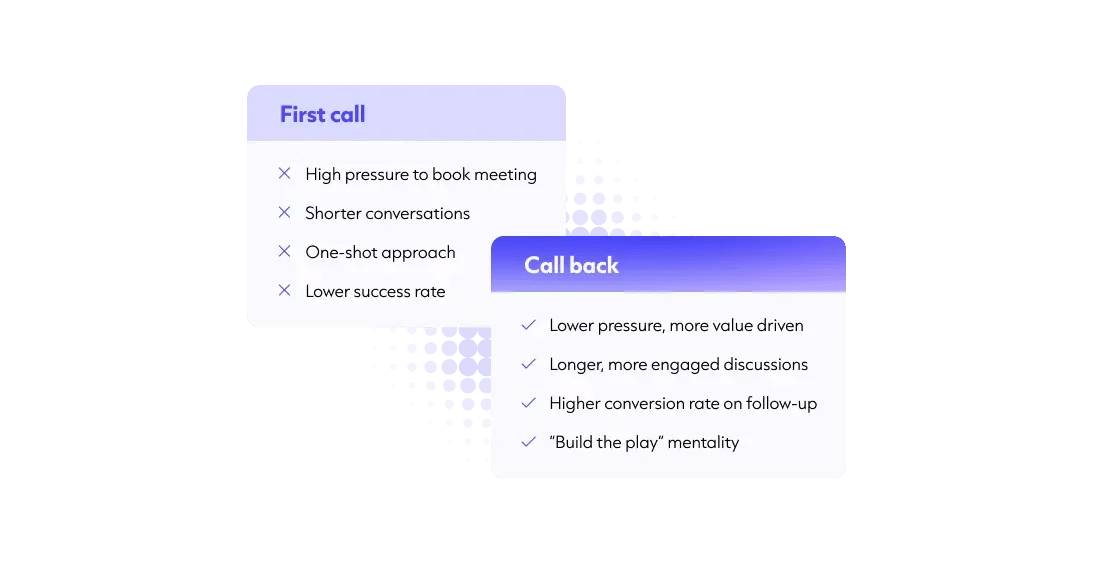
Sales teams are increasingly recognising that pushing too hard for a meeting on the first call can backfire. Instead, reframing the conversation as a quick introduction or a value-led touchpoint creates more opportunity over time.
A well-timed callback puts your rep in a stronger position for the next interaction, when the prospect’s timing is better, and they’re more open to engaging.
James Greene adds: “In large B2B sales, success rarely happens on the first call, the goal is to understand the prospect’s challenges, not to sell. Lead with insight and curiosity to build trust and relevance, not pressure. “Not now” can often mean “yes, later”, respect timing and follow up strategically. Pushing causes resistance.”
Cold calling into other regions
Cognism’s overall cold calling success rate reached a leading 11.3%, but how does performance vary across different segments?
The latest data reveals some interesting shifts across the board:
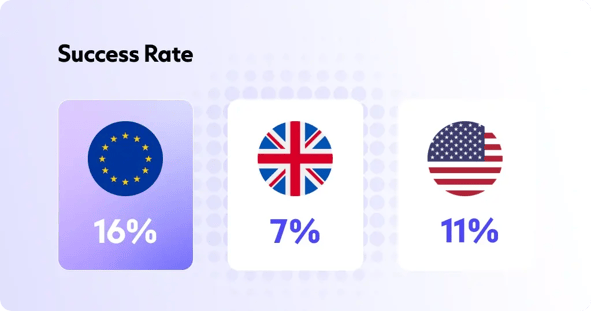
That’s a notable shift from back in 2025, when the UK led performance.
This year, Europe comes out on top, with the US aligning closely to Cognism’s overall average, and the UK moving into third place.
So what’s changed?
As WHAM highlighted in the 2025 report, when businesses expand into new regions, they often bring existing teams and approaches with them – the same reps, the same playbook. In the early stages, that’s understandable.
But this year’s results suggest that the regions with the strongest performance are those that are adapting more quickly to local market dynamics. That means tailoring messaging, refining timing, and aligning outreach to regional buyer expectations.
From a strategic perspective, this is exactly what you’d expect as teams mature in new markets. It’s no longer just about entering a region; it’s about building region-specific approaches that actually drive results.
Our UK performance has remained relatively consistent year on year. And as outlined above, our broader cold calling strategy underpins the strong results we’ve seen, including a standout 16% success rate in Europe throughout 2025.
Felix Scholl sheds some light: "From my perspective, recognising and converting penalty kicks was super important.
Our focus on buying signals and event triggers felt like a World Cup winning penalty kick and has been pivotal to calling prospects at the right time. Additionally the increased number of Diamond Data® contacts made sure we're not missing these penalties and in doing so, we’ve boosted our cold call success rate to a massive 16%."
And for the improved US success rate, Jon Dolan, North American superstar, says: “It all starts with prospecting. We’ve been prioritising Diamond Data® when doing cold outreach, ensuring we’re focusing our efforts on the highest-quality prospects.”
“By using heatmaps to measure and optimise our output, we’ve been able to identify the best times to connect, make smarter calls, and ultimately boost our success rate across the US. It’s all about efficiency, fewer wasted plays, more shots on target.”
What the data tells us about cold calling in 2026
Now that 2025 has come to a close, the takeaway is clear: cold calling isn’t dead, but it has evolved. And what about the teams seeing results? They’re not relying on outdated tactics or high-volume, low-impact outreach. They’re operating with more precision.
This report shows that sales teams are embracing a new approach to outbound – one that’s more agile, strategic, and aligned with modern buyers:
- Industry success rates are rising again, from 2.3% to 2.7%, following a challenging period in 2024
- Cognism’s success rate has reached 11.3%, up from 6.7% – clear evidence that precision outperforms volume
- The average number of calls to reach a prospect has dropped to 1.55, reflecting more efficient targeting and dial strategies
- More emphasis is being placed on high-quality conversations
- And while objection patterns are evolving, the most effective teams know how to navigate them with confidence
The shift is clear: success in cold calling today comes from working smarter, not just harder.
The game has changed. So should your tactics.
Cold calling used to be a numbers game. More calls equal more chances. But that formula no longer works when buyers are busier, harder to reach, and more resistant to old-school sales approaches.
Now, success comes down to:
- Calling the right person, at the right time, with the right message
- Having a playbook that’s built around intent, timing, and context
- Personalising pitches
- Treating objections as opportunities to find out more information
- Leveraging tools and data
From cold calls to commercial impact
If there’s one big takeaway from this year’s performance review, it’s this: cold calling isn’t just about booking meetings anymore, it’s about making a lasting commercial impression.
Today’s best sales teams know that:
- Every call is a chance to show relevance
- Every conversation builds recognition
- And trust starts long before a pipeline opportunity appears
This shift means the cold call has a new role, not just to close, but to open. Open relationships, open minds, and open doors for future deals.
This is because when the timing is finally right, buyers remember the rep who brought insight, not just a pitch. In 2026, the high-performing teams will be those who:
- Focus on quality over quantity
- Invest in data and tools that give them an edge
- Are consultative, curious and confident
- View cold calling not as a one-shot attempt, but as part of a long-term play
Sales extends beyond hitting quota to playing the long game – and winning it.