
STUDY
Fluent in data: How Mid-Market & Enterprise Buyers Buy Revenue Data Software in 2026
Confidence in data. Confidence in ROI. Confidence that what they buy won’t create risk. We surveyed 600+ leaders to uncover how mid-market and enterprise teams really evaluate revenue data providers in 2026.
Start reading

Buying has formalised
The data shows that revenue data software purchasing is no longer informal or rep-led. Only 10% of respondents report individual decision-making. The overwhelming majority describe purchases involving small buying groups, formal committees, or procurement-led enterprise processes.
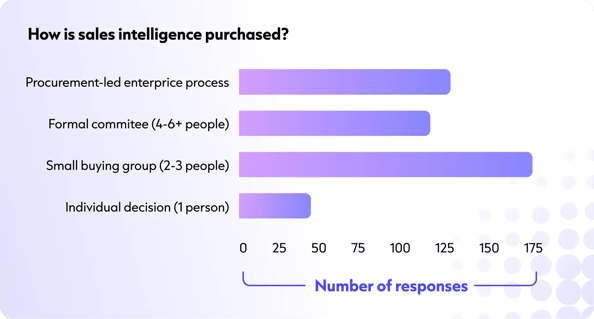
In practical terms, nearly nine in ten decisions involve multiple stakeholders, and cross-functional friction is common. Revenue teams do not control the decision-making for revenue technology independently, particularly at Enterprise scale.
Tom Wilson, Senior Sales Manager, Mid-Market explains:
“I regularly see at least 3-5 people involved in any mid-market buying decision and more in enterprise deals.”
In practice, this means sellers often need to expand the evaluation group beyond the initial contact before a deal can meaningfully progress with the right decision makers involved.
As Dyanna Daryadel, Senior Mid-Market Account Executive explains:
“If I move to a trial with just one stakeholder, I know that’s not going to close soon. I need to bring in more people, sometimes run another trial, and involve three or four stakeholders before the deal can progress.”
Procurement-led buying is most common among large organisations, where compliance and governance considerations are started earlier in the evaluation process. Enterprise buyers demonstrate greater concern around security, operational fit, and risk exposure.
In many cases, this formalisation extends to structured vendor selection processes such as RFPs. Enterprise buyers are significantly more likely to shortlist vendors through procurement before hands-on evaluation begins.
As Dyanna explains:
“Mid-market evaluations rarely involve formal RFP processes, whereas enterprise organisations frequently shortlist vendors through procurement before the evaluation stage even begins.”
What this means
If buying is cross-functional, procurement-led, and increasingly risk-averse, then selling must be too. Revenue software vendors can no longer optimise purely for end-user enthusiasm. A strong demo for Sales is not enough to secure a deal.
Vendors must anticipate the needs of multiple stakeholders involved in modern buying processes:
- Sales outcomes: Clear productivity impact, measurable pipeline influence, and credible ROI proof.
- RevOps integration: Clean CRM enrichment, process alignment, data governance controls, product adoption, and reporting compatibility.
- Marketing outcomes: Reliable ICP coverage, accurate segmentation, campaign activation readiness, and measurable contribution to pipeline and demand generation.
- IT architecture: Secure APIs, scoped permissions, minimal attack surface, and infrastructure reliability.
- Security requirements: Documented controls, certifications, penetration testing, and data handling transparency.
- Procurement governance: Contract clarity, predictable pricing, vendor stability, and risk mitigation.
- Legal and compliance validation: Lawful data sourcing, regulatory alignment, and defensible compliance posture.
Sales asks about growth. RevOps asks about system integrity. IT and Security ask about exposure. Procurement asks about defensibility. Legal asks about liability.
In a governed buying environment, deals stall when vendors cannot equip internal champions with the materials, documentation, and proof required to satisfy every function involved.
The defining category issue: Data quality
Across multiple sections of the study, one issue, unsurprisingly, consistently rises to the top: data quality. When asked about their biggest historical challenges with sales intelligence tools, 75% cite data quality. It is the single most dominant pain point buyers report.

That concern carries directly into future evaluations. When assessing new vendors, 58% rank poor data quality as a top purchase barrier, again the leading concern in the category.
The pattern continues when buyers are asked what they actually want. The most selected desired outcome is data accuracy and freshness (65%). This outranks prospecting speed, contact volume, AI capabilities, and other feature-led benefits.
Additional signals reinforce the theme:
- 47% prioritise CRM data quality and enrichment
- 27% explicitly select improving CRM data quality
- Open-text feedback frequently references data reliability issues
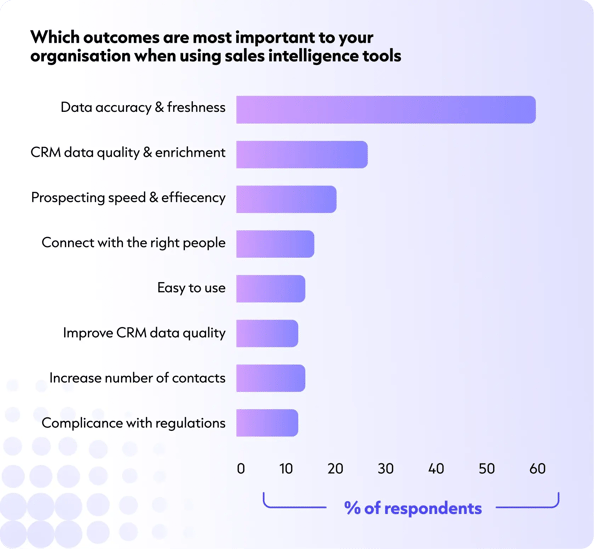
Data quality appears not once, but repeatedly, as a past frustration, a current evaluation filter, and a future expectation.
As Margeaux Guercia, Enterprise Account Executive, explains:
“At the enterprise level, data quality becomes the entire category discussion. Buyers aren’t as feature and functionality focused, they’re more so trying to understand whether the data is reliable enough to operationalise across their CRM and GTM teams.”
Buyers are less focused on volume expansion and more focused on accuracy, freshness, reliable execution, and clean systems of record.
Mid-market buys for acceleration
Mid-market organisations demonstrate a clear optimisation logic: speed, simplicity, and fast commercial impact.
Dyanna Daryadel explains:
“In mid-market, the evaluation usually moves quickly. Buyers often go straight into a trial and focus primarily on how the product performs. In enterprise, the process is much broader. Security, compliance, and data analysis are often evaluated before the trial even begins and their evaluations tend to be much larger projects. Plus there are more layers of approval.”
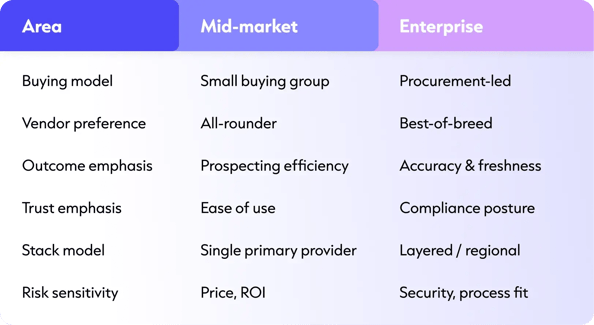
Vendor preference reinforces this pattern. Mid-market buyers lean toward all-rounder providers, reflecting a desire to consolidate tools and reduce operational complexity. These buyers are more likely to choose a single provider rather than combining multiple vendors to ensure appropriate coverage per region.
Their evaluation criteria also signal workflow acceleration as a factor. Among desired outcomes, buyers prioritise:
- Prospecting speed and efficiency
- CRM data quality and enrichment
- Increasing the number of contacts
At the same time, Mid-market buyers show stronger sensitivity to price and ROI. Purchase barriers frequently centre on cost justification and value exchange.
Mid-market organisations are optimising for:
- Faster pipeline creation
- Higher rep productivity
- Clear commercial returns
- Simplified tech-stacks
- Reduced operational overhead
They are less concerned with governance and security and more focused on immediate performance impact. Acceleration is the primary lens through which value is assessed.
Enterprise buys for protection
Enterprise organisations operate under a fundamentally different optimisation logic. Where mid-market teams prioritise speed, enterprise buyers prioritise control.
In practice, this means evaluations are often governed by security, legal, and procurement processes before commercial discussions even begin. As Margeaux Guercia explains:
“For true enterprise organisations, we are often looking at months of legal and security review before a full evaluation can even begin.”
These governance processes have also become more rigorous over time.
“I’ve noticed it even from last year to this year. Security questionnaires and legal reviews have become much more detailed,” adds Dyanna Daryadel. “What used to take one round of redlines can now take three or four before a deal is finalised.”
This level of scrutiny reflects the operational importance of revenue data within large organisations. Decisions in this category affect multiple systems and functions, including:
- Customer data integrity
- CRM reliability
- Compliance exposure
- Integration architecture
- Forecasting confidence
Because of this, governance cannot be treated as a late-stage hurdle. Security, compliance, and data governance considerations often shape the evaluation from the outset. Experienced sellers therefore emphasise that these discussions must be introduced early in the process.
As Dyanna explains:
“In mid-market evaluations, security and compliance are usually considered after a successful trial, once the buyer is already leaning toward moving forward. In enterprise environments, those conversations tend to happen much earlier. If enterprise buyers haven’t raised security protocols yet, it’s the seller’s responsibility to bring them up because the process can take such a long time.”
Waiting for governance teams to appear late in the evaluation significantly increases the likelihood of delays or stalled deals.
These dynamics also shape vendor strategy. Enterprise buyers tend to favour best-of-breed providers, prioritising depth and precision in critical capabilities rather than consolidating tools into a single platform. They are also more likely to operate layered or regionally-specialised vendor stacks, reducing dependency on a single system and distributing operational risk.
Their desired outcomes reinforce this pattern. Across all segments, data accuracy and freshness remains the most prioritised outcome, but enterprise organisations place even greater emphasis on reliability and governance alignment. Ease of use still matters, but compliance posture and operational fit are evaluated earlier and more rigorously.
The hierarchy of purchase barriers illustrates why. Enterprise buyers consistently cite concerns such as:
- Poor data quality
- Poor ROI
- Ease-of-use risk
- Poor process fit
- Price
- Security approval and procurement complexity
As organisational size increases, sensitivity to security, governance, and operational fit rises accordingly. Revenue software buying at enterprise level is not driven purely by upside. It is equally, and often primarily, driven by risk avoidance.
As Margeaux notes:
“We’ve seen a significant increase in security due diligence in the wake of AI. Many enterprise organisations now require separate security questionnaires specifically for AI-related capabilities.”
Enterprise buyers are actively working to prevent:
- Wasted investment
- Operational and integration disruption
- Compliance and reputational exposure
In enterprise environments, the dominant question is rarely “Will this help us move faster?”
It is more often:
- Can we defend this decision internally?
- Does this align with our governance standards?
- Will this introduce risk across regions or systems?
- Is the data precise enough to support scale?
Regional expansion raises the stakes
International growth materially increases the risk profile of revenue software. When asked which regions are strategically most important for growth, respondents overwhelmingly prioritise:
- Europe (74%)
- North America (63%)
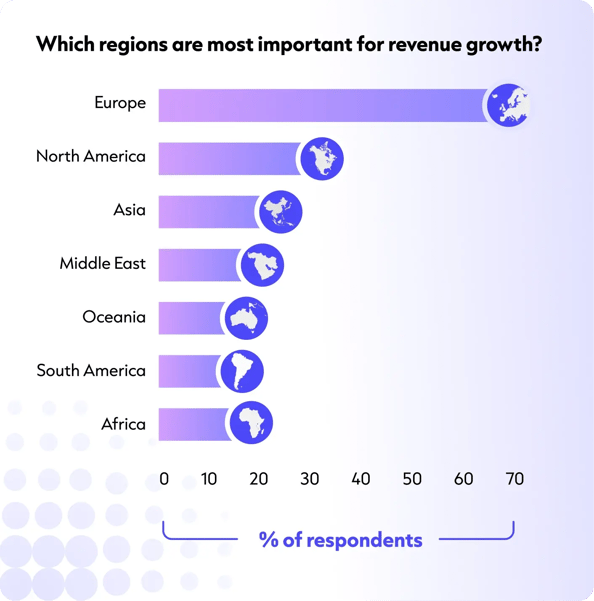
Other regions trail significantly behind. Europe and North America are not just large markets; they are highly regulated, commercially mature environments with complex compliance requirements and data standards.
Buyers do not view geographic coverage as optional expansion capability. They increasingly view it as baseline reliability. This aligns with trust drivers in the study, where geographical coverage (33%) ranks among the top factors influencing vendor confidence.
When organisations expand internationally, several risks compound:
- Inconsistent contact accuracy across regions
- Regulatory exposure due to uneven compliance standards
- Fragmented CRM data integrity
- Operational complexity in multi-region go-to-market teams
As Margeaux explains:
“In global organisations, teams often discover during evaluations that data behaves very differently depending on the market they’re targeting. What works well for a North American sales team doesn’t always translate in European markets, where regulatory standards and data availability can be very different.”
“In these cases, Enterprise teams need to solve for coverage, quality and compliance, otherwise the data becomes difficult to operationalise at scale.”
For Enterprise buyers operating layered or regional vendor stacks, geographic precision becomes even more critical. A data gap in one priority market is not a minor inefficiency; it can undermine forecasting reliability, campaign performance, and compliance posture.
The more regions an organisation operates in, the more revenue data shifts from a productivity enhancer to a core system dependency.
Trust is earned operationally, and tested after purchase
Trust in revenue software is not built through brand alone. While marketing and positioning shape initial perception, the study shows that lasting trust is earned through operational experience.
When asked what drives confidence in a vendor, buyers prioritise:
- Ease of use (53%)
- Geographical coverage (33%)
- Clear data sourcing and compliance posture (33%)
- Customer support (26%)
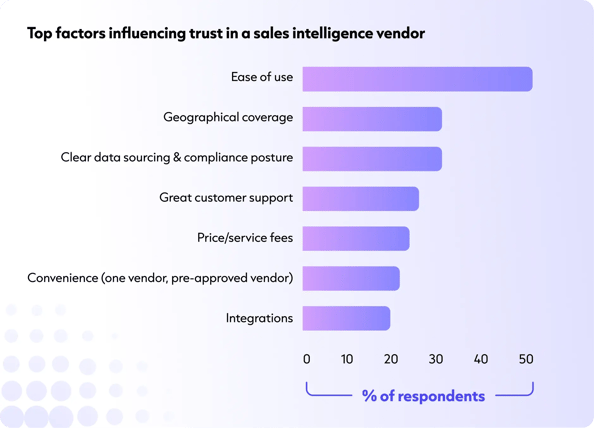
Ease of use is the single strongest trust driver, which acts as a proxy for reliability. If a system is intuitive, stable, and frictionless, buyers infer that the underlying data and infrastructure are dependable. If the experience is clunky, inconsistent, or opaque, they assume deeper systemic weaknesses.
This matters because trust operates in two phases.
Before purchase, trust is influenced by brand narrative, positioning, and vendor claims. Buyers are persuaded by messaging around innovation, coverage, AI capability, and ROI potential.
Trust also begins forming during the evaluation itself. Madeline Hopkin, Mid-Market AE said:
“Buyers notice how responsive vendors are, how proactive they are in answering questions, and whether they bring the right experts into the conversation.”
Dyanna adds:
“Often buyers haven’t actually defined how they’re going to evaluate vendors yet. When you suggest ways to compare providers properly and encourage them to get the stats rather than just guessing who’s better, they usually appreciate that because it helps them make a more informed decision.”
After purchase, trust is validated, or eroded, through lived experience.
If the data is inaccurate. If enrichment disrupts CRM integrity. If integrations create friction. If compliance claims feel overstated. Trust deteriorates quickly.
This is where trust becomes loyalty. When operational reality aligns with pre-purchase claims, vendors earn credibility and advocacy. When it does not, the damage is reputational, not just transactional.
In this category, trust is not won in the sales cycle. It is confirmed, or lost, in execution.
Implications for B2B procurement
For Mid-market buyers: Move quickly, but validate impact
Mid-market organisations optimise for acceleration. Their evaluation processes are typically faster and involve fewer governance layers, but buyers are still highly sensitive to ROI risk and operational friction.
In these environments, the goal is not to build the most exhaustive evaluation process. It is to validate performance quickly and ensure the solution can deliver measurable commercial value.
To support confident decision-making, Mid-market buyers should prioritise:
1. Fast validation of data quality
- Sample datasets to test coverage against target accounts
- Clear evidence of data accuracy and freshness
- Real-world validation through hands-on trials
2. Clear commercial impact
- Transparent ROI modelling
- Evidence of productivity improvements
- Measurable pipeline impact
3. Operational simplicity
- Demonstrable ease of use
- Seamless CRM integration
- Minimal operational overhead
4. Stack simplification
- Clear articulation of which tools can be consolidated
- Reduced complexity for Sales and RevOps teams
- Lower operational maintenance requirements
In mid-market environments, the trial itself often becomes the primary evaluation mechanism. Buyers typically move quickly into hands-on testing and judge vendors based on how effectively the product performs in practice.
For Enterprise buyers: Equip governance, not just growth
Enterprise organisations operate under protection logic. Evaluations are designed not only to assess upside, but to minimise risk across systems, teams, and compliance frameworks.
As a result, enterprise buying processes are more structured and often involve procurement screening, security reviews, and formal vendor shortlisting before hands-on evaluation begins.
For Enterprise buyers, confident decisions depend on ensuring that vendors can satisfy multiple governance requirements simultaneously.
This means prioritising:
1. Security and compliance readiness
- Documented data sourcing and compliance posture
- Security certifications and audit reports
- Clear policies on data handling and governance
2. Technical and architectural transparency
- API documentation and integration guidance
- Clear permission and access controls
- Data flow visibility across systems
3. Evidence of operational reliability
- Data accuracy benchmarks
- SLA commitments and performance guarantees
- Case studies from organisations operating at comparable scale
4. Multi-stakeholder enablement
- Procurement-ready summaries
- Legal-friendly documentation
- RevOps integration playbooks
In enterprise environments, vendors are rarely evaluated solely on product capability. They are evaluated on whether the purchase decision can be defended internally across security, legal, procurement, and operational teams.
Across both segments: Structure the evaluation
One finding across the study is that many buyers begin the process without a clearly defined evaluation framework.
This highlights an emerging dynamic in modern B2B purchasing: vendor evaluation is increasingly collaborative.
Rather than simply presenting product capabilities, effective vendors help buyers design structured evaluation processes, identify meaningful comparison metrics, and build internal justification for the decision.
In a formalised buying environment, clarity around evaluation criteria becomes a competitive advantage.
